Sound Healing Instruments: A Guide to Every Tool Used in Sessions
Introduction
Sound healing instruments complete guide: have you ever noticed how a single resonant tone can quiet a busy mind, slow your breathing, and make a room feel completely different? From the lingering hum of a Tibetan singing bowl to the deep vibrations of a gong, sound can become a powerful focus for relaxation and meditation.
But what actually happens during a sound healing session? Which instruments are used, how do they differ, and how can you choose the right experience for your needs?
Sound-based practices bring together listening, rhythm, resonance, and sometimes physical vibration. Practitioners use different instruments to create soundscapes that encourage stillness, mindful awareness, and a sense of calm. Each tool has its own character, playing technique, and practical purpose.
In this guide, you’ll explore the most common instruments used in sound healing, understand how sessions are structured, and learn what to consider before attending a session or buying your first instrument. You’ll also discover how the peaceful environment of Rishikesh, India, can complement a mindful sound practice.
Whether you’re a yoga practitioner, a curious beginner, or someone considering sound healing training, this guide will help you make informed choices without confusing traditional beliefs with established scientific evidence.
1. What Are Sound Healing Instruments and How Do They Work?
Sound healing instruments are tools used to produce tones, rhythms, harmonics, and vibrations during practices such as sound meditation, sound baths, and complementary wellness sessions.
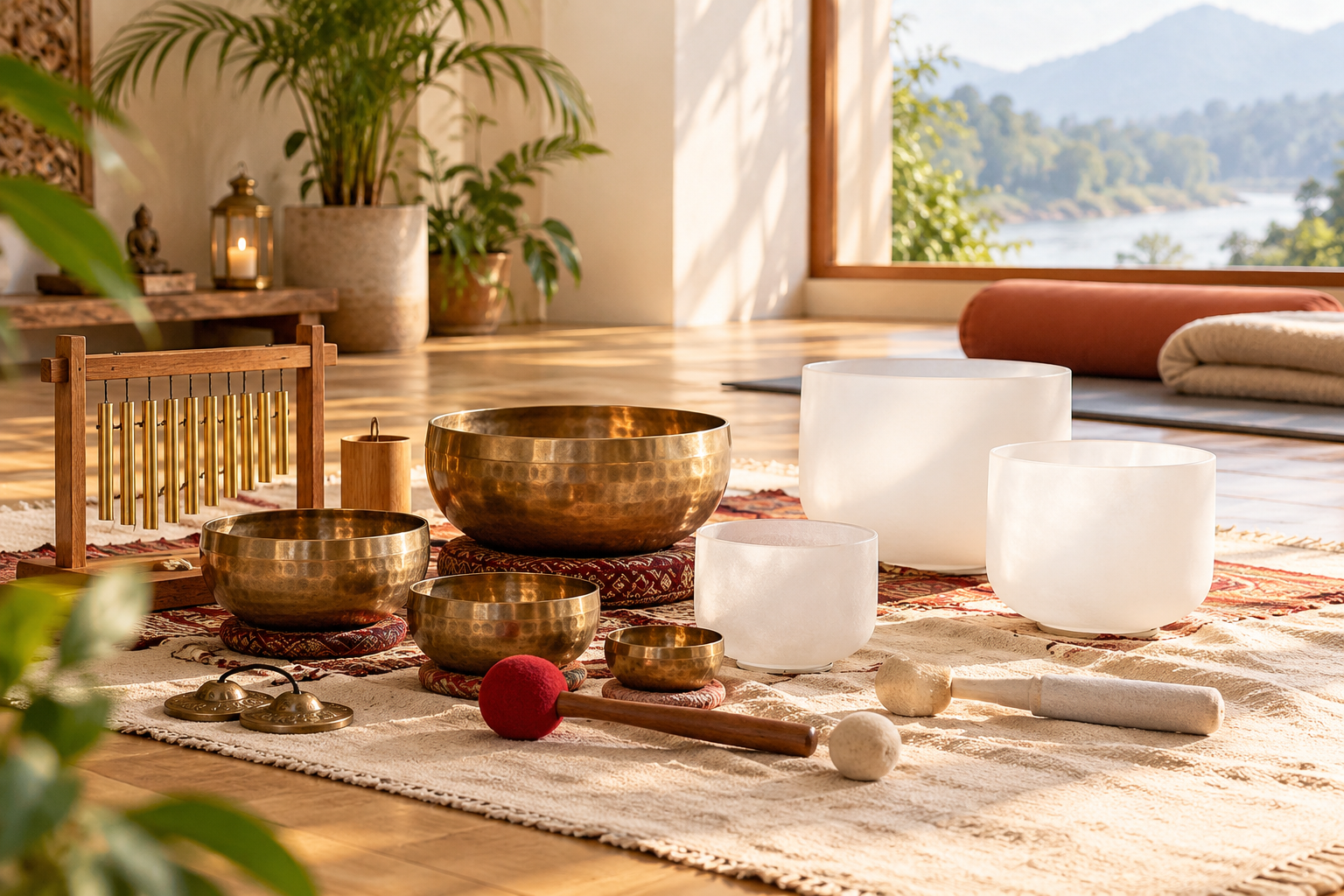
Common examples include metal singing bowls, crystal bowls, gongs, tuning forks, bells, chimes, drums, and the human voice. Practitioners combine these tools to create different auditory experiences, rather than relying on one instrument for every purpose.
The role of sound, resonance, and vibration
When you strike a singing bowl, it produces sound waves that travel through the surrounding air. Depending on the instrument, its material, shape, and playing technique, you may hear a clear fundamental tone alongside additional frequencies and harmonics.
Your brain processes these sounds, while your attention may naturally settle on the changing tones. Slow, predictable sound patterns can provide a useful anchor for meditation, much like focusing on your breathing.
Some instruments also create vibrations you can physically feel, particularly when used close to the body or when a suitable instrument is placed on a supporting surface.
These experiences can feel soothing, but it’s important to distinguish subjective relaxation from proven medical treatment. Research on singing bowls suggests possible benefits for psychological well-being, but study quality and results vary. A 2025 systematic review identified 19 clinical studies and highlighted the need for stronger evidence. You can explore related research through PubMed’s medical research database.

What a sound healing session may involve
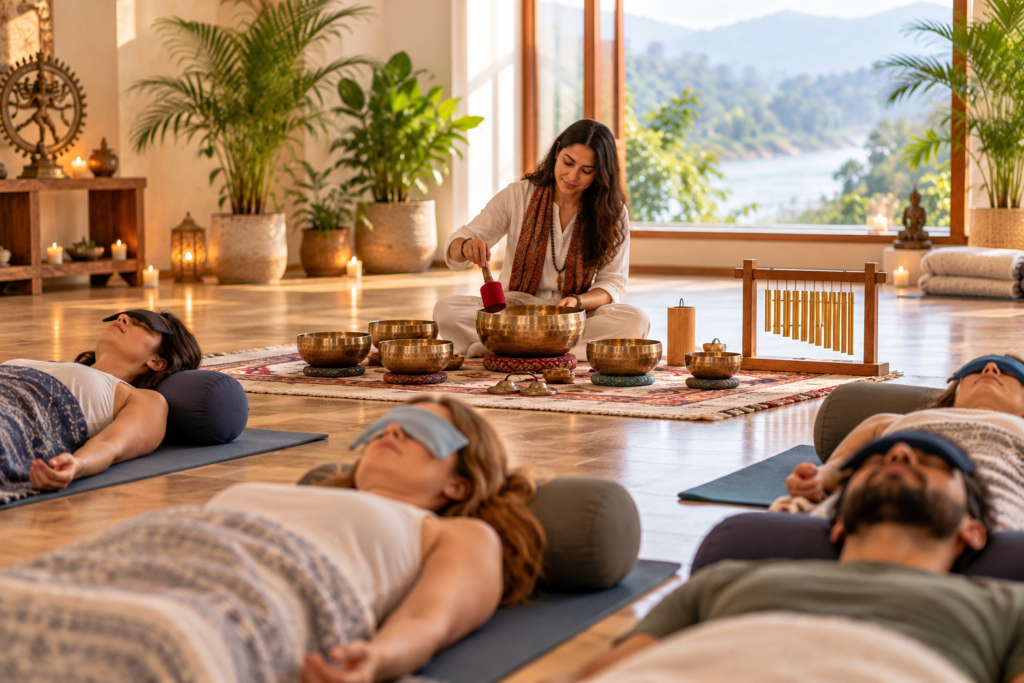
A typical session might begin with a brief settling exercise, followed by a sequence of soft tones, longer resonances, and periods of silence. You generally sit comfortably or lie on a mat while listening.
The goal is not to force a particular sensation. You may feel relaxed, distracted, emotional, or simply neutral. Individual responses vary, and none of these experiences proves that a specific frequency has medically healed the body.
2. A Complete Guide to the Main Sound Healing Instruments
Different tools create different sound textures. Understanding these differences helps you appreciate what a practitioner is doing during a session.
Tibetan and Himalayan singing bowls
Singing bowls are among the best-known instruments used in sound meditation. Traditional metal bowls are played by striking them gently or moving a mallet around the rim to produce a sustained, sometimes layered tone.
Their sound can range from a warm, low resonance to a brighter, ringing note. Larger bowls often produce lower tones, while smaller bowls frequently produce higher ones, although construction and thickness also affect the result.
Common uses:
- Beginning or ending a meditation session.
- Supporting slow breathing and focused listening.
- Creating transitions between stages of a sound bath.
- Accompanying restorative yoga or relaxation exercises.
You’ll often hear the term Tibetan singing bowl, although bowls vary in origin, design, and manufacturing method. Not every bowl sold under this label has a documented traditional lineage.
If you are buying one, listen to its tone rather than choosing solely by appearance or claims about particular frequencies.
Crystal singing bowls
Crystal bowls are commonly made from quartz-based materials and produce clear, sustained tones. Compared with many metal bowls, they can sound brighter, more penetrating, and less complex to some listeners.
Practitioners often use them in sound baths where continuous tones and gradual changes in pitch create an immersive atmosphere.
Their loudness deserves attention. A crystal bowl can be surprisingly intense in a small room, especially when played close to your ears. Ask the practitioner to adjust the volume if needed.
Gongs
Gongs create a much broader range of sound than a single struck note might suggest. A gentle mallet can produce a soft shimmer, while a stronger strike may generate a powerful swell of overlapping tones.
Gong baths use these changing sounds to create an immersive listening experience. They may be particularly appealing if you enjoy deep resonance, evolving textures, and long periods of sound.
However, gongs can become loud. A good practitioner builds intensity gradually and gives participants the option to move farther away.
Tuning forks
Tuning forks are metal instruments that vibrate at a particular designed frequency when activated. Some practitioners use them in the surrounding space, while others use specialized techniques involving contact with appropriate body areas.
They offer a more focused sound than a gong or large bowl.
Tuning forks are not all interchangeable. Some are designed primarily for acoustic use, while others are intended for particular therapeutic or musical applications. Claims that a specific fork automatically balances organs, chakras, or body systems should be treated cautiously.
For a closer look at this tool, explore our related guide to tuning forks for sound healing and how to use them.
Bells, tingshas, and chimes
Small bells and tingshas produce short, bright tones that can mark the beginning or end of a practice. Chimes create lighter, more delicate sound patterns that change with each movement.
These instruments are useful when you want to bring attention gently back to the present moment without filling the room with heavy, continuous sound.
They are also practical for beginners because they are generally easier to handle than large gongs.
3. More Sound Healing Tools: Drums, Voice, and Electronic Sounds
Metal bowls and gongs attract most of the attention, but they are only part of the wider sound healing toolkit.
Frame drums and rhythmic percussion
Frame drums produce pulses rather than the long ringing tones associated with singing bowls. Practitioners may use a slow, steady rhythm to support movement, guided meditation, or group participation.
The experience depends heavily on tempo and volume. A gentle rhythm may feel grounding, while fast or forceful drumming can be stimulating rather than relaxing.
Other percussion instruments, including shakers and seed rattles, add texture and variation to a session.
Mantra chanting and the human voice
The voice is one of the most accessible sound-making tools available. Chanting, humming, and repeating a mantra can combine breath awareness with sound and rhythm.
In yoga traditions, mantra practice may carry philosophical, devotional, or meditative significance. You do not necessarily need musical training to participate, although you should feel comfortable with the words and the practice.
If you prefer a vocal approach, our guide to mantra chanting and sound healing explores how chanting can fit into a broader yoga routine.
Binaural beats and recorded sound
Binaural beats are produced when slightly different tones are presented separately to the two ears, usually through headphones. The listener perceives a beat-like auditory effect.
Recorded meditation music, ambient sound, and frequency-based audio are also used in relaxation practices.
These options require no physical instrument and can be convenient for home use. However, claims that a particular frequency reliably clears emotional blocks, balances chakras, or cures illness are not established medical facts.
You can compare the listening experience with physical instruments in our article on binaural beats versus singing bowls.
How do you choose between these tools?
| Instrument | Sound character | Common session use |
|---|---|---|
| Metal singing bowl | Warm, layered resonance | Meditation and relaxation |
| Crystal bowl | Clear, sustained tone | Immersive sound baths |
| Gong | Deep, evolving sound | Full soundscape experiences |
| Tuning fork | Focused, relatively pure tone | Targeted listening exercises |
| Bells and chimes | Bright, brief tones | Transitions and attention |
| Frame drum | Rhythmic pulses | Grounding and movement |
| Voice and mantra | Breath-linked, vocal sound | Chanting and meditation |
| Binaural audio | Perceived beat through headphones | Individual listening practice |
No single instrument is best for everyone. Your comfort with volume, sensitivity to particular tones, cultural interests, and personal preferences matter more than marketing claims.
4. How to Use Sound Healing Instruments in a Session
Owning beautiful instruments is not the same as knowing how to use them well. A successful session depends on timing, listening, volume control, and the practitioner’s ability to respond to the people in the room.
Start with a comfortable environment
Choose a quiet space with enough room for everyone to sit or lie down comfortably. Keep instruments stable on suitable cushions or stands, and make sure participants can leave or change position without difficulty.
You don’t need an elaborate altar or expensive equipment. A comfortable mat, a few well-chosen instruments, and a thoughtful session plan can be enough.
For ideas about preparing your surroundings, see our guide to setting up a sound healing space at home.
Build a sequence instead of playing everything
A practitioner might begin with a gentle bell, introduce a singing bowl, gradually add other instruments, and finish with silence.
This progression gives listeners time to adjust to each sound. Constantly switching instruments or striking everything at once can make a session confusing and overwhelming.
A simple sequence could include:
- Arrival: A few gentle tones to mark the beginning.
- Settling: Slow bowl sounds with pauses between them.
- Exploration: A gradual introduction of additional textures or a gong.
- Quiet integration: Silence or very soft sounds before participants return to ordinary activity.
The sequence is a practical framework, not a rigid formula. You should adjust it to the group’s comfort and experience.
Learn technique and sound awareness
Strike a bowl gently and notice how the tone changes as it fades. With practice, you’ll become more aware of the pressure, angle, and movement needed to produce different sounds.
Avoid striking an instrument repeatedly just because the previous sound has become quieter. Space between notes can be as important as the notes themselves.
If you plan to facilitate sessions professionally, learn instrument care, appropriate positioning, participant consent, and basic safety practices alongside playing technique.
5. What Are the Benefits and Limitations of Sound Healing?
Sound meditation is often chosen because it offers a structured opportunity to pause, listen, and relax. However, the experience should be understood in the context of the available evidence.
Potential benefits
Relaxation and stress management: A quiet environment and sustained tones may help you step away from everyday distractions. The session can also provide a dedicated period of rest.
Mindful attention: Following a sound as it begins, changes, and fades gives your attention a clear focus. This can be useful if sitting silently feels difficult.
A supportive meditation routine: Instruments can make meditation more engaging, especially when you prefer auditory experiences to breath counting or silent observation.
A sense of connection: Group sound sessions can create a shared atmosphere. For some participants, the combination of sound, stillness, and community makes the practice meaningful.
What does the research actually say?
A 2025 systematic review of clinical studies on singing bowls reported promising findings for some psychological outcomes, including anxiety and sleep-related measures. However, the included studies differed in their methods, populations, and interventions, limiting how confidently the results can be generalized.
The evidence does not establish that all sound healing instruments have the same effects. Nor does it prove that specific frequencies can cure disease, remove toxins, or reliably balance energy centres.
A sensible approach is to treat sound healing as a complementary wellness practice rather than a replacement for medical care. If you are managing a health condition, continue following advice from your qualified healthcare professional.
Who should take extra care?
Sound healing is not automatically comfortable for every person. Loud or unexpected sounds may be distressing if you experience sound sensitivity, tinnitus, migraines, or trauma-related responses.
If you have a relevant medical concern, ask your healthcare professional whether the proposed session is appropriate. Tell the practitioner about your preferences, request lower volume, and avoid instruments being played close to your ears without your consent.
A responsible facilitator welcomes these requests instead of promising that discomfort is necessary for healing.
6. Why Rishikesh Is a Meaningful Place to Explore Sound Healing
Rishikesh attracts yoga practitioners from India and abroad because it brings together established yoga communities, spiritual traditions, teacher-training schools, and opportunities for quiet reflection.
In Tapovan, you can explore yoga and meditation in a setting shaped by the Himalayan foothills and the nearby Ganga. The atmosphere may help you create distance from your usual routine and devote more attention to practice.
The location alone does not guarantee a better session. The instructor’s experience, your comfort, the instruments used, and the quality of the guidance remain important.
What to look for in a Rishikesh session
Before booking, ask a few practical questions:
- Which instruments will be used, and how loud will the session become?
- Is the session suitable for beginners?
- Will instruments be played on or near the body?
- Can you request a quieter experience or take a break?
- Does the facilitator explain the practice without making unrealistic medical claims?
If you’re planning a broader wellness visit, consider how sound meditation fits into your schedule alongside yoga, rest, and time outdoors.
You can explore a 5-day yoga retreat in Rishikesh if you want a longer period for yoga and relaxation, rather than treating a single session as a complete wellness programme.
7. Explore Sound Healing with Maa Ganga Yogashala
If you’re interested in learning about sound healing beyond reading about individual instruments, guided practice can help you understand their different tones, techniques, and uses.
At Maa Ganga Yogashala, located in Tapovan, Rishikesh, you can explore our sound healing programme to learn more about the available experience and course details.
Whether you are an international yoga seeker or an Indian practitioner, take time to understand the programme’s format, what it includes, and whether it matches your goals before enrolling.
A good learning environment should encourage careful listening, practical experience, respectful facilitation, and honest discussion of what sound-based practices can and cannot achieve.
8. Frequently Asked Questions About Sound Healing Instruments
Which instrument is best for beginners?
A metal singing bowl is a practical starting point because you can learn basic striking techniques and explore its resonance without needing complex equipment. Bells and chimes are also accessible options.
Choose an instrument you enjoy hearing, and practise at a comfortable volume.
How many instruments are needed for a sound healing session?
There is no fixed number. A session can use one singing bowl or combine several instruments, such as bowls, a gong, and chimes.
The quality of the experience depends more on the practitioner’s technique, pacing, and awareness of participants than on the size of the collection.
Are crystal singing bowls better than metal bowls?
Neither is universally better. Crystal bowls often produce clear, sustained tones, while metal bowls can create complex, layered resonance.
Your preference, the room’s acoustics, and the session’s purpose should guide your choice.
Can sound healing cure anxiety or insomnia?
Sound healing may support relaxation for some people, and research on singing bowls has reported promising but limited findings. It is not a proven cure for anxiety disorders or insomnia.
Seek appropriate medical or psychological support if symptoms persist or interfere with daily life.
Can you practise sound healing at home?
Yes. You can begin with a comfortable listening space, a suitable instrument, and short periods of mindful listening.
Keep the volume moderate, avoid untrained contact techniques on the body, and use the practice as a wellness activity rather than a substitute for professional treatment.
9. Conclusion: Choose Sound Healing Instruments with Intention
Sound healing instruments complete guide: understanding the tools behind a session helps you choose an experience that suits your interests, comfort, and goals.
From singing bowls and gongs to tuning forks, chimes, and mantra chanting, each instrument offers a different way to explore listening and meditation. You don’t need every instrument to begin. Start with one that appeals to you, practise carefully, and allow yourself time to understand its sound.
If you want to explore this practice in Rishikesh, take the next step with Maa Ganga Yogashala. Explore our sound healing programme in Rishikesh to learn about the available course and experience, and discover whether it fits your wellness or learning goals.