100 Hour vs 200 Hour Yoga Teacher Training: Which Course Should You Choose?
Deciding between a 100 hour vs 200 hour yoga teacher training is one of the most critical choices you will make on your spiritual and professional path. You already know that deepening your practice requires dedication, time, and the right environment to truly absorb the ancient teachings.
Stepping onto the mat for a dedicated immersion is vastly different from attending local studio classes a few times a week. You are stepping into a structured lifestyle designed to challenge your physical limits, break down your mental barriers, and rebuild your understanding of the mind-body connection.
However, committing to an immersive program requires absolute clarity on what you want to achieve. Do you want to teach others, or are you seeking personal healing and physical mastery? Both courses offer phenomenal growth, but they serve two entirely different purposes in your development.
Many students arrive in India confused about the intensity, the curriculum, and the legalities of international teaching certifications. Choosing the wrong course might leave you feeling either overwhelmed by the demands or underqualified for your career aspirations.
This comprehensive breakdown will strip away the confusion and outline every single difference between these two foundational courses. You will discover exactly what each curriculum entails, how the daily schedules compare, and which option aligns perfectly with your current life situation.
The Foundations of 100 Hour vs 200 Hour Yoga Teacher Training
Understanding the fundamental purpose of each course is the first step in making an educated decision. You cannot approach these programs as simple fitness retreats; they are rigorous academic and physical immersions.
A 100-hour course serves as an intensive introduction to the broader system of yoga. It is designed specifically for dedicated students who want to experience ashram life without the intense pressure of preparing for teaching examinations.
Think of it as the first building block of a complete education. You focus heavily on your personal alignment, breaking bad habits you may have developed over years of unguided practice. You dive into the history of the practice and learn how breath control directly affects the nervous system.
Conversely, the 200-hour program is the recognized global standard for entering the wellness industry as a professional. It is a comprehensive, unbroken month of study that shifts your perspective from being a student to becoming a confident guide.
International governing bodies require a minimum of 200 hours of standardized study to register you as a certified instructor. Organizations like Yoga Alliance dictate strict curriculum categories, including anatomy, methodology, and practical teaching hours, ensuring you are equipped to lead classes safely.
If your ultimate goal is to lead classes, host workshops, or open a studio, the 200-hour certification is the non-negotiable starting line.
Deep Dive: What Happens in a 100-Hour Course?
The 100-hour curriculum focuses unapologetically on you as an individual. The primary goal is to strip away external distractions and help you build a highly disciplined, deeply rooted personal daily routine.
During these two weeks, you will spend hours dissecting primary asanas (postures). You will learn the skeletal variations that dictate why a pose looks different on your body compared to your neighbor’s body.
Teachers guide you through the foundational texts, introducing you to Patanjali’s Yoga Sutras and the Eight Limbs of Yoga. You begin to understand that the physical postures are merely a small fraction of the entire system designed to prepare the mind for deep meditation.
This program is perfect if you have a demanding job or family obligations and simply cannot take an entire month off. It provides a massive mental reset and physical detox in just fourteen days.
Many students choose this route as a testing ground. They use the 100 hours to evaluate if they truly enjoy the rigorous ashram lifestyle before committing fully to a teaching path. If you want to know what drives people to this specific choice, reading 100 Hour Yoga Teacher Training: 5 Honest Reasons to Go provides excellent perspective.
At the end of this course, you will receive a certificate of completion, which allows you to seamlessly return later to finish the remaining 100 hours required for full certification.
The Daily Rhythm of a 100-Hour Immersion
Your day begins before sunrise, usually around 5:30 AM, with herbal tea and silence. You transition immediately into Shatkarma (yogic cleansing techniques) to purify the respiratory and digestive systems before physical exertion.
This is followed by a grueling but deeply rewarding two-hour physical practice, usually focusing on traditional Ashtanga or Hatha styles. You break a heavy sweat, pushing your muscular endurance while maintaining absolute focus on your breath.
Mid-day is filled with theoretical classes covering basic anatomy and philosophy. You learn the Sanskrit names of the postures and the energetic pathways (Nadis) of the body.
Evenings are dedicated to slower practices like Yin, restorative postures, or guided meditation. By 9:00 PM, the ashram enters strict silence, allowing your nervous system to fully integrate the day’s intense teachings.
Deep Dive: What Happens in a 200-Hour Course?
The 200-hour program is a profoundly different beast. While it incorporates everything from the 100-hour curriculum, it quickly pivots toward the art and science of teaching others.
You transition from focusing solely on your own body to observing the bodies of your peers. You learn how to verbally cue complex movements clearly and concisely, ensuring a room full of beginners can follow your voice with their eyes closed.
A massive portion of this course is dedicated to anatomy and physiology. You study the biomechanics of movement, learning how joints, ligaments, and muscle fascia interact during extreme stretching and weight-bearing postures.
You also dive deep into injury prevention. Medical literature found on databases like PubMed frequently highlights the importance of safe alignment, and your teachers will aggressively train you to spot and correct dangerous postures in your future students.
Perhaps the most challenging aspect is the practicum. You will be required to stand in front of your peers and teach full classes. You will face performance anxiety, learn to command a room, and discover your authentic teaching voice.
By the end of the four weeks, you are fundamentally transformed. You possess the legal certification, the practical skills, and the quiet confidence necessary to guide others through their own physical and mental struggles.
Exploring the 200-Hour Teaching Methodology
Teaching methodology is where the real magic happens for future instructors. You do not just learn how to do a pose; you learn the exact sequence of steps required to build up to it safely.
You study the art of sequencing. How do you prepare the hips for a deep external rotation? Which counter-poses are mandatory after an intense sequence of backbends to protect the lumbar spine?
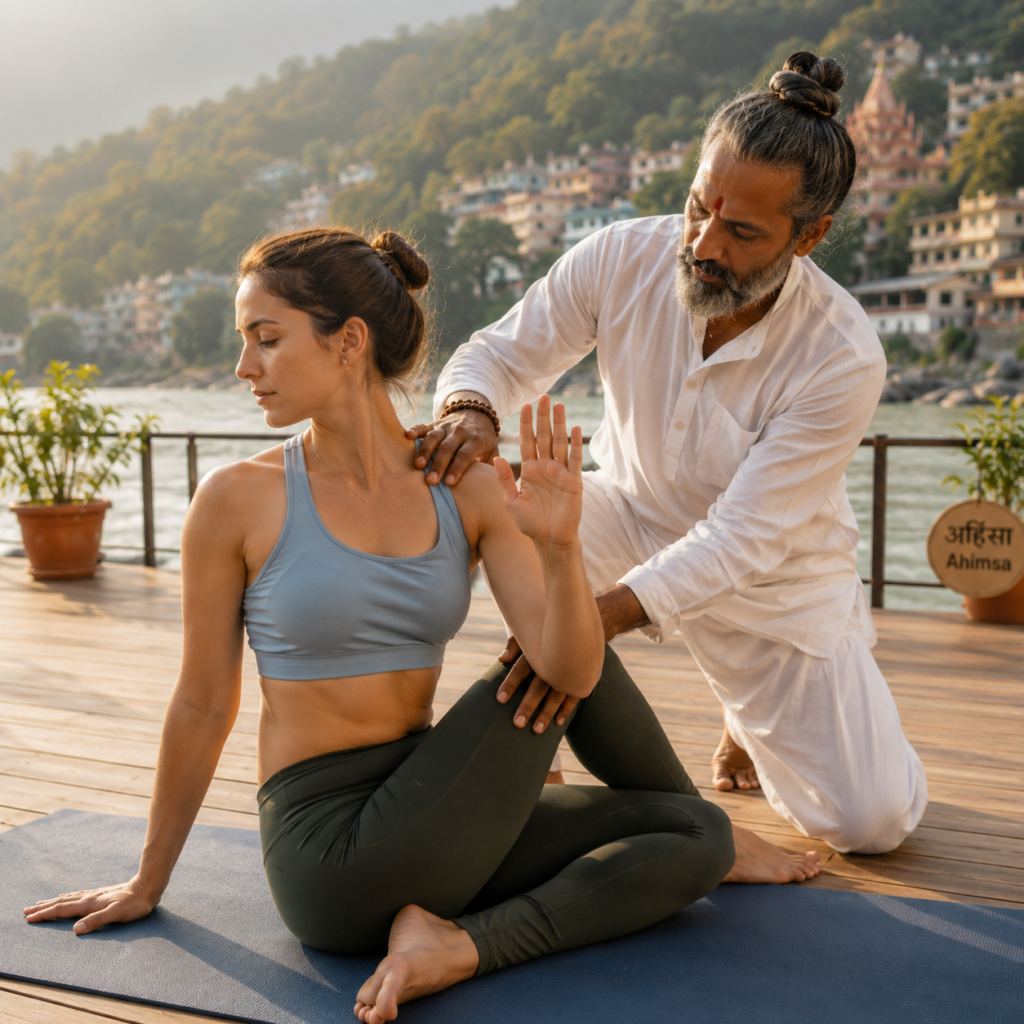
You also learn hands-on adjustments. Touching a student requires immense sensitivity, anatomical knowledge, and consent. You practice adjusting your peers, learning how much pressure is helpful and what angles provide the most relief in a tight posture.
Finally, you explore the business side. You learn how to market yourself, how to approach studios for jobs, and how to structure private sessions. It is a comprehensive blueprint for launching a successful career. For a deeper look at the financial aspects, understanding the Cost of Rishikesh Yoga Teacher Training is essential for your preparation.
Key Differences: 100 Hour vs 200 Hour Yoga Teacher Training
When comparing the two paths directly, the differences boil down to time, intention, curriculum depth, and professional outcomes. Let us break them down systematically.
First, the time commitment is the most obvious factor. Fourteen days versus twenty-eight days represents a massive difference in your ability to step away from your daily life, your job, and your family.
Second is the energetic output. A 100-hour course is deeply introspective. You absorb information, focus on your internal landscape, and heal your own nervous system. It is a time for filling your own cup.
The 200-hour course demands external output. You are forced out of your comfort zone. You must project your voice, analyze others, and actively practice leading a room. It is exhausting, but it builds unbreakable self-assurance.
Third is the depth of the theoretical study. In two weeks, you merely scratch the surface of ancient texts and anatomy. In four weeks, you study the physiological responses of the nervous system, the endocrine system, and how specific breathing techniques manipulate heart rate variability.
Financial and Practical Considerations
Financially, the 200-hour program requires a larger upfront investment. You are paying for a month of accommodation, three meals a day, and highly specialized instruction from master teachers.
However, piecing together a 100-hour course now and another later often costs more in the long run due to double airfare and separate registration fees. If your goal is teaching, doing the full month at once is economically smarter.
You also have to consider your physical preparation. Four weeks of practicing four to five hours a day requires serious stamina. Proper physical and mental readiness is crucial, which is why reading a guide on Yoga Teacher Training India Preparation: 7 Best Easy Tips is highly recommended before booking your flight.
Certification and Global Recognition
This is the deciding factor for most students. If you complete a 100-hour course, you cannot legally insure yourself as an instructor in most Western countries. You are simply a highly educated practitioner.
When you complete the 200-hour course from an accredited school, you earn the right to register with global alliances. This registration is the golden ticket that studios, gyms, and retreat centers look for when hiring.
It proves you have met rigorous standards in anatomy, philosophy, and safety. It tells employers that you know how to handle a room full of mixed-level students without causing injury. Finding the right school is vital, so reviewing the Best Certified Yoga TTC in Rishikesh can help you make a safe, informed choice.
Why Rishikesh? / Why This Matters
You can take a course anywhere in the world, so why travel all the way to Rishikesh? The answer lies in the undeniable, palpable energy of the environment.
Rishikesh is recognized globally as the birthplace of this ancient science. Practicing here means you are stepping into a lineage that has been unbroken for thousands of years.
You are surrounded by the towering Himalayas and the rushing waters of the sacred Ganga River. The entire town operates on a rhythm of spirituality. The food is sattvic, the air is thick with the scent of incense, and the sound of chanting echoes through the valleys at dawn.
This environment strips away your worldly distractions. You are not worrying about traffic, your wardrobe, or your social calendar. You are forced to confront yourself on the mat, raw and unfiltered.
Learning from Indian masters who have lived these philosophies since childhood provides a level of authenticity that cannot be replicated in a Western studio. They teach from a place of deep cultural embodiment, not just from a textbook. If you want to understand the profound impact of this environment, explore Why Yoga in Rishikesh is Life-Changing.
When you train here, you undergo an ego death. The intensity of the practice, combined with the culture shock, breaks you down and builds you back stronger, more resilient, and deeply grounded.
Discover Your Path With Us
If you’re considering training in Rishikesh, Maa Ganga Yogashala offers deeply authentic, highly structured programs tailored to your specific goals and time constraints.
We understand that choosing the right course is a massive life event, and our experienced teachers are dedicated to guiding you safely through every single posture, text, and emotional breakthrough.
Our programs are held in a deeply supportive, family-like environment overlooking the Ganga, ensuring you feel completely secure as you navigate this intense period of personal growth.
FAQs
Can I teach professionally after a 100-hour training?
No, a 100-hour program is designed for personal development and foundational learning. You must complete a minimum of 200 hours at a certified school to register as a professional instructor globally.
I am a complete beginner. Can I join a 200-hour course?
Yes, absolute beginners are welcome, provided you have a sincere dedication to learning. The course is designed to build your knowledge from the ground up, though having a basic physical practice beforehand will help you manage the physical demands.
Is it better to split the course into two 100-hour modules?
Splitting the course is a wonderful option if you cannot take a full month off work. It allows you to integrate the first half of the teachings deeply into your life before returning to tackle the advanced methodology and practicum.
What happens if I get injured during the intense physical practice?
Authentic schools prioritize alignment and safety above all else. You are taught how to modify every posture to suit your body’s current limitations, ensuring you build strength safely without risking traumatic injury.
Conclusion
Choosing between a 100 hour vs 200 hour yoga teacher training is ultimately a deeply personal decision rooted in your current life circumstances and future aspirations.
If you are seeking profound personal healing, a deeper understanding of philosophy, and a break from modern burnout, the two-week immersion provides the perfect sanctuary. If you are driven by a fierce desire to share this ancient science with the world and build a career in wellness, the full month of rigorous study is your undeniable path forward.
Take a moment to evaluate your available time, honestly assess your physical and mental readiness, and define exactly what you want to achieve when you step off the plane in India.
Ready to begin? Explore our complete 200-Hour Yoga Teacher Training to launch your career, or start your journey gently with our foundational 100-Hour Yoga Teacher Training and take the first step toward true transformation today.