
Continuing Education After 200 Hour YTT 300 Hour: 300-Hour or Specialisation?
Finishing your 200-hour yoga teacher training can feel like reaching the top of a mountain—until you realize it is actually the trailhead. Continuing education after 200 hour YTT 300 hour training is one of the biggest decisions you can make if you want to teach with more confidence, deepen your personal practice, or build a clearer specialty.
The good news is that you do not automatically need another long certification. A 300-hour advanced training can make sense when you want broader professional development and a path toward RYT 500. A focused specialisation can be smarter when you already know the population, method, or subject you want to serve.
This guide helps you compare both routes without treating more certificates as automatically better. You will learn what a 300-hour pathway can add, when a specialist course is the better investment, how teaching experience should influence your decision, why Rishikesh can be a useful place for advanced study, and what questions to ask before paying for your next program.
Continuing Education After 200 Hour YTT 300 Hour: What Does It Actually Mean?
After a foundational 200-hour YTT, you have learned enough to start teaching, but you are still building judgment. Your next training should therefore solve a real gap rather than simply add another certificate to your CV.
A 300-hour advanced teacher training is designed to build on your foundational education. Under the current Yoga Alliance framework, an RYT 500 can be earned after completing 500 hours of training through an RYS 500 program or by combining a 200-hour training with an additional 300-hour advanced training at an RYS 300. The two programs can be completed at different registered schools.
That distinction matters. A 300-hour program is not simply “another 300 hours of yoga.” It should move you toward deeper teaching methodology, sequencing, practice, anatomy, philosophy, observation, and professional judgment.
Before choosing a school, check its current Yoga Alliance registration and the exact credential attached to the program. You can use Yoga Alliance as a starting point for understanding RYT and RYS pathways.
You should also separate three different goals:
- More confidence teaching general classes.
- A formal advanced training pathway toward RYT 500.
- A specific skill, such as sound healing, prenatal yoga, yoga therapy, meditation, or another focused discipline.
If you are unclear about which of these you actually need, spending money on another broad course can leave you with more certificates but little additional clarity.
300-Hour Training vs Specialisation After 200-Hour YTT
The most useful comparison is not “Which certificate is better?” It is “What problem are you trying to solve?”
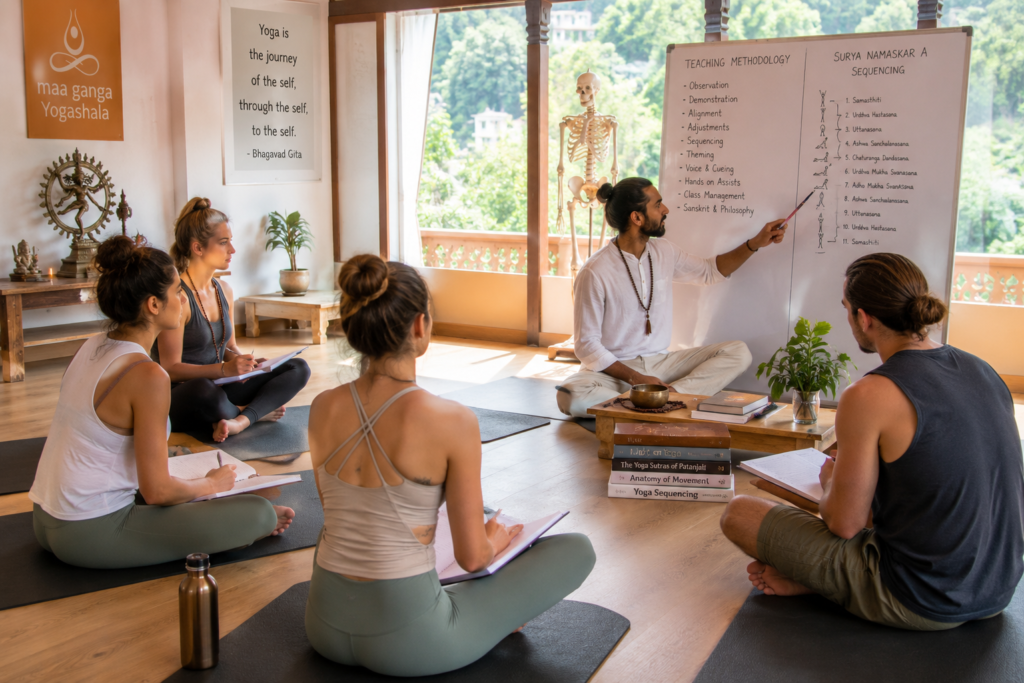
Choose a 300-hour advanced training when you want to become a more complete teacher. You may want deeper work in sequencing, teaching methodology, anatomy, philosophy, practicum, and the ability to handle more complex student needs. A structured advanced program can also give you a cohort, mentors, teaching feedback, and enough time to revisit concepts that felt theoretical during your first YTT.
Choose a specialisation when you already have a direction.
For example, you might discover that your strongest interest is working with children, prenatal students, meditation, sound, mobility, restorative practice, or another specific population or method. In that situation, a targeted program can give you usable expertise faster than a broad 300-hour curriculum.
When a 300-hour path is the better choice
A 300-hour route is usually stronger if:
- You want a broader advanced foundation rather than one niche.
- You plan to pursue the RYT 500 pathway.
- You want more supervised teaching and feedback.
- Your 200-hour training felt too compressed.
- You want to teach a wider range of students and class formats.
- You are considering yoga teaching as a serious long-term profession.
When a specialisation is the better choice
A specialisation can be more practical if:
- You already know your ideal student.
- You have started teaching and can see a clear skills gap.
- You want to add a specific service to your existing classes.
- You prefer short, focused continuing education.
- You are not interested in pursuing RYT 500 right now.
The important point is that these paths are not enemies. A teacher can complete advanced general training and later add focused education. Your sequence should reflect your actual career stage, not what looks most impressive on paper.
How to Choose Your Next Yoga Training Without Wasting Money
Your first 200-hour training may have been chosen mainly because you wanted to become a teacher. Your second training should be chosen with much more precision.
Start by reviewing your first six to twelve months of teaching. Which questions do students repeatedly ask you? Which classes are hardest for you to plan? Where do you feel least confident? Are you struggling with sequencing, verbal cues, anatomy, modifications, philosophy, meditation, or adapting practices for different bodies?
Your answers are more useful than a generic list of “advanced yoga topics.”
Look at curriculum before marketing
A good program should clearly explain what you will study, how much supervised practice you receive, who teaches the modules, how assessment works, and what credential or certificate you receive.
Do not assume that a program labelled “advanced” is automatically a 300-hour Yoga Alliance pathway. Verify the school designation and curriculum directly.
Also check whether the program gives you meaningful practicum. More classroom theory is not automatically better. If you leave knowing more terminology but still struggle to observe a student and adjust your teaching, your education has not solved the real problem.
Your next training should ideally improve at least one of these:
- Teaching precision.
- Student safety and modification skills.
- Sequencing and class design.
- Communication and observation.
- Knowledge of philosophy and yogic traditions.
- Confidence working with a defined population.
- Professional direction and employability.
For a formal 500-hour route, the structure matters even more because Yoga Alliance treats the 200-hour and 300-hour tracks as distinct training requirements rather than allowing hours from one track to be casually reused in another. If teaching methodology is where you feel least confident, our guide to teaching methodology in 200-hour YTT can help you identify the fundamentals worth strengthening.
Should You Work as a Yoga Teacher Before Doing 300 Hours?
For many practitioners, yes.
You can learn a lot about teaching only after real students are sitting in front of you. A training room can teach you how to demonstrate a posture. A real class teaches you how different bodies respond, how quickly you need to move, how much explanation students actually need, and when your carefully planned sequence needs to change.
Teaching before your next major training also helps you identify what kind of teacher you want to become.
You may discover that you love leading dynamic Vinyasa classes but need better sequencing skills. Or you may find that students come to you mainly for stress management and meditation. Another teacher might realize that working with beginners is more rewarding than teaching advanced asana.
That information should influence your education.
You can also use this period to build a teaching portfolio: class plans, student feedback, workshops attended, practice notes, and examples of how you adapt sessions. If your long-term goal is professional teaching, this evidence of real experience can be more valuable than collecting certificates without applying them.
For a broader look at what can come professionally after foundational training, see our guide to building a yoga teacher career after 200-hour TTC. You can also review the full guide to Yoga Alliance RYT 200 certification if you want to revisit what your foundational credential represents.
If you are still strengthening your fundamentals rather than moving into advanced study, our 200-hour yoga teacher training in Rishikesh explains the foundation that advanced education is supposed to build upon.
Why Rishikesh Matters for Advanced Yoga Education
Rishikesh can be useful for continuing education because the learning environment extends beyond the classroom. You can practice early, study during the day, observe different teaching approaches, and spend time around practitioners from different countries and traditions.
That does not mean every Rishikesh course is automatically high quality. Location is not a substitute for curriculum, experienced trainers, student support, or transparent credentials.
The stronger reason to study in Rishikesh is immersion. When your daily routine is organized around practice, study, reflection, and teaching, you get more opportunities to connect concepts with lived experience.
India also offers educational pathways outside the Yoga Alliance system. The Ministry of AYUSH’s Morarji Desai National Institute of Yoga lists programs ranging from certificate courses to diploma and degree-level yoga education, showing that continuing study can take several institutional forms. You can explore AYUSH’s official yoga education resources for broader information about India’s institutional yoga education landscape.
For international students, Rishikesh can also provide a chance to learn alongside Indian practitioners and teachers from other countries. That diversity can challenge assumptions you may have formed during a first training.
For Indian practitioners, studying locally can make advanced education more accessible while keeping you connected to the cultural and philosophical context of yoga.
A Practical Decision Framework: 300 Hours or Specialisation?
If you are still stuck between the two options, use a simple test.
First, ask: “Do I need breadth or depth?”
If you need breadth, lean toward a 300-hour program. If you already have breadth and need depth in one area, consider specialisation.
Second, ask: “What do I want to be known for in two years?”
You do not need a perfect five-year plan. But you should be able to name the type of student or teaching environment you want to serve.
Third, ask: “Will this course change what I can actually do?”
If the answer is only “I will have another certificate,” stop and reconsider.
A useful comparison looks like this:
| Your situation | Better next step |
|---|---|
| You want RYT 500 | 300-hour advanced training |
| You want broader teaching expertise | 300-hour training |
| You already have a niche | Specialisation |
| You have little teaching experience | Teach first, then decide |
| You want a focused add-on skill | Specialisation |
| You are unsure about your direction | Shorter continuing education + teaching experience |
If you want to strengthen your foundation before committing to a larger program, a 100-hour yoga teacher training in Rishikesh can also be worth evaluating, depending on your existing training and your intended pathway.
You can also explore focused learning through sound healing training if that area genuinely matches the kind of sessions you want to offer. The point is not to collect options. It is to choose the education that closes your biggest skill gap.
Continue Your Practice With Maa Ganga Yogashala
If you are considering continuing your yoga education in Rishikesh, we offer training and focused experiences that can fit different stages of practice rather than assuming every student needs the same next step.
If you are not ready for another long teacher training, a shorter retreat can also give you time to step back from teaching, rebuild your personal practice, and think clearly about your next professional move. Our 5-day yoga retreat in Rishikesh is one option to consider.
The right continuing education decision should leave you more capable, not simply more certified.
FAQs: Continuing Education After 200-Hour YTT
Is a 300-hour YTT the same as RYT 500?
Not exactly. A 300-hour training is an advanced training component. Under Yoga Alliance’s current pathway, an RYT 500 requires 500 hours of qualifying training, which can be completed through an RYS 500 program or by combining a qualifying 200-hour training with a separate 300-hour advanced training. Teaching-hour requirements also apply before registration.
Should you do a 300-hour YTT immediately after 200 hours?
Not necessarily. If you have little teaching experience, spending time teaching first can help you identify your actual weaknesses and interests. You may then choose a much more relevant advanced program.
Is a specialisation better than a 300-hour YTT?
Neither is universally better. A specialisation is often better when you already have a clear niche. A 300-hour program is generally more appropriate when you want broader advanced training or are pursuing the RYT 500 pathway.
Can you combine a 200-hour and 300-hour training from different schools?
Yes, Yoga Alliance states that the 500 hours can be completed by combining a 200-hour training with a separate 300-hour advanced training, and the two programs may be completed at different registered schools. Always verify the current school designations and requirements before enrolling.
What should you check before paying for advanced yoga education?
Check the school’s current registration, trainer credentials, curriculum, contact and non-contact hours, practicum, assessment, student support, schedule, total cost, accommodation if relevant, and exactly what credential or certificate you will receive.
Conclusion: Choose the Education Your Teaching Actually Needs
Continuing education after 200 hour YTT 300 hour training can be the right next move, but only when the advanced curriculum matches your goals. A 300-hour pathway makes sense when you want breadth, deeper teaching competence, and a structured route toward RYT 500. A specialisation makes more sense when you already know the students, methods, or subject area you want to serve.
Do not choose based on the biggest number of hours. Choose based on the biggest improvement you need.
If you are ready to strengthen your foundation or begin your next stage of study in Rishikesh, explore our 200-hour yoga teacher training in Rishikesh and compare it with the focused learning options available through Maa Ganga Yogashala.
Your next certificate should not just prove that you studied more. It should make you a better teacher.