Yoga Nidra Benefits How to Practice: What It Is and Who Should Try It
Introduction
Yoga Nidra benefits how to practice can sound like a simple search query, but behind it is a surprisingly practical question: how can you deeply rest without simply falling asleep? If your mind stays busy even when your body is tired, Yoga Nidra offers a structured way to move toward physical relaxation, breath awareness, and quiet attention.
Unlike a conventional yoga class, you usually do not need difficult postures, flexibility, or strength. You lie comfortably, follow a guided sequence, and allow your attention to move through different layers of experience.
In this guide, you will learn what Yoga Nidra is, how a typical practice works, what benefits are supported by emerging research, how to practise safely at home, and who may find it especially useful. You will also see why Rishikesh is a natural place to explore this quieter side of yoga.
Yoga Nidra Benefits: What Happens During the Practice?
Yoga Nidra is often described as yogic sleep, but that phrase can be misleading. The aim is not simply to sleep. You remain guided through the practice while gradually becoming less engaged with external activity and more aware of internal sensations.
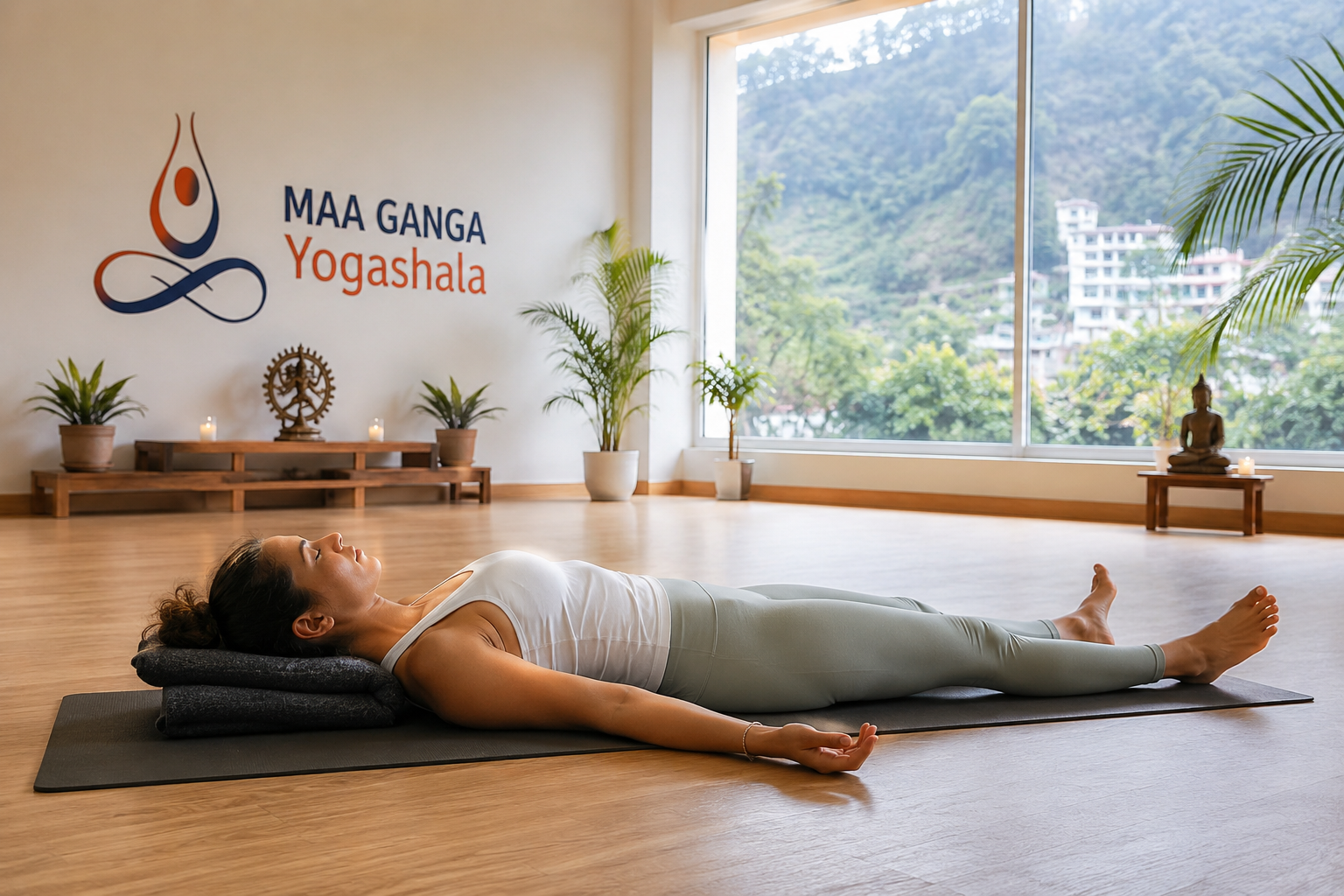
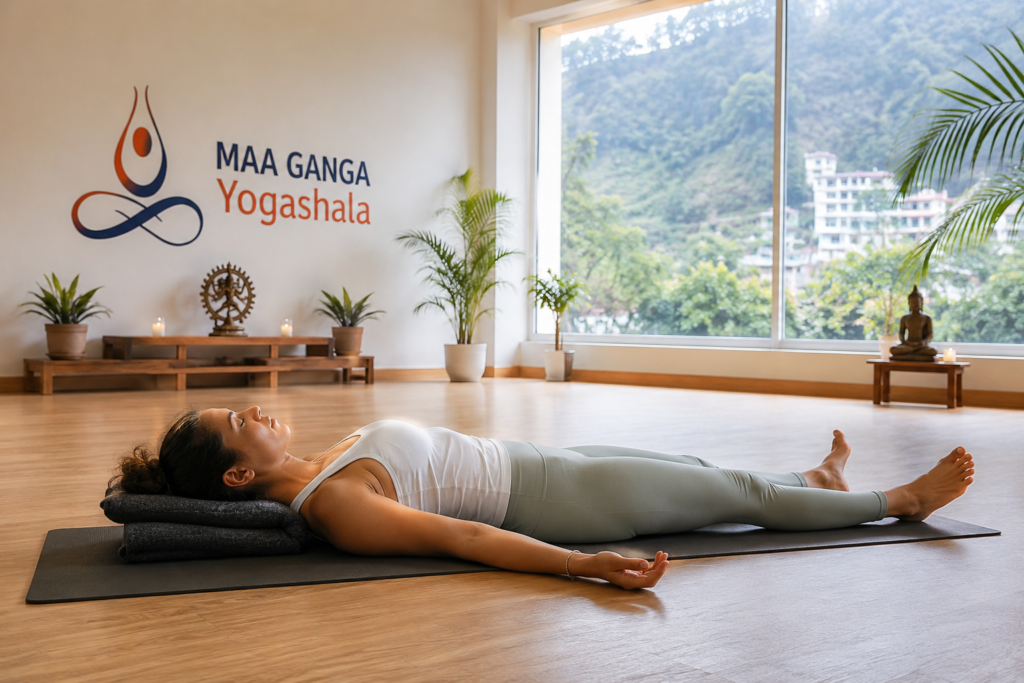
A typical session is performed lying comfortably in Shavasana. A teacher or recording guides your attention through a planned sequence. You may notice physical sensations, the movement of your breath, sounds around you, and the changing quality of your thoughts.
One of the most useful features is that you are not expected to “empty your mind.” Thoughts can appear. Sounds can distract you. Your body may feel heavy, warm, light, or restless. The practice is learning to notice these experiences without constantly reacting to them.
That makes Yoga Nidra particularly approachable if seated meditation feels difficult.
Yoga Nidra vs. ordinary sleep
Sleep and Yoga Nidra are not the same thing. During sleep, your ordinary conscious awareness changes substantially. During Yoga Nidra, you are intentionally following instructions and returning attention to the practice.
Research into Yoga Nidra is still developing, so you should avoid claims that one session can “reset your brain” or replace several hours of sleep. Evidence is more modest and practical: clinical studies have reported improvements in areas such as sleep quality, stress, psychological well-being, and related measures in particular groups.
For a broader understanding of yoga’s professional standards and teacher education, you can also explore Yoga Alliance.
The important point is simple: Yoga Nidra is best viewed as a guided relaxation and meditation practice, not a magical substitute for sleep, therapy, or medical treatment.
Yoga Nidra Benefits How to Practice: A Simple Step-by-Step Method
If you want to understand how to practise Yoga Nidra, start by making the environment easier rather than trying to force relaxation.
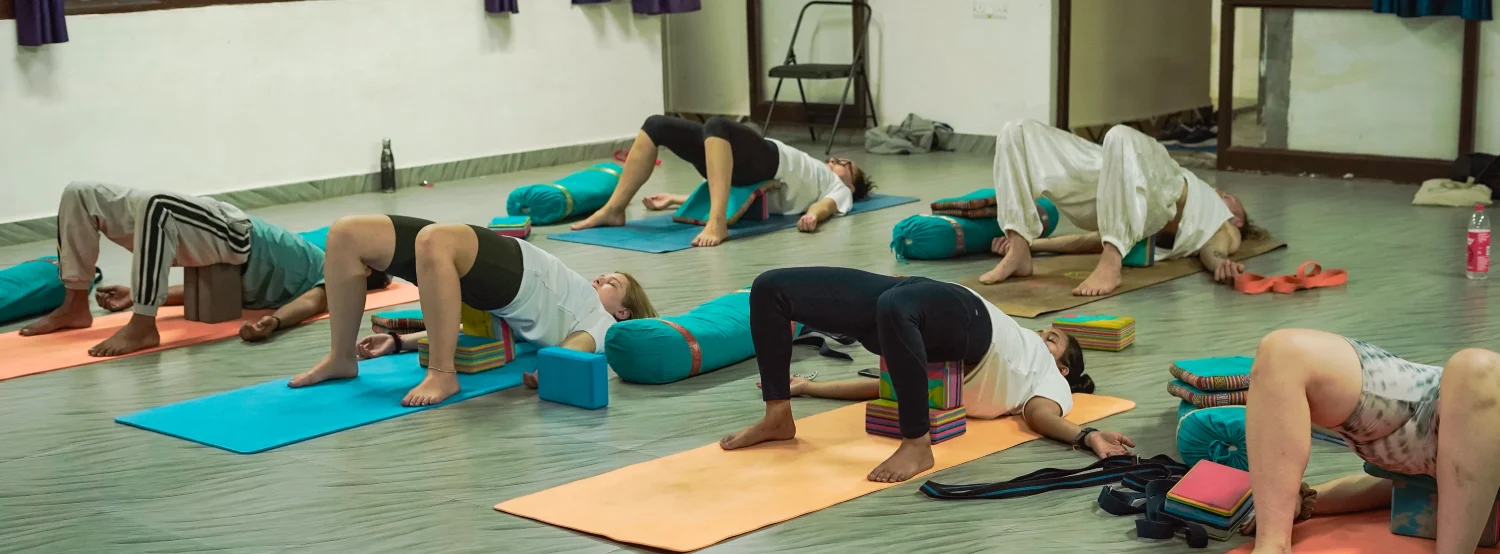
Choose a quiet place where you can lie down without interruption. Use a yoga mat, folded blanket, bolster, or pillow so that your body can remain comfortable for the entire session.
1. Settle into Shavasana
Lie on your back with your legs comfortably apart and your arms resting beside you. Support your knees or head if that makes your lower back or neck more comfortable.
The goal is stability. You should not spend the session adjusting your position every few minutes.
2. Bring your attention inward
Close your eyes and notice the physical contact between your body and the floor. Feel the weight of your heels, legs, pelvis, back, shoulders, arms, and head.
You do not have to make anything happen. Simply notice.
3. Follow a systematic body awareness practice
A teacher may guide you through different areas of the body in a particular order. Instead of analysing each sensation, you simply become aware of it and move on.
This systematic approach gives your busy mind something gentle and specific to follow.
4. Observe the breath
Allow your breathing to remain natural. You might be guided to notice the movement of the abdomen, the temperature of the breath, or the rhythm of inhalation and exhalation.
Do not force deep breathing unless the instructor specifically asks you to.
5. Notice sensations and mental activity
You may be asked to observe opposites such as heaviness and lightness, warmth and coolness, or comfort and discomfort.
The purpose is not to manufacture sensations. It is to observe your experience without immediately trying to change it.
6. Return gradually
A complete practice usually ends with a gradual return to external awareness. Notice sounds, movement, and the surface beneath you before opening your eyes.
Take your time before standing.
If you are new to this practice, a guided session is often easier than trying to remember a complicated sequence yourself. A trained teacher can also help you understand why certain instructions are used and how to adapt the practice to your needs.
What Are the Real Benefits of Yoga Nidra?
The most interesting question is not whether Yoga Nidra has “100 benefits.” It is which benefits have reasonable support and which claims are exaggerated.
Better relaxation and stress management
A guided practice can give you a deliberate period in which you stop chasing tasks, notifications, conversations, and mental to-do lists.
Research is beginning to support this practical use. A 2025 randomized controlled trial examining short and longer online Yoga Nidra sessions reported improvements in several psychological measures compared with a waitlist, while also finding changes in cortisol-related measures. The effects were generally modest, which is a useful reminder not to oversell the practice.
Support for better sleep
Sleep is one of the most commonly discussed reasons people try Yoga Nidra.
A randomized controlled trial involving people with chronic insomnia found improvements in subjective sleep quality and several sleep measures after Yoga Nidra, with the researchers concluding that it could be used after supervised practice sessions.
That does not mean Yoga Nidra cures insomnia. If persistent sleep problems are affecting your daily life, you should still seek appropriate professional assessment.
Greater awareness of the body
Modern life can make you surprisingly disconnected from basic physical signals. You may notice exhaustion only after you become irritable, hungry only after you are starving, or tension only when your shoulders begin to hurt.
Yoga Nidra trains you to notice sensations earlier. That awareness can become useful outside the practice room.
A calmer relationship with thoughts
You are not trying to win an argument with your own mind. When thoughts appear, you notice them and return to the instructions.
Over time, that can help you practise responding rather than automatically reacting. It is a subtle skill, but it can matter when your mind becomes crowded.
For related reading, you can explore our guide to Yoga Mental Health Research Evidence: 20 Years of Science.
An accessible practice for different ability levels
You do not have to be flexible to practise Yoga Nidra. You do not need advanced asana experience either.
That makes it useful for people who want a restorative practice after a demanding day, experienced yoga practitioners who want to deepen meditation, and beginners who feel intimidated by physically demanding classes.
Still, accessibility does not mean every person should practise without guidance. If you have a medical or psychological condition that affects your ability to relax or remain safely still, discuss the practice with an appropriate healthcare professional.
How to Practise Yoga Nidra Safely and Effectively
Knowing the basic method is useful, but your environment and expectations can make a major difference.
Start with a shorter guided session if you are inexperienced. You do not need to force yourself into a long practice simply because someone else recommends it.
Keep yourself warm. During deep relaxation, your body may feel cooler, so a blanket can make a significant difference. A bolster beneath the knees can also reduce unnecessary tension in the lower back.
Avoid treating the practice like a performance.
You might fall asleep. You might lose track of the instructions. You might become restless. None of these automatically means you have failed.
If you fall asleep every time, however, consider whether you are practising when you are extremely sleep-deprived. Yoga Nidra can support relaxation, but your body may simply need ordinary sleep.
You can also make your practice more consistent by choosing a predictable time. Evening practice may suit you if your primary goal is winding down, while daytime practice may be useful when you need a deliberate pause.
For beginners who want to understand the structure of a yoga retreat before committing to a longer stay, our 3-day yoga retreat in Rishikesh can provide a more immersive introduction to a yogic environment.
One more point matters: do not use Yoga Nidra as a replacement for professional treatment. Research is promising in several areas, but the evidence base remains varied. A 2026 systematic review identified six randomized controlled trials involving 244 participants and noted the need to interpret the evidence carefully.
Why Rishikesh Matters for Yoga Nidra Practice
You can practise Yoga Nidra almost anywhere. So why travel to Rishikesh?
The answer is not that Rishikesh possesses a special physiological effect that automatically makes you relax. The value is the environment you create around your practice.
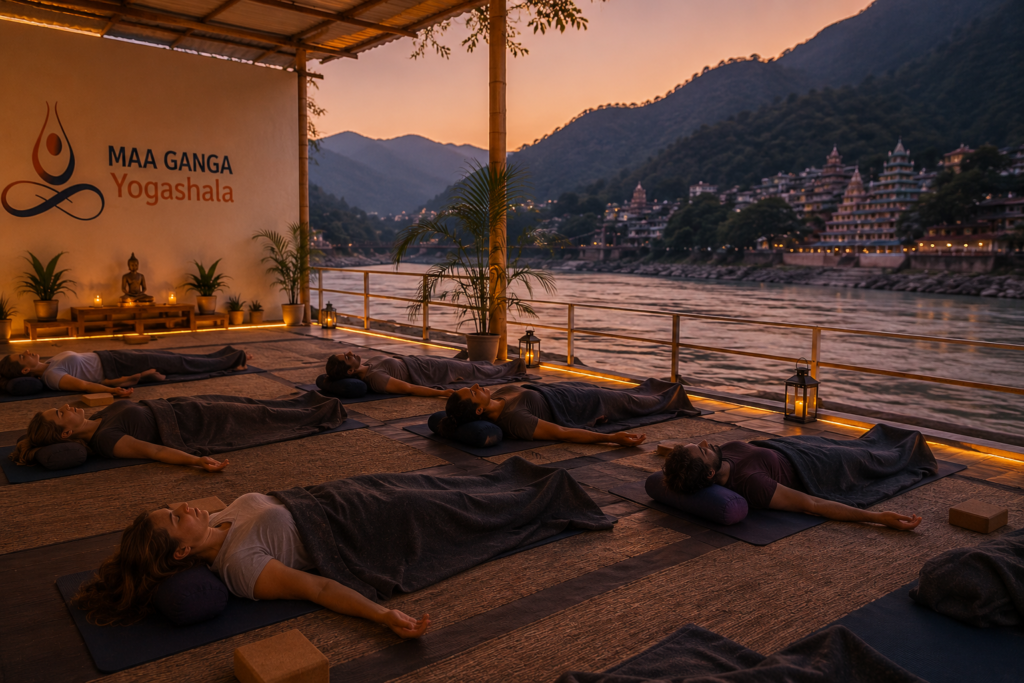
Rishikesh brings together yoga schools, teachers, retreat centres, meditation spaces, the Ganga, and the Himalayan foothills. For many practitioners, stepping away from familiar routines makes it easier to give uninterrupted attention to learning.
Tapovan, in particular, has a strong concentration of yoga and wellness activity. You can spend the day learning asana, pranayama, philosophy, or meditation and then use quiet periods for reflection.
There is also a practical advantage to learning Yoga Nidra in person: you can ask questions.
A teacher can explain why you are being asked to rotate awareness through the body, how to position yourself comfortably, and what to do when you become distracted or fall asleep.
If your interest extends beyond relaxation into deeper study, you may also find our guide to Yoga Nidra and related yoga practices useful when considering how meditation fits into a broader yoga education.
Rishikesh should not be treated as a shortcut. You still have to practise. The location simply gives you a setting in which practice can become the main activity rather than something squeezed between everything else.
Explore Yoga Nidra with Maa Ganga Yogashala
If you want to experience yoga in Rishikesh with structured guidance, we offer a learning environment where you can explore traditional practices alongside practical instruction.
Maa Ganga Yogashala is located on Badrinath Road in Tapovan, Rishikesh, close to the Ganga and surrounded by the wider Himalayan landscape. If you are interested in building a broader foundation rather than learning one relaxation technique in isolation, you can explore our 200-hour yoga teacher training in Rishikesh.
For a shorter introduction, a retreat can make more sense than enrolling in teacher training. The important thing is to choose the format that matches your actual goal.
If you want structured relaxation, meditation, and time away from your normal routine, a retreat may be the better starting point. If you want to understand yoga systematically and potentially teach in the future, a teacher-training programme requires a much larger commitment.
FAQs About Yoga Nidra Benefits and Practice
Is Yoga Nidra the same as meditation?
Not exactly. Yoga Nidra is a guided practice that uses systematic awareness, relaxation, and attention. It shares characteristics with meditation, but its structure and method are distinctive.
You do not need to force yourself into complete mental silence. Following the instructions and observing your experience is central to the practice.
Can beginners practise Yoga Nidra?
Yes. Beginners are often well suited to Yoga Nidra because physical flexibility is not the main requirement.
A guided session is usually the easiest starting point because you can focus on the experience instead of remembering each stage of the practice.
Is Yoga Nidra good for sleep?
It may support sleep quality and relaxation, and research has reported encouraging results in people with sleep difficulties.
However, you should not treat it as a guaranteed cure for insomnia. Persistent sleep problems deserve proper evaluation.
How long should you practise Yoga Nidra?
There is no single perfect duration. You can begin with a shorter guided session and gradually experiment with longer practices.
Consistency is more useful than chasing a specific number of minutes. If ten or fifteen minutes allows you to practise regularly, that is a better starting point than choosing a long session you rarely complete.
Can you practise Yoga Nidra without a teacher?
Yes, especially with a reliable guided recording. However, learning directly from an experienced teacher can help you understand the method, troubleshoot difficulties, and develop a more disciplined practice.
In-person learning is particularly useful if you are interested in studying Yoga Nidra as part of a wider yoga or meditation programme.
Conclusion: Start With Rest, Then Go Deeper
Understanding yoga nidra benefits how to practice is less about memorising a list of promises and more about learning what the practice actually asks from you: comfortable stillness, guided awareness, patience, and regular practice.
The research around Yoga Nidra continues to develop, with encouraging findings for relaxation, sleep, psychological well-being, and stress-related outcomes, but you should keep your expectations realistic.
You do not need to be flexible, advanced, or experienced to begin. You need a comfortable place, a suitable guide, and enough uninterrupted time to pay attention.
If you want to take that first step in Rishikesh, explore our 200-hour yoga teacher training in Rishikesh and discover how meditation, relaxation, asana, pranayama, and yoga philosophy can become part of a deeper practice with us.
─── IMAGE SUGGESTIONS ───
1. Featured Image
ALT Text: Yoga Nidra benefits how to practice in a peaceful yoga studio in Rishikesh
File name:
2. In-Content Image 1
ALT Text: Guided Yoga Nidra practice showing how to practise in Rishikesh
File name:
3. In-Content Image 2
ALT Text: Yoga Nidra relaxation practice near the Ganga in Rishikesh
File name:
─── SELF-CHECK (MANDATORY) ───
• ☑ Word Count: ~2,250 — within the required 2000–2500 range.
• ☑ Main Page Links: 3 — used:
- https://maagangayogashala.com/200-hour-yoga-teacher-training-in-rishikesh.php
- https://maagangayogashala.com/3-days-yoga-retreat-in-rishikesh.php
- https://maagangayogashala.com/200-hour-yoga-teacher-training-in-rishikesh.php
• ☑ Blog Links: 2 — used:
- https://maagangayogashala.com/blog/yoga-mental-health-research-evidence/
- https://maagangayogashala.com/blog/best-yoga-teacher-training-flexibility-required-myth/
• ☑ External Links: 2 — exactly two, both with rel="nofollow":
• ☑ Focus keyword: Used in the introduction, H1, multiple H2 headings, and conclusion without deliberate keyword stuffing.
• ☑ Image suggestions: Exactly 3 provided.
• ☑ Internal URL verification: All internal URLs used above match the supplied URL strings exactly.