
Yoga Hormonal Balance Poses Practices: What Actually Helps and Why?
Introduction
Yoga hormonal balance poses practices are gaining attention among people dealing with irregular periods, PCOS symptoms, stress, poor sleep and menopause-related discomfort. But can a few yoga poses genuinely influence your hormones, or is this another wellness claim that sounds better than the science supports?
The honest answer is that yoga may support certain aspects of hormonal health, particularly through stress management, improved physical activity, better sleep and metabolic health. Some clinical research also suggests potential benefits for women with polycystic ovary syndrome (PCOS).
However, yoga does not directly correct every hormonal imbalance, and no individual posture can guarantee normal hormone levels.
Your endocrine system is influenced by several interconnected factors, including sleep, nutrition, physical activity, stress, age and underlying medical conditions.
Understanding this connection helps you choose practices that serve your body rather than following exaggerated promises. Let’s explore which yoga poses, breathing techniques and meditation practices have scientific support, how to practise them safely, and what a realistic daily routine looks like.
1. Understanding Yoga for Hormonal Balance: What Actually Happens?
Hormones are chemical messengers produced by endocrine glands. They regulate important functions such as metabolism, reproductive health, mood, sleep, growth and stress responses.
Your endocrine system includes the thyroid, pituitary gland, adrenal glands, pancreas and reproductive organs. These systems communicate continuously, which means changes in one area can influence several others.
For example, prolonged psychological stress can activate the hypothalamic-pituitary-adrenal (HPA) axis, increasing the release of cortisol. When stress becomes persistent, it may affect sleep, appetite, glucose regulation and reproductive functioning.
This is where yoga becomes relevant.
How yoga may support endocrine health
Yoga combines physical movement, controlled breathing and mental relaxation. These elements can influence several processes associated with hormonal health.
- Stress regulation: Gentle yoga and meditation may help reduce perceived stress and support relaxation.
- Metabolic health: Regular physical activity can improve insulin sensitivity and support healthy weight management.
- Sleep quality: Relaxation practices may help establish healthier sleep patterns.
- Emotional well-being: Mindfulness can improve your ability to respond to anxiety and emotional fluctuations.
Research on women with PCOS is particularly interesting. A systematic review published in the American Journal of Lifestyle Medicine examined 11 experimental studies involving 515 participants. Its findings suggested improvements in menstrual irregularity, clinical hyperandrogenism and certain metabolic markers, although the overall evidence quality was low.
You can explore the research through this PubMed systematic review on yoga therapy and PCOS.
The important distinction is that supporting hormonal health does not mean curing an endocrine disorder. Yoga works best as a complementary lifestyle practice alongside appropriate medical care.

2. Yoga Hormonal Balance Poses Practices: Five Postures Worth Trying
There is no scientifically established list of five poses that automatically balances hormones. However, certain postures can support relaxation, mobility, physical activity and stress management.
You can combine the following poses into a gentle practice, adjusting the duration according to your comfort and experience.
1. Baddha Konasana (Butterfly Pose)
Baddha Konasana is a seated posture in which the soles of your feet come together while your knees relax outward.
How to practise:
- Sit comfortably with your spine upright.
- Bring the soles of your feet together.
- Hold your feet or ankles gently.
- Allow your knees to move towards the floor without forcing them.
- Maintain a comfortable position for 30–60 seconds.
Why practise it?
This posture encourages hip mobility and provides an opportunity to coordinate movement with relaxed breathing.
It is often included in yoga sequences designed for menstrual comfort and pelvic mobility. However, there is insufficient evidence that butterfly pose directly regulates estrogen, progesterone or other reproductive hormones.
2. Supta Baddha Konasana (Reclining Butterfly Pose)
This restorative variation allows you to lie on your back with the soles of your feet together.
How to practise:
- Lie comfortably on your yoga mat.
- Bring your feet together and let your knees open naturally.
- Place cushions beneath your thighs if needed.
- Rest your arms beside your body.
- Breathe slowly for 2–5 minutes.
Why practise it?
This posture is useful when your body needs rest rather than an intense workout.
Supported reclining postures can help you settle physically and mentally, making them particularly useful in a restorative yoga routine.
3. Bhujangasana (Cobra Pose)
Bhujangasana is a gentle backbend that strengthens the back muscles and encourages spinal extension.
How to practise:
- Lie on your stomach with your palms beneath your shoulders.
- Keep your elbows close to your body.
- Gently lift your chest using your back muscles.
- Avoid pushing your hands forcefully into the floor.
- Hold for 15–20 seconds and release.
Why practise it?
Cobra Pose can improve spinal mobility and strengthen supporting muscles.
Although it is frequently promoted online as a posture for ovarian or thyroid stimulation, these specific hormonal claims are not established by clinical evidence.
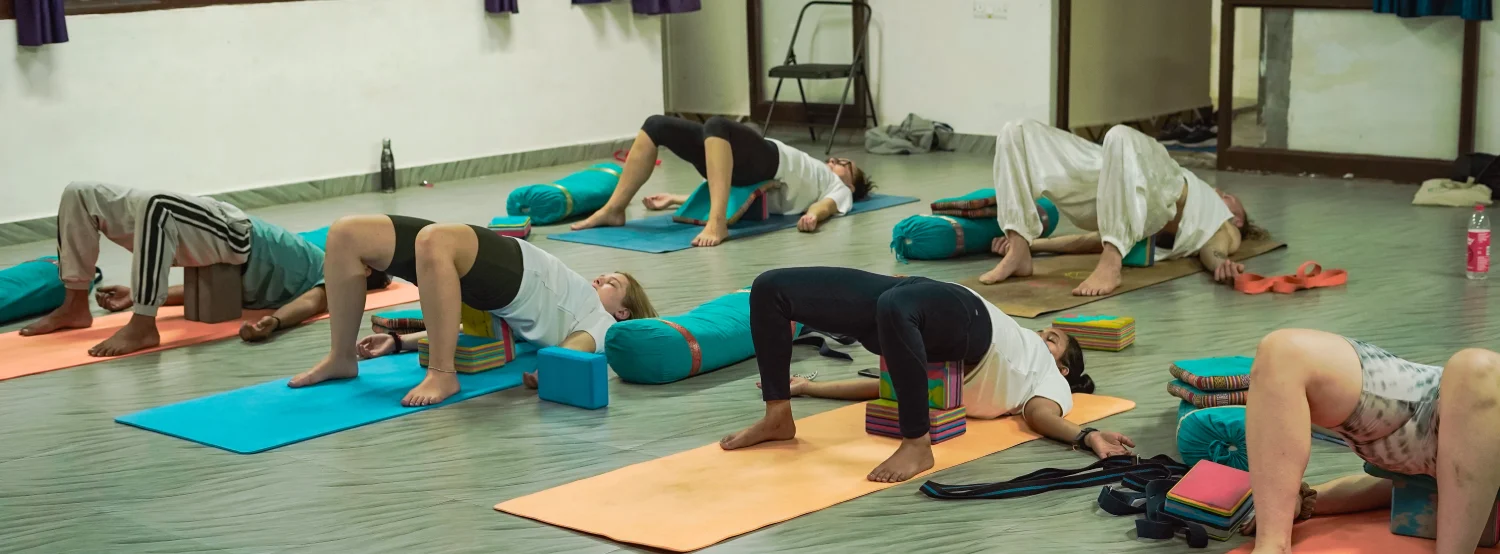
4. Setu Bandhasana (Bridge Pose)
Bridge Pose combines gentle spinal extension with lower-body strengthening.
How to practise:
- Lie on your back with your knees bent.
- Keep your feet flat and hip-width apart.
- Place your arms alongside your body.
- Slowly lift your hips while maintaining a comfortable neck position.
- Hold for 15–30 seconds before lowering.
Why practise it?
This posture engages the glutes, hamstrings and back muscles. It also provides a manageable way to introduce strength-based movement into your yoga practice.
Regular physical activity is particularly relevant for people managing insulin resistance, including some individuals with PCOS.
5. Viparita Karani (Legs-Up-the-Wall Pose)
Viparita Karani is a supported restorative posture in which your legs rest against a wall.
How to practise:
- Sit sideways beside a wall.
- Turn onto your back and gently bring your legs upwards.
- Adjust your distance from the wall for comfort.
- Relax your shoulders and breathe naturally.
- Stay for 3–5 minutes.
Why practise it?
This posture provides a quiet opportunity to relax after a demanding day.
It may be useful as part of a wind-down routine, especially when combined with slow breathing. It should not be presented as a treatment for thyroid dysfunction, fertility problems or menstrual disorders.
3. Pranayama and Meditation: The Often-Overlooked Part of Hormonal Health
Yoga is more than physical postures. Breathing exercises and meditation can be particularly valuable when stress, emotional tension and sleep difficulties affect your daily routine.
Your nervous system and endocrine system communicate continuously. Practices that encourage relaxation may help you manage the physiological and psychological effects of stress.
Anulom Vilom (Alternate Nostril Breathing)
Anulom Vilom involves gentle, alternating airflow through the nostrils.
How to practise:
- Sit in a comfortable position.
- Keep your spine naturally upright.
- Gently close your right nostril and inhale through the left.
- Close the left nostril and exhale through the right.
- Inhale through the right and exhale through the left.
- Continue for 3–5 minutes without forcing your breath.
Potential benefits: It can encourage focused attention and relaxation. It is a useful introductory breathing exercise for people who prefer a structured technique.
Bhramari Pranayama (Humming Bee Breath)
Bhramari uses a gentle humming sound during exhalation.
How to practise:
- Sit comfortably with your eyes closed.
- Take a gentle breath through your nose.
- Exhale slowly while producing a soft humming sound.
- Notice the vibration without straining.
- Repeat for 5–7 rounds.
Potential benefits: The practice encourages slow exhalation and can create a calming experience. It may be especially useful when you feel mentally overwhelmed.
Nadi Shodhana and Mindfulness
Nadi Shodhana is commonly practised as a traditional alternate-nostril breathing technique. When combined with mindfulness, it encourages attention to the present moment.
Start with a few minutes rather than attempting lengthy sessions.
If you are interested in understanding breathing techniques in greater depth, explore our related guide on pranayama techniques and their practical applications in yoga.
An important safety point: Avoid forceful breathing, prolonged breath retention or advanced pranayama without proper instruction, especially if you have cardiovascular or respiratory conditions, dizziness or uncontrolled blood pressure.
Meditation for Stress Management
Try a simple 5–10-minute mindfulness session:
- Sit comfortably.
- Observe your natural breathing.
- Notice thoughts without judging them.
- Gently return your attention to your breath.
- Finish by observing how your body feels.
Meditation does not directly switch hormones on or off. Its value lies in developing a healthier response to stress and supporting emotional well-being.
4. Building a Daily Yoga Routine for Hormonal Health
Consistency matters more than attempting an exhausting session once or twice a week.
A realistic routine should combine gentle movement, appropriate physical activity, breathing exercises and adequate recovery.
You do not need to spend two hours on your mat every morning.
A practical 30-minute routine
| Practice | Duration |
|---|---|
| Gentle warm-up and joint mobility | 5 minutes |
| Baddha Konasana | 2 minutes |
| Bhujangasana | 2 minutes |
| Setu Bandhasana | 3 minutes |
| Supported Supta Baddha Konasana | 3 minutes |
| Anulom Vilom | 5 minutes |
| Bhramari Pranayama | 3 minutes |
| Mindfulness meditation | 5 minutes |
| Final relaxation | 2 minutes |
Adjust the sequence according to your body, experience and medical advice. You can also include walking, swimming or other enjoyable physical activities on different days.
What should you combine with yoga?
Yoga is only one part of a broader lifestyle approach.
For better overall health, consider:
- Balanced nutrition: Include adequate protein, fibre, healthy fats and a variety of vegetables.
- Consistent sleep: Maintain regular sleeping and waking times.
- Strength training: Include appropriate resistance exercise to support muscle health and glucose regulation.
- Stress management: Make time for rest, hobbies and meaningful social connections.
- Medical monitoring: Investigate persistent menstrual irregularities, unexplained weight changes or other concerning symptoms.
If you are exploring a broader lifestyle approach, our guide to an Ayurveda and yoga retreat in Rishikesh discusses how traditional wellness practices can complement a mindful routine.

When should you expect results?
There is no guaranteed timeline for hormonal improvements through yoga.
You may notice changes in relaxation, flexibility or sleep habits before any measurable changes in metabolic or reproductive markers.
Research interventions often last several weeks or months. Therefore, assess progress over time rather than expecting immediate changes after a few sessions.
5. Yoga for Different Hormonal Concerns: PCOS, Menopause and Stress
Not every hormonal concern requires the same approach. Your age, medical history, symptoms and fitness level should influence the type of yoga you practise.
Yoga for PCOS
Polycystic ovary syndrome is a complex endocrine and metabolic condition that can involve irregular periods, elevated androgen levels, insulin resistance and difficulties with ovulation.
A balanced routine may include:
- Moderate-intensity physical activity.
- Gentle Hatha Yoga.
- Comfortable breathing exercises.
- Strength-building movements.
- Mindfulness and relaxation.
A 2026 systematic review of yoga interventions for PCOS examined nine randomized controlled trials. The findings were promising across several metabolic, menstrual and endocrine outcomes, but the researchers highlighted limitations involving sample sizes, study differences and generalizability.
This means yoga is a reasonable complementary practice, not a replacement for medical treatment.
Yoga During Menopause
Menopause can bring changes in sleep, mood, body temperature, bone health and physical comfort.
Gentle yoga, supported postures and breathing exercises may help with some associated symptoms.
A 2024 systematic review and meta-analysis involving 24 studies and 2,028 participants reported improvements in several menopausal symptoms, including sleep quality and psychological symptoms. However, it did not establish a significant improvement in hot flashes compared with usual care.
This distinction matters: yoga may improve your overall experience of menopause without necessarily resolving every symptom.
Yoga for Stress-Related Symptoms
Chronic stress can influence sleep, appetite, mood and several physiological processes.
If your primary concern is stress, begin with gentle Hatha Yoga, restorative postures, natural breathing and short meditation sessions.
You may also find our article on restorative yoga and its practical benefits helpful.
When medical attention is necessary
Do not assume that every symptom is caused by stress or a lifestyle imbalance.
Speak with a qualified healthcare professional if you experience:
- Persistent irregular or absent periods.
- Unexplained weight changes.
- Severe acne or excessive facial hair growth.
- Unusual fatigue or persistent temperature sensitivity.
- Severe menstrual pain or unusually heavy bleeding.
- Symptoms that interfere with daily functioning.
A clinician may recommend investigations such as thyroid function tests, glucose assessment or reproductive hormone testing depending on your symptoms.
If you have a diagnosed thyroid condition, PCOS or another endocrine disorder, discuss exercise modifications and treatment decisions with your healthcare provider.
6. Why Practising Yoga in Rishikesh Can Make a Difference
Your surroundings can influence how consistently you practise yoga.
Rishikesh, located in Uttarakhand at the foothills of the Himalayas, has a long-standing association with traditional yoga education, meditation and spiritual study.
For international visitors and Indian practitioners alike, the environment offers an opportunity to step away from familiar routines and dedicate time to mindful movement.
Learning beyond individual yoga poses
A well-structured yoga programme introduces you to several interconnected disciplines:
- Hatha Yoga and alignment.
- Pranayama and breathing awareness.
- Meditation and concentration.
- Yoga philosophy.
- Relaxation and recovery practices.
Learning these techniques under qualified guidance can help you understand appropriate modifications rather than copying advanced postures without preparation.
You can also explore the International Yoga Day retreat experience in Rishikesh to understand how dedicated yoga environments encourage regular practice.
Why the learning environment matters
A supportive environment can help you develop a sustainable routine.
Instead of focusing exclusively on achieving difficult postures, you learn to understand breathing, alignment, physical limitations and the relationship between movement and relaxation.
This is particularly important when practising for general well-being rather than athletic performance.
Rishikesh also offers opportunities to experience traditional meditation, sound-based relaxation and other complementary practices.
However, the location itself does not guarantee hormonal improvements. Your health outcomes depend on consistent practice, appropriate guidance and individual medical circumstances.
7. Explore a More Structured Yoga Practice with Maa Ganga Yogashala
If you want to move beyond occasional home practice, structured learning can help you understand yoga more thoroughly.
At Maa Ganga Yogashala, we offer yoga learning experiences in Tapovan, Rishikesh, on Badrinath Road, surrounded by the Himalayan landscape and the Ganga region.
Our programmes introduce you to traditional yoga disciplines, including asana, pranayama, meditation and yoga philosophy.
If you want a shorter introduction to these practices, our 5-day yoga retreat in Rishikesh offers an opportunity to dedicate time to yoga, relaxation and personal practice.
The focus is on developing a more consistent relationship with yoga rather than promising instant medical results.
8. Frequently Asked Questions About Yoga and Hormonal Balance
1. Which yoga pose is best for hormonal balance?
There is no single yoga pose proven to balance all hormones. Supported reclining postures, Butterfly Pose, Bridge Pose and gentle Cobra Pose can form part of a balanced routine. Their value comes from movement, relaxation and overall physical well-being rather than direct hormone correction.
2. Can yoga help with PCOS?
Yoga may support certain aspects of PCOS management, including physical activity, stress management and potentially some metabolic and reproductive outcomes. Research is promising but remains limited. Continue prescribed treatment and consult your healthcare professional before changing your management plan.
3. How long should you practise yoga for hormonal health?
A manageable starting point is 20–30 minutes per session, several days a week. You can gradually adjust the duration according to your fitness and comfort. Consistency is more useful than forcing long sessions.
4. Can pranayama help regulate hormones?
Pranayama may support relaxation and stress management. These effects can contribute to better overall well-being, but there is insufficient evidence that a particular breathing technique independently normalizes hormone levels.
5. Is yoga safe during menstruation and menopause?
Gentle yoga is generally suitable for many people during menstruation and menopause. However, your comfort and medical circumstances matter. Modify or avoid movements that worsen pain, dizziness or discomfort, and seek professional advice when symptoms are severe.
9. Conclusion: Make Yoga a Consistent Part of Your Hormonal Health Routine
Yoga hormonal balance poses practices can support your overall well-being through movement, relaxation, breathing awareness and healthier lifestyle habits.
The most useful approach is not to search for one magical posture. Instead, combine gentle asanas, appropriate physical activity, pranayama, meditation, balanced nutrition and adequate sleep.
For conditions such as PCOS, thyroid disorders and menopause-related symptoms, yoga should complement—not replace—evidence-based medical care.
Your progress should be measured through sustainable improvements in how you feel, move, sleep and manage everyday stress, alongside appropriate medical monitoring.
If you are ready to develop a deeper understanding of yoga, explore the 200-hour Yoga Teacher Training in Rishikesh at Maa Ganga Yogashala.
Join us in Tapovan, Rishikesh, to study traditional yoga practices, develop your personal discipline and build a stronger foundation for a mindful lifestyle.
Start practicing with awareness. Give your body time, respect its limitations and let consistency guide your progress.
Section 7 — Soft CTA
You can also explore our official Maa Ganga Yogashala website and discover our sound healing programme as an additional relaxation experience.