Bandhas Yoga Types How to Practice: The Ultimate Guide for Serious Seekers
Mastering bandhas yoga types how to practice is the absolute key to unlocking your true potential on the mat and beyond. Have you ever watched an advanced practitioner float into a handstand with zero effort, or sit in deep meditation for hours without moving a single muscle?
The secret does not lie in raw physical strength or endless stretching routines. The true power stems entirely from internal energy locks that direct your vital life force efficiently.
In this comprehensive guide, you will learn exactly what these locks are and why they matter so much. We will break down the precise anatomy, the underlying philosophy, and the practical steps needed to safely integrate them into your daily sequence.
Whether you are a dedicated student or an aspiring teacher, understanding this internal framework will completely redefine your relationship with movement and stillness.
Understanding Bandhas Yoga Types How to Practice Safely
Before diving into the specific bandhas yoga types how to practice, you must fully grasp the fundamental safety protocols required for this deep internal work. Energy locks are not merely physical muscular contractions.
They are complex mechanisms that alter your blood pressure, your heart rate, and the flow of prana throughout your entire nervous system. Because of this profound physiological impact, approaching them with respect and patience is non-negotiable.
Rushing into intense breath retention while aggressively pulling your abdomen or throat can lead to severe dizziness, physical agitation, or nervous system dysregulation. Your physical vessel must be adequately prepared first.
Many leading health and wellness authorities, including the Yoga Alliance, emphasize the critical importance of proper structural alignment and qualified guidance when introducing these subtle body practices.
Listening to your physical cues is your absolute greatest safeguard. If you ever feel pressure in your head, ringing in your ears, or a fluttering heart rate, release the lock immediately and return to natural breathing.
Mastery is never about how forcefully you can squeeze your internal muscles. It is entirely about how subtly and consciously you can direct your energy, which takes immense time and patience.
The Core Bandhas Yoga Types How to Practice Daily
There are three primary bandhas yoga types how to practice that form the absolute foundation of internal energy work: Mula Bandha, Uddiyana Bandha, and Jalandhara Bandha.
When these three are mastered individually, they can eventually be combined into Maha Bandha, the supreme energetic seal. To truly grasp their function, you must first understand the yogic concept of nadis.
Nadis are the invisible energy channels that run throughout your subtle body. The most important of these is the Sushumna Nadi, the central channel running directly along your spine.
The locks act as intelligent energetic dams, preventing your prana from leaking outward and downward. Instead, they force this potent life force to rise upward through the central channel.
Mula Bandha: The Root Lock
Mula Bandha is the foundational lock, located at the perineum, which is the space between the anus and the genitals. Engaging this specific lock seals your energy directly at the base of your spine.
Physically, it involves a highly subtle lifting and contracting of the deeper pelvic floor muscles. To practice Mula Bandha, begin by sitting in a highly comfortable meditation posture.
Take a deep, slow breath in, and as you exhale completely, gently lift the pelvic floor upward toward your navel. Hold this subtle lift as you continue to breathe normally.
Over time, you can easily maintain this light engagement throughout your entire asana practice. Understanding this deep internal support connects closely with studying the Eight Limbs of Yoga Philosophy, rooting physical action in spiritual purpose.
Mastering the Abdominal and Throat Locks
Once you have established a remarkably steady root lock, you can safely begin to explore the abdominal and throat seals. These higher locks require significantly more focus.
They are generally practiced exclusively during intense breath retention, making them significantly more advanced than the root lock.
Uddiyana Bandha: The Upward Flying Lock
Uddiyana directly translates to “to fly upward.” This lock is located in the core abdominal region and serves as a powerful tool for massaging the internal organs.
It forcefully stimulates digestion and drives stagnant energy upward. It must strictly only be practiced on an entirely empty stomach and always on an external breath retention.
To practice properly, stand with your feet hip-width apart and bend your knees slightly while resting your hands on your thighs. Take a deep breath in through your nose, then forcefully exhale all the air out through your mouth.
Without inhaling, perform a mock inhalation by expanding your ribcage as if you are trying to breathe in. This powerful vacuum effect will suck your abdomen deeply up and in, hollow behind your ribs.
Modern scientific literature, frequently documented in medical databases like pubmed.ncbi.nlm.nih.gov, continuously explores how these deep abdominal vacuums stimulate the vagus nerve and promote intense parasympathetic relaxation.
Jalandhara Bandha: The Throat Lock
Jalandhara Bandha directly controls the powerful energy moving upward into your head. It safely regulates the delicate circulatory and respiratory systems during intense breathing exercises.
It is expertly performed by resting the chin firmly in the notch between the collarbones while holding the breath securely. This precise action gently compresses the main arteries of the neck.
To practice it safely, sit perfectly tall, inhale deeply, hold your breath securely, lengthen the back of your neck, and carefully drop your chin down to your chest. Lift your chest slightly upward to meet your chin.
Always remember to lift your head carefully back to a completely neutral position before you begin your exhalation.
Maha Bandha: The Great Lock and Energetic Integration
Maha Bandha is considered the ultimate culmination of your dedicated internal practice. It is the highly focused, simultaneous application of all three primary locks: Mula, Uddiyana, and Jalandhara.
Performing Maha Bandha seals the prana completely and securely within the central channel. This creates an intense internal pressure cooker of spiritual energy that rapidly purifies the nadis.
To practice Maha Bandha safely, you must be entirely comfortable with the three individual locks. Sit in a steady posture, exhale completely, and carefully hold the breath out.
First, strategically engage Jalandhara Bandha. Next, apply Uddiyana Bandha deeply. Finally, pull up firmly into Mula Bandha. Hold all three simultaneously while the breath remains peacefully suspended.
When you reach your comfortable capacity for breath retention, release the locks in the exact reverse order. The profound sensations generated here require a deeply grounded mental state.
Pairing this highly advanced physical technique with focused visualization, as expertly detailed in our Chakra Meditation Beginners Guide, helps to distribute the generated energy safely and efficiently.
The Critical Connection Between Breathwork and Energy Locks
You absolutely cannot separate the dedicated practice of bandhas from the vital practice of pranayama. The primary purpose of the locks is to safely manage massive energetic shifts.
When you practice breathing techniques like Alternate Nostril Breathing, you are dramatically altering your body’s oxygen and carbon dioxide ratios immediately. This rapidly shifts your entire nervous system state.
Applying the energy locks during the crucial breath retention phases prevents this intense energy from scattering and causing physical discomfort.
For example, practicing the throat lock during internal breath retention prevents dangerous pressure from building up in your delicate head. Practicing the root lock during external retention keeps your foundation incredibly stable.
Understanding the precise timing of when to apply and when to release these specific locks is a profound art form. If you are deeply serious about refining your respiratory work, understanding the Pranayama Teacher Training Importance is an absolute necessity.
Integrating Locks into Your Daily Physical Sequence
While the deep, completely held locks are strictly reserved for seated pranayama practice, a highly refined lighter version can easily be incorporated into your dynamic asana sequences.
During a standard Vinyasa flow, maintaining a highly subtle root lift and a very light lower-abdominal engagement completely transforms your entire movement quality.
It instantly makes your complex transitions feel significantly lighter. It powerfully protects your fragile lower back during deep backbends and provides the strict core stability necessary for safe arm balances.
Think of this lighter engagement as an internal thermostat smoothly turned to “low.” It keeps a steady, highly warming fire continuously burning in your belly throughout your entire practice.
When you confidently float forward to the top of your mat, it is this specific internal lift—not your heavy leg muscles—that provides the profound sensation of pure weightlessness.
This beautiful integration requires immense, unwavering mindfulness. The ultimate goal is to make the highly subtle engagement as natural and automatic as your daily breath.
Overcoming Common Pitfalls During Internal Practice
When initially learning how to properly practice these deep internal seals, students frequently encounter a few highly common roadblocks. Strict awareness is the first crucial step to overcoming them successfully.
The single most common mistake is using far too much physical muscular force. Students often unknowingly clench their jaw, squeeze their glutes, or tense their heavy shoulders when trying to find the delicate locks.
Remember constantly that these are highly subtle energetic valves, not heavy lifting strength exercises. The muscular contraction should feel deeply internal and highly localized.
Another highly frequent error is dangerously practicing the abdominal vacuum on a partially full stomach or during inhalation. Always ensure you are practicing on an entirely empty stomach.
Finally, many eager students aggressively rush the breath retention phase. They foolishly hold their breath until they are desperately gasping for air, which causes the nervous system to panic intensely.
Always carefully release the delicate locks and inhale smoothly before you ever feel the desperate urge to breathe rapidly.
The Philosophy and Lineage Behind the Deep Practice
To attempt to practice these internal seals without intimately understanding their philosophical roots is to easily miss half of their profound power. The foundational yogic texts dedicate immense attention to these locks.
They beautifully describe them as the absolute ultimate tools for conquering the highly restless mind and completely defeating internal fears.
The ancient sages deeply understood that the human mind and the physical breath are intimately linked; where one goes, the other rapidly follows. By successfully sealing the prana, the mind is firmly forced into total concentration.
This is never merely a physical exercise, but a deeply spiritual methodology specifically designed to reveal pure consciousness.
Honoring this ancient lineage directly means approaching the difficult practice with genuine humility and deep devotion. It profoundly shifts your daily effort from a physical workout into a deeply sacred, moving ritual.
Why Rishikesh?
Context heavily matters when actively studying ancient yogic technologies. Learning these highly advanced techniques requires an environment that fully supports deep introspection and sharp spiritual focus.
This is precisely why thousands of dedicated seekers travel directly to Rishikesh, the undisputed ancient yoga capital of the highly spiritual world.
Situated directly at the foothills of the grand Himalayas, with the sacred Ganges River flowing rapidly through its center, Rishikesh provides a wholly unique energetic resonance.
The crisp air is incredibly clean, and the daily rhythm is naturally, perfectly aligned with the demanding yogic path.
Immersing yourself completely in this sacred space accelerates your deep learning curve dramatically. Exploring the proven benefits of Tapovan Rishikesh Yoga will quickly reveal exactly why this specific location fundamentally changes your physical conditioning.
Taking the Next Crucial Step in Your Personal Journey
Reading extensively about these complex techniques is truly only the absolute beginning of the process. The actual, permanent transformation exclusively occurs through highly consistent, expertly guided daily practice.
Attempting to successfully master these highly subtle internal locks purely through lonely self-study often leads to deep frustration or highly improper anatomical alignment.
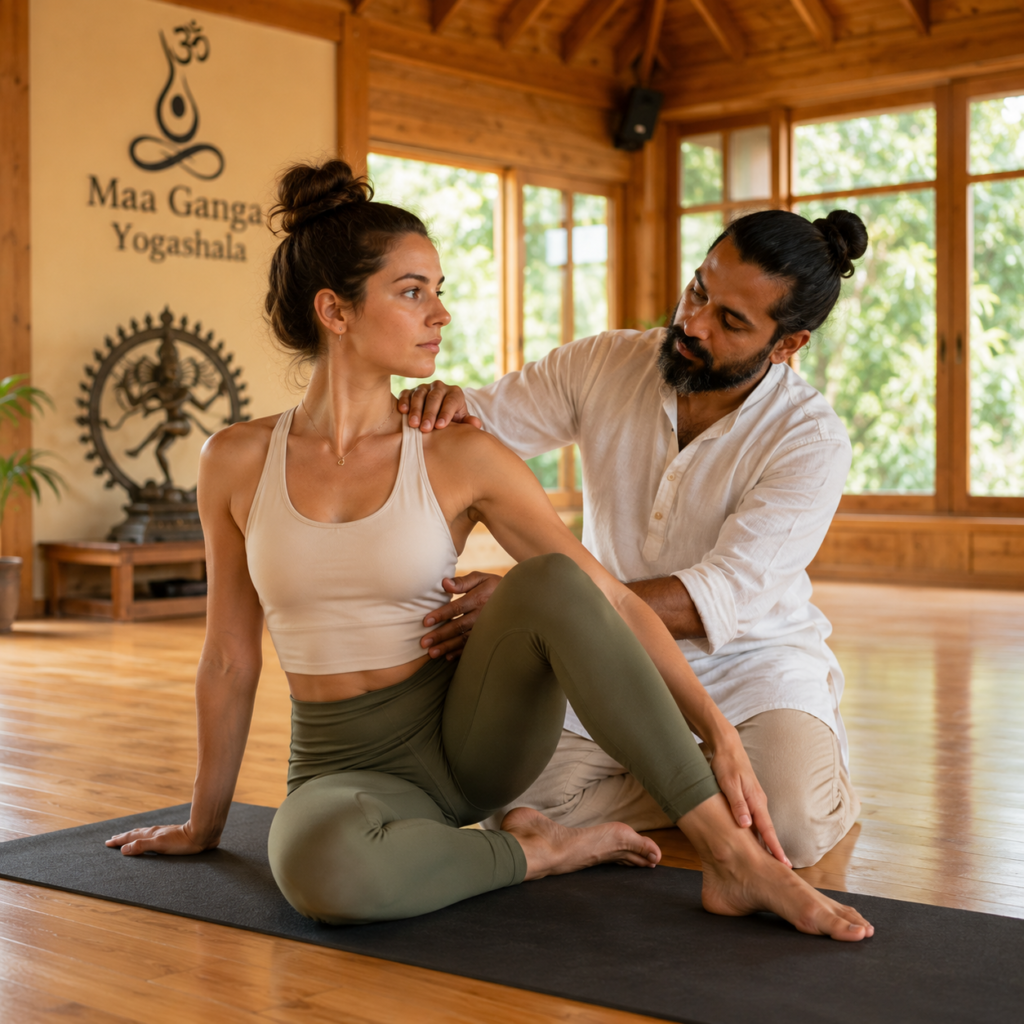
If you’re considering training deeply in Rishikesh, Maa Ganga Yogashala uniquely offers traditional, highly personalized expert instruction designed to safely elevate your personal practice instantly.
You can easily explore our core philosophy and welcoming space directly on our home page.
For those actively seeking a highly focused short immersion to perfect these complex foundational techniques safely, our 5-Days Yoga Retreat in Rishikesh provides the truly ideal structured environment to unplug and focus entirely inward.
FAQs About Internal Energy Locks
How long does it truly take to safely master these techniques?
True mastery is absolutely a lifelong, dedicated journey. You can confidently learn the basic physical engagements within a few short weeks under an expert teacher. Refining the highly subtle energetic flow naturally takes many years of highly consistent, daily effort.
Are these powerful locks safe for absolutely anyone to practice?
Deep breath retentions and intense abdominal vacuums are strictly contraindicated for pregnancy, high blood pressure, and heart disease. Always consult your personal healthcare professional and carefully inform your instructor of any prior conditions before beginning.
Why do I suddenly feel highly emotional when practicing the abdominal lock?
The sensitive abdominal region heavily stores a massive amount of hidden emotional tension and unprocessed deep stress. Releasing this precise area frequently causes safely trapped emotions to instantly surface. Gentle practices like our expert Sound Healing sessions are incredibly beneficial for smoothly processing these deep releases safely.
Do I specifically need a formal certification to learn these complex tools?
No, you absolutely do not need to be a formal teacher to benefit. However, structured programs provide immense necessary discipline. Exploring if Yoga Alliance Certification Worth It? can successfully help you definitively decide your perfect path forward.
Conclusion and Your True Path Forward
Integrating bandhas yoga types how to practice successfully into your daily life is a highly profound commitment to your total physical and spiritual continuous evolution.
These incredible internal seals are the brilliant secret architecture that safely transforms a standard physical routine into a deeply powerful, awakening moving meditation.
Remember constantly that this beautiful journey requires immense patience, deep self-compassion, and highly qualified expert guidance. Honor your unique physical body and respect your delicate breath entirely.
Ready to begin? Explore our highly comprehensive 200-Hour Yoga Teacher Training in Rishikesh and take the very first step today.