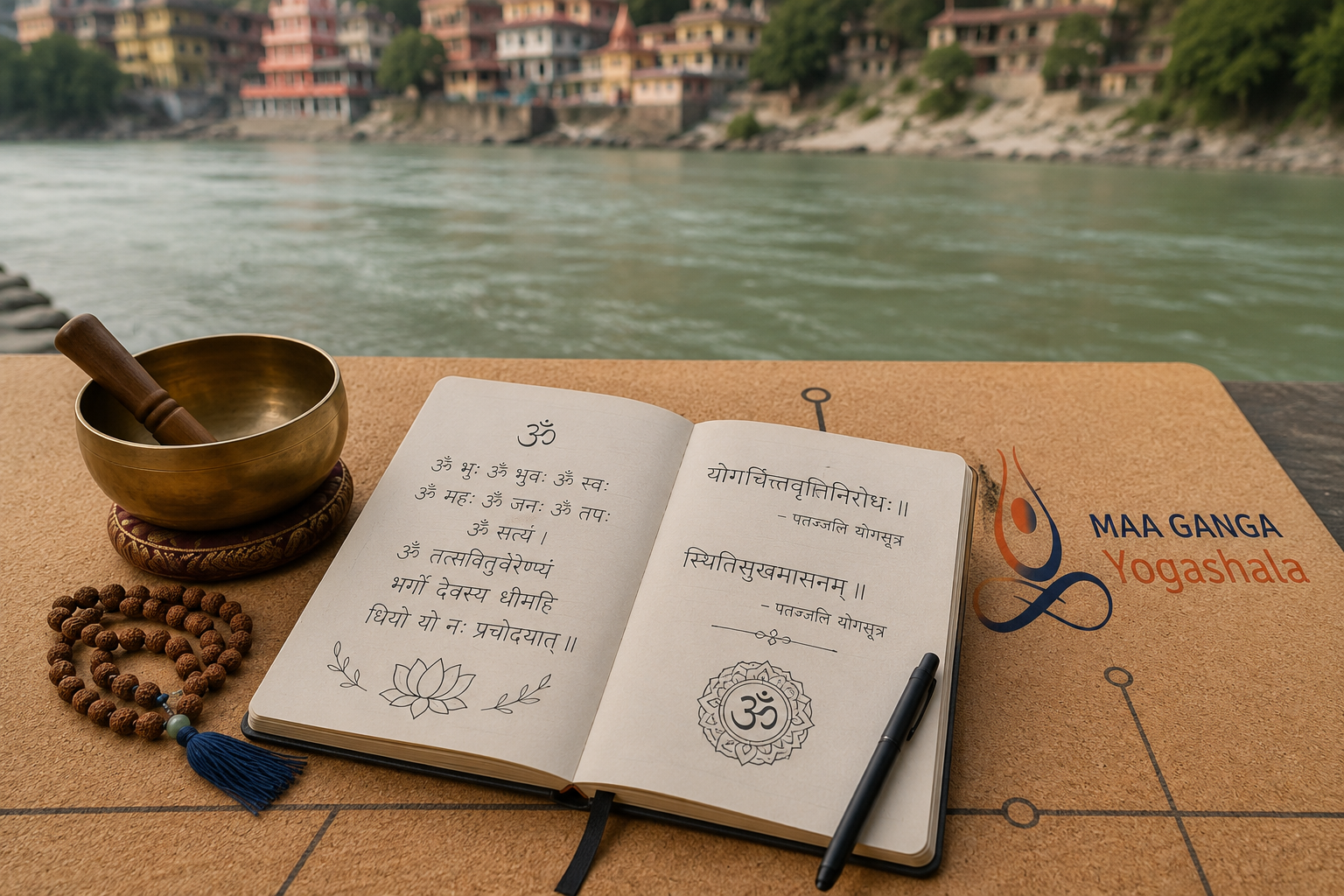
Sanskrit Yoga Teacher Training Essential Terms: The Ultimate Guide
Sanskrit yoga teacher training essential terms can feel like a completely new language when you first step onto the mat as a guide. Have you ever stumbled over a pose name, secretly hoping your students did not notice the hesitation in your voice?
You are not alone in this experience. Every new teacher faces the hurdle of memorizing ancient vocabulary while simultaneously trying to remember sequencing, alignment, and breath cues.
Learning this language is not about sounding impressive or complicated to your students. It is about connecting to the deep, historical roots of the practice and communicating with clarity.
When you understand the literal translation of a posture, teaching it becomes incredibly intuitive. The names of the poses actually tell you exactly what the body should be doing.
This comprehensive guide will break down the exact vocabulary you need to confidently lead a room. You will learn to decode prefixes, suffixes, and philosophical concepts without feeling overwhelmed.
By the end of this breakdown, you will view this ancient language not as a barrier, but as your greatest teaching tool. Let us begin building your confidence right now.
Why Sanskrit Yoga Teacher Training Essential Terms Matter
You might wonder why you cannot just use English names for every posture and call it a day. While using your native language is perfectly fine for beginners, knowing the traditional names offers undeniable benefits.
First, Sanskrit provides a universal standard across the global yoga community. If you travel to another country or attend a workshop with an international teacher, these terms remain consistent.
The Yoga Alliance sets specific standards for educational curriculums, and understanding this terminology is a foundational requirement for any certified program.
Beyond standardization, Sanskrit is considered a vibrational language. The sounds and syllables are designed to resonate with specific energetic frequencies in the physical and subtle bodies.
Speaking these words aloud actually alters the energy of the room you are teaching in. It shifts the atmosphere from a standard fitness class into a dedicated spiritual practice.
If you want to read more about how language shapes the classroom experience, check out our guide on 100 Hour YTT Language of Instruction India: 7 Best Facts.
Ultimately, using these terms honors the cultural origins of the discipline. It shows respect for the lineage of teachers who preserved these teachings for thousands of years.
The Foundational Roots of Traditional Yoga Language
Before you memorize specific poses, you must understand the core concepts that define the practice itself. These foundational words will appear repeatedly in yogic texts and lectures.
The word Yoga itself comes from the root word Yuj, which translates to “to yoke,” “to attach,” or “to unite.” It signifies the union of the individual consciousness with universal consciousness.
Asana simply means “seat” or “posture.” Historically, it referred exclusively to the seated position held during meditation before evolving to encompass the physical shapes we practice today.
Understanding the difference between just moving the body and truly practicing union is vital. This distinction is exactly what separates our discipline from standard modern workouts.
To explore this distinction further, read our comprehensive Yoga vs Stretching Difference Benefits: Ultimate Breakdown.
Prana refers to life force energy, breath, or vitality. It is the invisible current that animates the physical body and sustains the mind.
Guru is a term you will hear often. Gu means darkness, and Ru means light; therefore, a Guru is a teacher who leads a student from the darkness of ignorance into the light of understanding.
Decoding Asana Names Meaning: The Suffixes and Prefixes
Mastering Sanskrit yoga teacher training essential terms becomes effortless when you realize the language works like building blocks. You do not have to memorize every single pose if you know the root words.
Most physical postures end with the suffix -asana. Once you identify the prefixes attached to it, the posture explains itself entirely.
Let us look at numbers first. Eka means one, Dvi means two, Tri means three, and Catur means four. Ashta means eight.
When you hear Trikonasana, you know Tri means three and Kona means angle. Therefore, it is the Three-Angle Posture, commonly known as Triangle Pose.
Similarly, Caturanga Dandasana breaks down into Catur (four), Anga (limb), and Danda (staff). It is the Four-Limbed Staff Pose.
If you want to master these foundational alignment cues in a professional environment, our 200-Hour Yoga Teacher Training in Rishikesh provides extensive daily posture clinics.
Now, let us examine direction and position. Adho means downward, and Urdhva means upward.
Supta means reclining or sleeping, while Utthita means extended. Parivrtta means revolved or twisted, and Ardha means half.
When you cue Ardha Chandrasana, you are asking for Ardha (half) and Chandra (moon). When you cue Supta Baddha Konasana, you want a reclining, bound-angle posture.
Recognizing these patterns instantly cuts your memorization time in half. You will begin to hear the instructions hidden directly inside the vocabulary.
Essential Body Part Terminology for Precise Cues
To guide students safely into alignment, knowing the basic Sanskrit for yogis regarding human anatomy is incredibly helpful. These words appear frequently in posture names.
Mukha translates to face. You see this in Adho Mukha Svanasana (Downward-Facing Dog) and Urdhva Mukha Svanasana (Upward-Facing Dog).
The Ministry of Ayush in India consistently emphasizes the precision of these traditional names in preserving the authenticity of therapeutic practices.
Sirsa means head. This is the root of Sirsasana, the Headstand.
Pada means foot or leg. Padmasana is Lotus Pose (though Padma means lotus, Pada refers to the feet placed on the thighs). You also see it in Eka Pada Rajakapotasana (One-Legged King Pigeon Pose).
Hasta means hand. Utthita Hasta Padangusthasana translates literally to Extended Hand-to-Big-Toe Pose.
Janu means knee. Janu Sirsasana is the Head-to-Knee Pose, a common seated forward fold that stretches the hamstrings and opens the hips.
Angustha means big toe. When you instruct students to grab their big toe with their peace fingers, you are utilizing an Angustha grip.
By sprinkling these anatomical terms into your cues, you subliminally educate your students while keeping them focused on their physical alignment.
Nature and Animal Postures in Your Sequencing
The ancient yogis observed the natural world around them and mirrored those shapes with their bodies. This is why so much of our vocabulary is based on flora and fauna.
Vriksha means tree. Vrikshasana asks the practitioner to ground their foot like a root and extend their arms like branches.
Surya means sun, and Chandra means moon. These celestial bodies represent the masculine (solar/active) and feminine (lunar/receptive) energies within us.
Animal names are incredibly prevalent. Svana means dog, Bidal means cat, and Go means cow.
Matsya is a fish, leading to Matsyasana (Fish Pose). Kurma is a tortoise, giving us the deep forward fold Kurmasana.
Kapot translates to pigeon, Bheka is a frog, and Garuda is the mythical eagle.
Ustra means camel, the inspiration for Ustrasana, a powerful heart-opening backbend. Bhujanga means cobra or serpent, giving us the foundational backbend Bhujangasana.
Using the English animal names makes classes accessible, but weaving in the Sanskrit equivalents connects your students to the deep reverence early practitioners had for nature.
Pranayama Vocabulary Guide and Energy Systems
Your role as an instructor goes far beyond guiding physical movement. You must also direct the unseen vital energy within the room.
Ayama means to extend or draw out. Therefore, Pranayama is the extension and control of the life force, usually practiced through intentional breathing techniques.
To understand why breath control is a non-negotiable skill for aspiring guides, review our breakdown on Pranayama Teacher Training Importance: 7 Proven Realities.
Nadi refers to an energy channel in the subtle body. Tradition states there are 72,000 nadis, but the three most important are the Sushumna (central), Ida (left/lunar), and Pingala (right/solar).
Chakra means wheel or vortex. These are the seven primary energy centers aligned along the spine, from the root to the crown of the head.
Learning to sequence classes around these specific energy centers is a profound skill. You can explore our dedicated practices for this through our Chakra Balancing program.
Bandha translates to lock or bind. These are internal physical engagements that seal and direct energy within the body.
Mula Bandha is the root lock, located at the pelvic floor. Uddiyana Bandha is the abdominal lock, and Jalandhara Bandha is the throat lock.
When you combine all three simultaneously, it is called Maha Bandha, or the great lock. Teaching students to engage these subtle locks transforms a physical stretch into a powerful energetic experience.
Yoga Philosophy Terminology and the Eight Limbs
To truly embody the practice, you must be familiar with the philosophical framework laid out by Patanjali in the Yoga Sutras. The system is built on Ashtanga, meaning eight limbs.
Yama refers to universal morality or ethical observances. These are external disciplines concerning how we interact with the world around us.
The five Yamas are Ahimsa (non-violence), Satya (truthfulness), Asteya (non-stealing), Brahmacharya (right use of energy/celibacy), and Aparigraha (non-greed).
Niyama refers to personal observances and internal disciplines. These govern our relationship with ourselves.
The five Niyamas are Saucha (purity), Santosha (contentment), Tapas (discipline/heat), Svadhyaya (self-study), and Ishvara Pranidhana (surrender to a higher power).
The remaining limbs include Asana (posture), Pranayama (breath control), and Pratyahara (withdrawal of the senses).
The final three limbs are the internal practices of the mind: Dharana (focused concentration), Dhyana (meditative absorption), and Samadhi (bliss or enlightenment).
Introducing these philosophical concepts during your classes elevating your teaching. It provides students with mental and emotional tools to use long after they roll up their mats.
Sequencing Terms You Will Use Daily
When planning your classes, certain structural terms will dictate the flow and focus of your offering. Knowing these ensures you communicate the style of your class clearly.
Vinyasa is incredibly common, meaning “to place in a special way.” It refers to linking movement with breath in a continuous, flowing sequence.
Surya Namaskar translates to Sun Salutation. This is the foundational warm-up sequence used to build heat and connect the breath to the body’s movement.
For a step-by-step guide on how to string these elements together effectively, read our 7 Best Ways to Create Yoga Sequence After Teacher Training.
Drishti means focused gaze. Directing your students’ eyes to a specific, unmoving point helps stabilize their physical balance and quiet their wandering minds.
Savasana is the Corpse Pose. It is arguably the most important posture of the entire practice, designed for complete physical and mental relaxation.
Namaste is the traditional closing greeting. It loosely translates to “the divine light in me honors the divine light in you,” serving as a perfect seal of mutual respect at the end of a session.
Why Rishikesh? / Why This Matters
Memorizing Sanskrit yoga teacher training essential terms from a textbook in your living room is one thing, but hearing them spoken in their birthplace is entirely different.
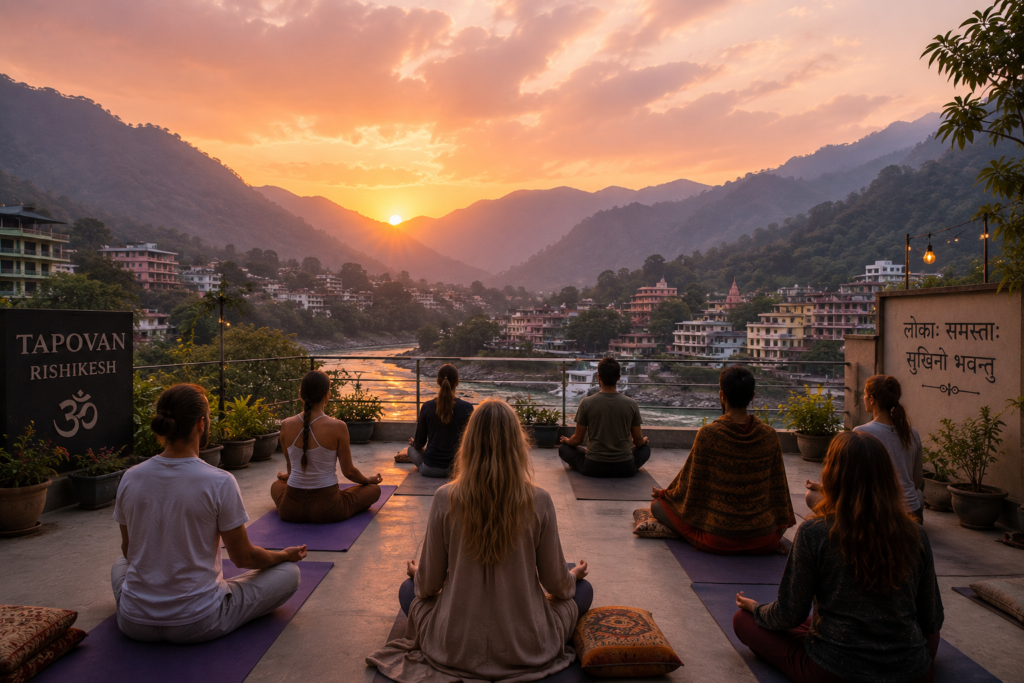
Rishikesh is universally recognized as the Yoga Capital of the World. Here, the language is not a dead academic exercise; it is a living, breathing part of daily life.
When you study in the shadow of the Himalayas and alongside the sacred Ganges river, the vocabulary takes on a profound resonance. The environment itself reinforces your learning.
You hear the mantras chanted in the temples, the names of poses used by local practitioners, and the philosophical concepts discussed casually over tea.
This total immersion bypasses the analytical brain and allows the language to settle directly into your heart. You stop trying to memorize and simply begin to absorb.
Learning at the source gives your teaching voice an undeniable weight of authenticity. Your students will feel the depth of your understanding every time you speak.
Begin Your Journey at the Source
If you are considering taking your practice to the next level in Rishikesh, we offer an authentic environment to master these concepts deeply.
Our programs at https://maagangayogashala.com/ are designed to seamlessly integrate traditional philosophy, anatomy, and vocabulary into practical teaching skills.
We ensure that every student leaves with the confidence to use this beautiful, ancient language respectfully and accurately in their own classrooms.
Frequently Asked Questions
Do I need to be fluent in Sanskrit to be a good teacher?
Absolutely not. You do not need conversational fluency. You only need a firm grasp of the specific vocabulary related to postures, breathwork, and philosophy to teach effectively.
How can I memorize these terms faster?
Focus on the root words, prefixes, and suffixes rather than memorizing entire names at once. Flashcards help, but the best method is simply using the terms aloud during your personal home practice.
Should I use English or Sanskrit in my classes?
A balanced approach is usually best. Introduce the traditional name first, immediately followed by the English translation. Over time, your regular students will naturally learn the ancient terms alongside you.
Are these names standard across all styles?
Mostly, yes. While some specific lineages might have slight variations in how a posture is named or executed, the foundational roots and primary posture names remain remarkably consistent globally.
Conclusion and Your Next Steps
Mastering Sanskrit yoga teacher training essential terms is a journey of respect, dedication, and patience. It transforms you from a fitness instructor into a true guardian of an ancient lineage.
Do not let the unfamiliar syllables intimidate you. Take it one word, one prefix, and one breath at a time until the language feels like second nature.
When you are ready to immerse yourself fully and find your authentic teaching voice, we are here to guide you every step of the way.
Ready to begin? Explore our 100-Hour Yoga Teacher Training in Rishikesh and take the first transformative step today.