Teaching Online Yoga Classes After Certification: A Practical Starter Guide
Introduction
Teaching online yoga classes after certification can feel like a strange jump: one week you are receiving feedback in a training room, and the next you are expected to guide students through a screen with confidence. The good news is that you do not need a huge following, expensive studio, or perfect camera setup to begin.
What you do need is a safe teaching structure, a clear niche, reliable technology, and enough practice to make your online classes feel personal rather than mechanical. Your certification gives you a foundation, but teaching online asks you to adapt that foundation to a different environment.
This guide walks you through what changes when you move from in-person teaching to virtual yoga, how to design your first classes, what equipment actually matters, how to find your first students, and how to build a sustainable routine without pretending that certification automatically creates a business.
Teaching online yoga classes after certification: what changes?
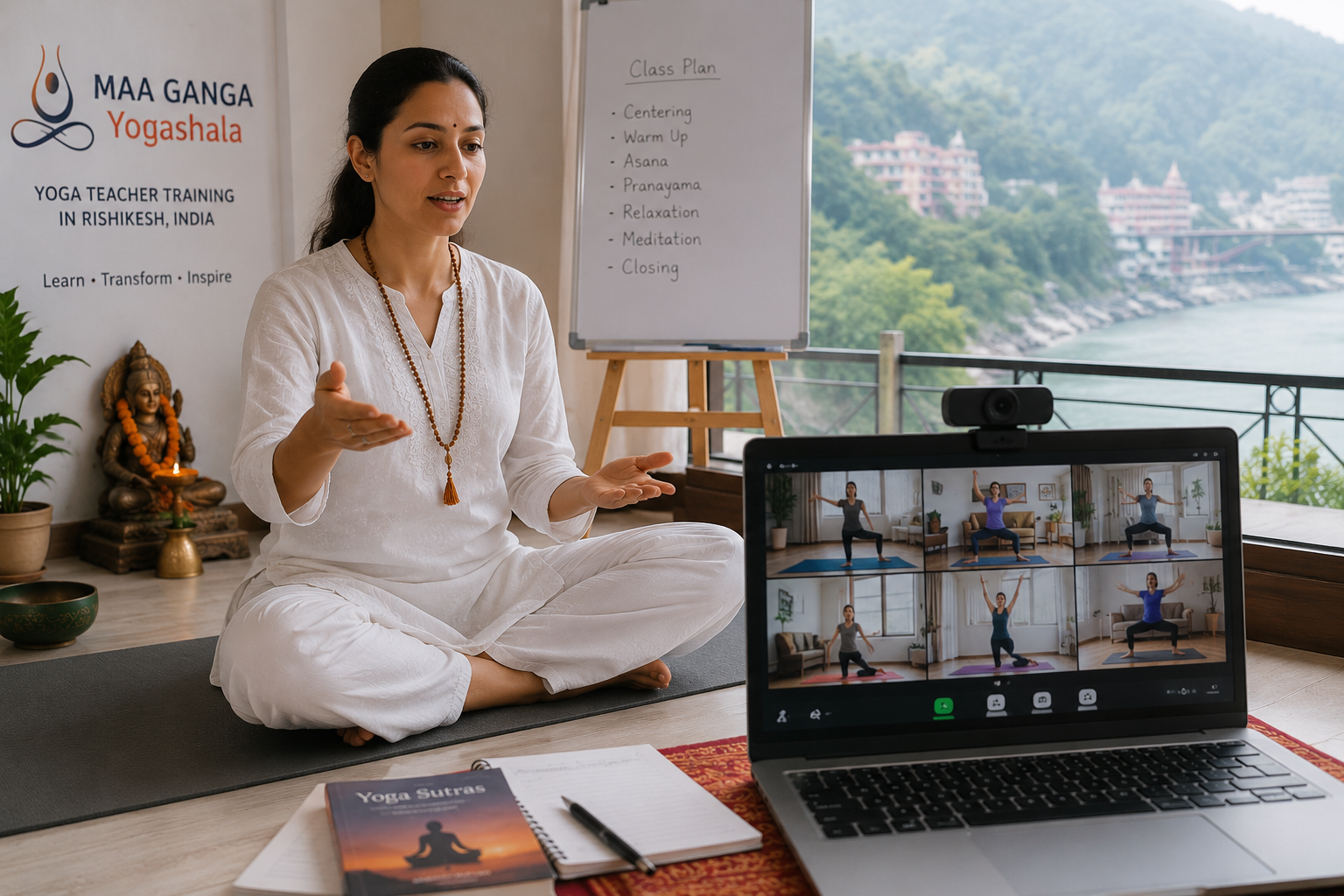
Teaching online is not simply teaching the same class through Zoom or another video platform. In a physical room, you can see a student’s posture from different angles, notice hesitation, adjust your voice according to the group’s energy, and physically demonstrate where appropriate. Online, your communication has to carry more of the teaching load.
Your instructions therefore need to be more precise. Instead of saying, “Come into the pose,” you may need to explain where the feet go, what the hands are doing, which direction the knees face, and what sensation should be avoided. You also need to give students time to process your cues because audio delay and screen limitations can make rapid instruction confusing.
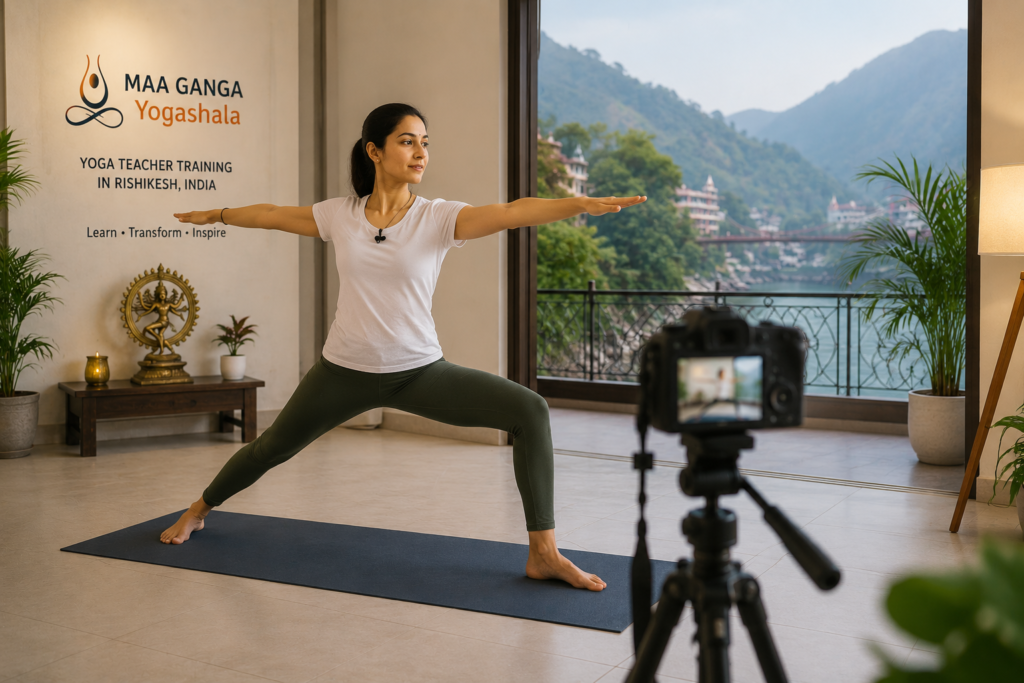
Your camera position matters too. A close head-and-shoulders frame is fine for a conversation, but it is useless when you are teaching standing postures. A wide, stable shot that shows your whole body is usually more practical.
Before you teach publicly, test your class with one or two people. Ask them whether they could hear every cue, see your demonstrations, understand transitions, and tell when they should rest. This small rehearsal can expose problems that certification practice cannot.
If you want to understand the broader professional responsibilities of a yoga teacher, review the Yoga Alliance resources alongside your school’s training guidance.
How to build your first online yoga class
Your first online class should be simpler than your most ambitious in-person class. The goal is not to prove how much you know. The goal is to create a session that a student can follow safely without getting lost.
Start with one clear outcome. You might design a 45-minute beginner mobility class, a gentle morning practice, a foundational Hatha session, or a short class for people who sit at a desk for long periods. A narrow promise makes your teaching easier to understand and your marketing easier to write.
A practical class structure
A useful beginner-friendly structure could look like this:
- 5 minutes: arrival, breathing, and intention
- 8–10 minutes: warm-up and joint preparation
- 20 minutes: main sequence
- 5 minutes: slower floor work or gentle stretching
- 5–7 minutes: relaxation or meditation
Keep transitions predictable. Online students cannot always see what you are doing if they need to look away from the screen to adjust a mat or prop.
Prepare verbal alternatives before the class begins. If a student cannot kneel comfortably, know what option you will offer. If someone has limited balance, have a wall-supported variation ready. Avoid improvising complicated modifications while several people are watching you.
You should also decide when you will demonstrate and when you will watch. Demonstrating every movement for the entire class can make it difficult to observe students. Demonstrate clearly, then move out of the pose when you need to assess the group.
A good online teacher learns to speak less when students need space to practice and more when they need orientation. That rhythm takes rehearsal.
Online yoga teaching setup: what you actually need
You can start without building a studio that looks like a production set. Spend money first on reliability, not decoration.
A practical starter setup includes:
- A phone, tablet, or camera that produces a clear image
- A stable tripod or stand
- A microphone or headset that keeps your voice understandable
- Consistent lighting, preferably facing you rather than behind you
- A quiet room with enough floor space for full-body framing
- A dependable internet connection
- A backup plan for power or connectivity problems
Sound deserves special attention. Students can forgive an ordinary-looking room. They will struggle with a class where your voice keeps disappearing.
Before each session, check your battery, storage, camera angle, microphone, internet connection, and the position of your mat. Put notifications on silent. Keep water, props, and notes within reach.
You should also think about privacy and boundaries. Do not assume that every student wants a class recorded. If you plan to record, explain how the recording will be used, who can access it, and how long you will keep it.
If you incorporate relaxation or complementary practices into your work, learn their scope carefully rather than presenting them as medical treatment. For general information about traditional systems and wellness practices in India, you can consult the Ministry of Ayush.
How to find your first online yoga students
The hardest part after certification is often not teaching. It is getting enough people to give you a chance.
Do not begin with the vague message, “I teach yoga online.” Give people a reason to choose your class. Your offer could be a beginner Hatha series, a morning flexibility class, a gentle practice for office workers, or a small-group foundational program.
Your first students may come from people who already know you. Former classmates, friends, colleagues, local contacts, retreat connections, and people who have attended your practice sessions can be a realistic starting point.
Offer a short trial or introductory session when appropriate, but do not train your audience to expect everything for free. A free session should have a purpose: gathering feedback, testing your format, or introducing your teaching style.
Build proof before chasing followers
You do not need thousands of social-media followers. You need evidence that your teaching helps people.
Ask early students for specific feedback:
- Was the class easy to follow?
- Were the instructions clear?
- Did the pace feel appropriate?
- Did they feel comfortable asking questions?
- What would make them attend again?
With permission, turn useful feedback into testimonials. Keep them specific and honest. “The class was amazing” is weaker than a statement explaining that the student finally understood a particular alignment cue or found the pacing suitable for a beginner.
Create a simple profile that explains who you teach, what style you offer, class length, schedule, price, and how someone can contact you. If your page requires ten clicks before someone can understand your offer, you are making the buying decision harder than necessary.
For practical ideas on positioning and promoting yourself, see our guide on how to market yourself as a yoga teacher.
Pricing, scheduling, and building a sustainable routine
Certification does not tell you what to charge. Your price should reflect your experience, class format, group size, preparation time, market, and the value of the service you actually provide.
Avoid copying another teacher’s price without understanding their model. A private session, a ten-person live class, and a recorded video library are different products.
For your first paid offering, keep the model simple. You might run a fixed four-week series rather than accepting random bookings every day. A series gives students a reason to stay and gives you a clearer teaching progression.
For example, week one could establish breath, movement principles, and foundational postures. Week two could introduce simple standing sequences. Week three could build coordination and transitions. Week four could combine the skills into a complete practice.
Scheduling also matters. If you teach international students, time zones become part of your product. A class at 7 a.m. in India may be convenient for one audience and impossible for another. Choose a target market first, then build a schedule around it.
Keep records of attendance, payments, cancellations, student questions, and recurring technical problems. These details help you improve your operation instead of relying on memory.
You should also decide your cancellation and refund policy before a problem occurs. Clear rules feel more professional than negotiating every situation individually.
If your long-term goal is to teach professionally, your education should not stop at the certificate. Our 200-hour yoga teacher training in Rishikesh can be a relevant foundation if you still need comprehensive teacher training.
Why Rishikesh matters when you want to teach globally
You can teach an online student from almost anywhere, but the environment where you trained can influence the depth of your preparation.
Rishikesh offers a setting where yoga is taught alongside philosophy, anatomy, sequencing, meditation, pranayama, and the discipline of daily practice. For you as a trainee, that combination can be useful because online teaching demands more than memorizing postures.
The real advantage is not the scenery. It is the chance to practise teaching under observation and receive corrections before you begin charging strangers online.
That distinction matters. A beautiful location cannot compensate for weak cueing, poor sequencing, or limited understanding of safety. Likewise, a certificate alone does not guarantee that you can manage a live class confidently.
If you are considering training in Rishikesh, our 100-hour yoga teacher training course in Rishikesh may suit you if you want a shorter, focused training pathway.
You can also explore our yoga teacher ethics training resource to think beyond teaching technique and consider boundaries, responsibility, communication, and professional conduct.
A practical 30-day plan to start teaching online
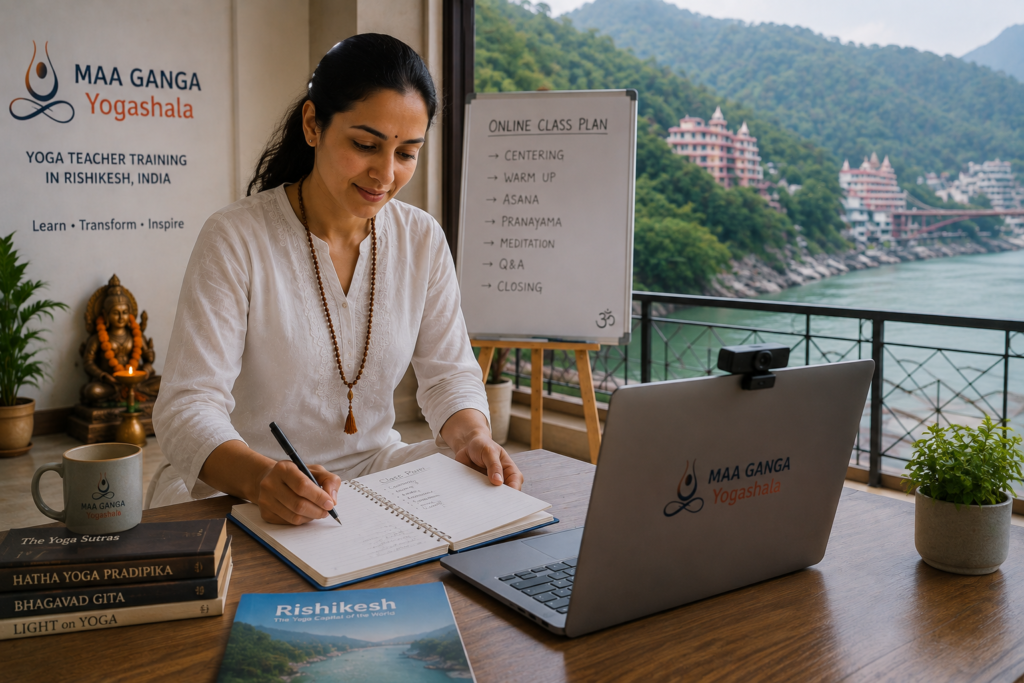
You do not need to wait until your website, branding, camera, and social media are perfect. Give yourself a defined launch period.
Days 1–7: choose your offer.
Select one audience, one style, one class length, and one realistic schedule. Write a short description of what students will get.
Days 8–14: rehearse.
Teach at least three complete practice classes. Record yourself privately. Watch the recording and look for filler words, unclear cues, rushed transitions, poor camera framing, and moments when your voice becomes difficult to hear.
Days 15–21: run a small pilot.
Invite a limited number of participants. Ask for structured feedback after every class. Do not change ten things at once; fix the most important problems first.
Days 22–30: launch a paid series.
Set a price, payment method, cancellation policy, class schedule, and registration process. Keep the first cohort small enough that you can observe students and improve the experience.
At the end of the month, review three numbers: attendance, repeat bookings, and referrals. Follower counts can be useful, but they do not tell you whether your teaching business is working.
If you are unsure how your first class should feel, our guide to teaching your first yoga class with confidence can help you prepare for the teaching side before you focus heavily on promotion.
Soft CTA: prepare for online teaching with a stronger foundation
If you want to teach online with more confidence, we offer structured yoga teacher training in Rishikesh through Maa Ganga Yogashala, where you can build teaching, sequencing, and foundational yoga skills before taking them to a virtual audience: explore Maa Ganga Yogashala.
FAQs
Can you teach yoga online after completing a TTC?
Yes, you can teach online after completing appropriate teacher training, but certification is only the starting point. You still need practical teaching ability, safe sequencing, clear communication, student screening, and an understanding of your professional boundaries.
Is online yoga teaching harder than teaching in person?
Neither format is automatically harder. They require different skills. Online teaching gives you reach and flexibility, but you lose some physical-room visibility and must rely heavily on verbal cues, camera positioning, and technology.
Do you need expensive equipment to teach online yoga?
No. A reliable camera, stable tripod, clear audio, suitable lighting, enough floor space, and dependable internet are more important than expensive equipment. Upgrade your setup when a specific limitation starts affecting student experience.
How can you get students without a large social-media following?
Start with a clearly defined offer and your existing network. Run a small pilot, collect useful feedback, build genuine testimonials with permission, and ask satisfied students for referrals. Consistent teaching quality is more valuable than chasing follower numbers.
Should you teach live classes or sell recorded yoga videos?
Start with the format you can deliver well. Live classes allow interaction and immediate feedback, which can help you improve as a new teacher. Recorded content can scale more easily, but it requires stronger production, editing, discoverability, and content strategy.
Conclusion: turn your certification into real teaching experience
Teaching online yoga classes after certification is possible, but do not confuse having a certificate with being ready to build a teaching practice. Your next step is to turn knowledge into repeatable skills: clear cues, sensible sequencing, student communication, reliable technology, and a simple offer that people understand.
Start small. Teach a focused class. Observe what students struggle with. Improve the next session. Then build from there.
If you still need a stronger professional foundation, explore our 200-hour Yoga Teacher Training in Rishikesh and prepare yourself to teach with greater structure and confidence. When you are ready, take what you learn in Rishikesh beyond the classroom and into your online teaching practice.