Yoga Adjustments Assists Teacher Training: Everything You Need to Know
Yoga adjustments assists teacher training programs form the essential bridge between memorizing poses and truly guiding students safely. Have you ever wondered why a simple, gentle touch from an experienced instructor instantly fixes your downward dog? That precise moment of physical feedback is an art form.
Learning to guide bodies safely requires immense trust, deep anatomical knowledge, and unwavering confidence. When you step up to the front of the mat, your students look to you for physical and energetic support. They rely on your expertise to prevent injuries.
Mastering the art of touch elevates your instruction from average to extraordinary. It allows you to communicate alignment principles without speaking a single word. In this guide, you will learn exactly what goes into mastering these physical cues.
Why Yoga Adjustments Assists Teacher Training Matters
The modern studio environment demands highly skilled instructors who understand human biomechanics. You cannot rely solely on verbal cues when a room is filled with varying levels of body awareness. Physical guidance provides immediate clarity.
Through structured education, you learn how to approach different body types safely. You discover how much pressure to apply, where to place your hands, and when to step away. This knowledge separates confident teachers from hesitant ones.
Organizations like Yoga Alliance set strict standards for alignment and biomechanics education. By adhering to these global standards, you guarantee your teaching methods remain professional, ethical, and universally respected.
Gaining this expertise completely shifts your internal dialogue. Instead of worrying about doing something wrong, you step into the studio knowing exactly how to support your students’ growth.
The Core Difference Between Adjusting and Assisting
Understanding the distinction between these two concepts shapes your entire approach to physical guidance. An adjustment corrects a misalignment that could potentially lead to injury. It fixes unsafe mechanical patterns.
An assist, on the other hand, guides a student deeper into a posture they are already performing safely. It provides stability, energetic grounding, or gentle lengthening. Knowing when to use which is a crucial teaching skill.
For example, realigning a student’s front knee in Warrior II to protect their joint is an adjustment. Pressing gently on their back thigh to help them ground deeper into the same pose is an assist.
Recognizing these nuances ensures your intentions are always clear. It helps you prioritize safety first, moving toward depth and exploration only when the foundational structure is perfectly secure.
Building Confidence Through Hands-On Practice
Stepping into another person’s personal space can feel intimidating when you first start teaching. It is entirely normal to feel nervous about applying too much pressure or moving a student incorrectly.
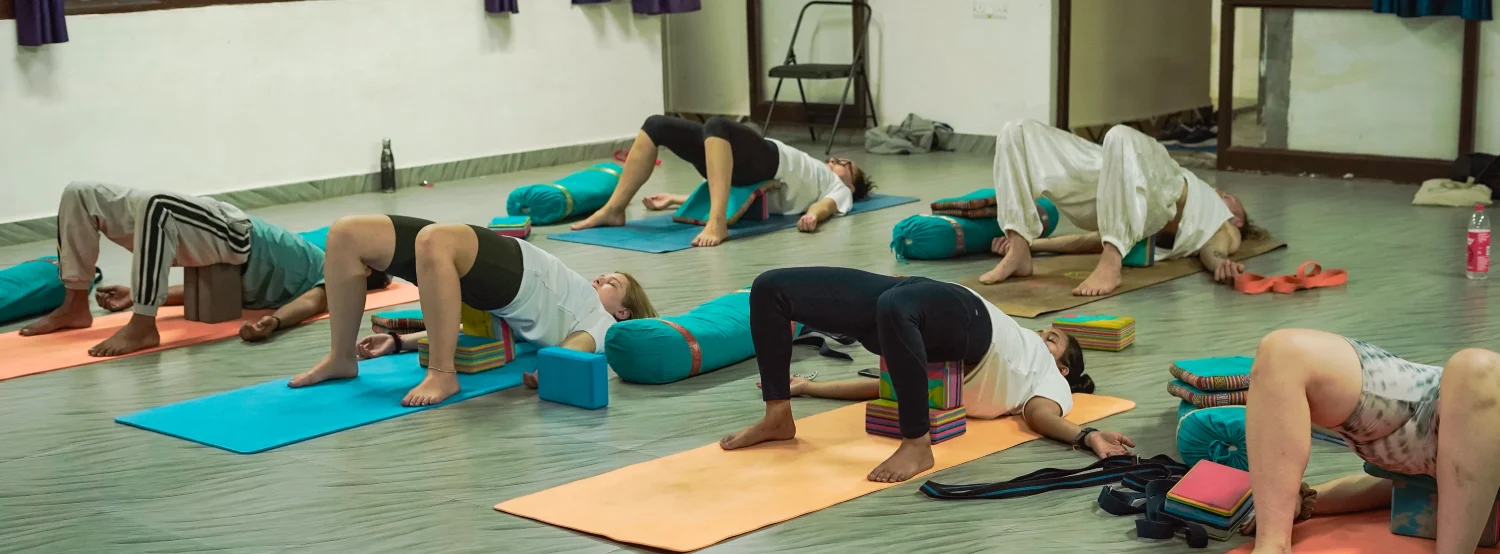
The only way to conquer this fear is through consistent, supervised repetition. Working with diverse body types during your education helps you build tactile memory. You learn how different bones, muscles, and fascia react to touch.
Building new yoga teacher confidence after training relies heavily on this hands-on practice. The more you physically guide your peers in a supportive environment, the faster your hesitation dissolves.
You will quickly realize that firm, confident touch is much more comforting to a student than a light, nervous one. Confidence in your hands translates to trust in your students’ minds.
Safety Protocols and the Ethics of Touch
Physical guidance requires a pristine ethical framework. Consent is the absolute baseline of any hands-on practice. You must always establish clear communication before touching a student.
Many modern studios use consent cards, allowing students to silently opt in or out of physical contact. If cards are unavailable, learning how to ask for verbal consent clearly and respectfully is mandatory.
Mastering yoga teacher ethics training 100 hour principles ensures you maintain professional boundaries at all times. It teaches you to read body language and recognize when a student feels uncomfortable, even if they said yes.
Never adjust a joint forcefully or pull a student into a deeper stretch. Your role is to offer structural support, not to force flexibility. Respect the natural limits of the nervous system.
Anatomy-Driven Corrections for Injury Prevention
You cannot safely adjust a posture if you do not understand the underlying anatomy. Knowing which muscles are engaging and which are stretching dictates where your hands should go.
For instance, understanding the shoulder girdle is non-negotiable before assisting downward-facing dog. You must know how external rotation of the upper arms creates space for the neck.
Research available through databases like PubMed constantly highlights the importance of biomechanical awareness in preventing sports and movement injuries. Applying evidence-based anatomy to your teaching protects both you and your class.
When your touch is guided by anatomical science rather than guesswork, your students progress safely. They develop functional strength and flexibility without compromising their joint integrity.
Breakdown: Adjusting Core Foundational Asanas
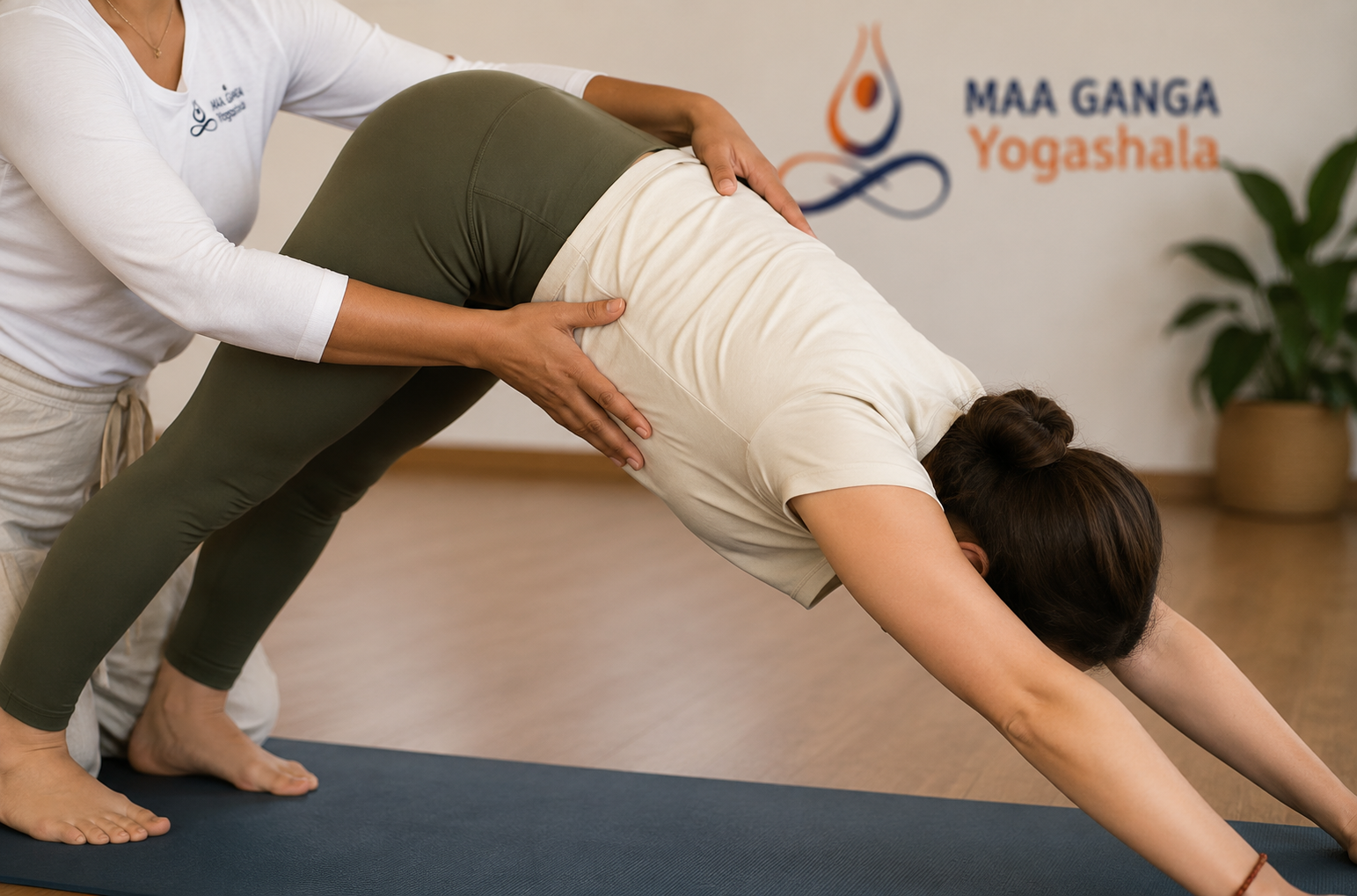
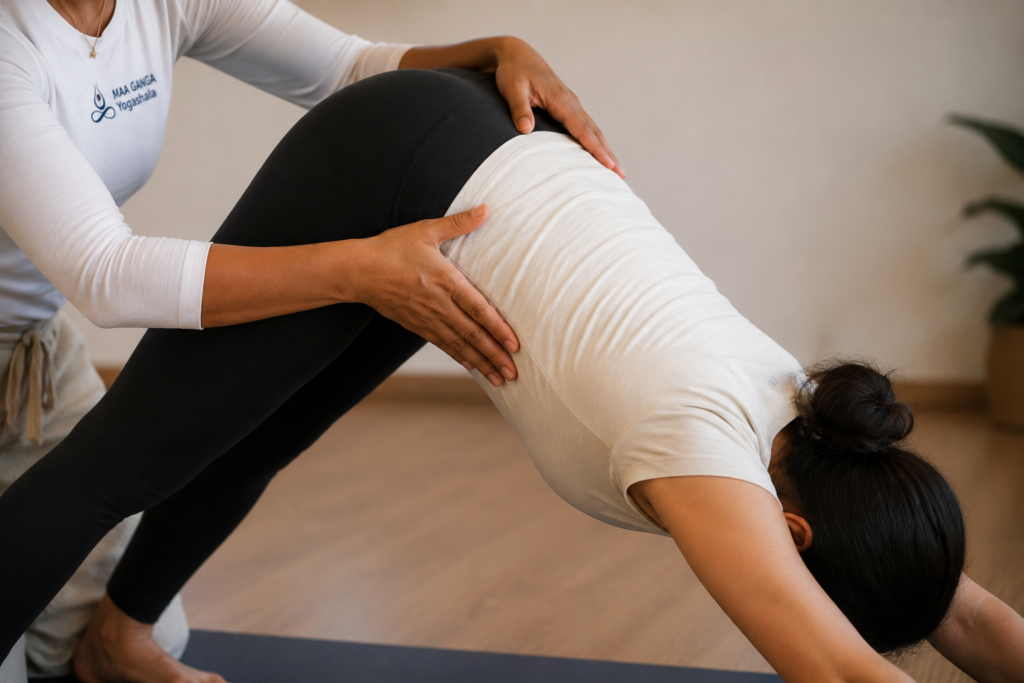
Let us look at how you might approach a few foundational poses. In Adho Mukha Svanasana (Downward Dog), a common assist involves standing in front of the student and gently pressing their hips up and back.
This traction relieves pressure from the wrists and elongates the spine. You must stabilize your own stance before applying pressure, ensuring your core supports your body weight.
In Trikonasana (Triangle Pose), students often collapse their side body. A highly effective assist involves gently drawing their top hip back while encouraging their bottom ribs to rotate forward.
During Savasana, a grounding assist—such as a gentle press on the shoulders or feet—calms the nervous system. These precise interventions require focus, steady breathing, and clear intention.
How Adjustments Enhance Yoga Class Sequencing
Your ability to offer physical guidance directly impacts how you structure your classes. When you know you can safely support students, you can sequence more complex peak poses.
Understanding yoga class sequencing principles teacher training allows you to map out where hands-on assistance will be most effective. You can plan your movement around the room strategically.
If you are teaching a challenging balance pose like Half-Moon, you can position yourself near students who need a physical anchor. Your sequence becomes a fluid dance between verbal cues and physical support.
This dynamic approach keeps your classes engaging and deeply supportive. It ensures nobody feels left behind during challenging transitions.
Reading Breath and Body Language Before Assisting
The breath is the ultimate indicator of a student’s internal state. Before you offer an assist, you must observe their breathing pattern. If their breath is shallow or held, they are in a state of stress.
Never push a student who is holding their breath deeper into a pose. Instead, offer a stabilizing touch and verbally cue them to exhale. Wait for their nervous system to relax.
Observing facial expressions and muscle tension is equally critical. Clenched jaws, shaking limbs, or darting eyes signal that the student needs a grounding adjustment, not a deepening one.
Your hands should always sync with the student’s breath. Apply pressure during their exhale to facilitate release, and hold steady during their inhale to provide an anchor.
Cultivating Your Unique Touch as an Instructor
No two instructors have the exact same style of physical guidance. Some teachers use a very firm, structural touch, while others prefer a lighter, energetic approach.
As you progress through your education, you will naturally discover what feels authentic to you. It takes time to find the exact balance between strength and softness in your hands.
Your unique touch becomes a signature part of your classes. Students will seek you out specifically because of how safe and supported they feel under your guidance.
Allow your intuition to develop alongside your mechanical knowledge. Trust your growing expertise and let your hands communicate the compassion you hold for your students.
Why Rishikesh? / Why This Matters
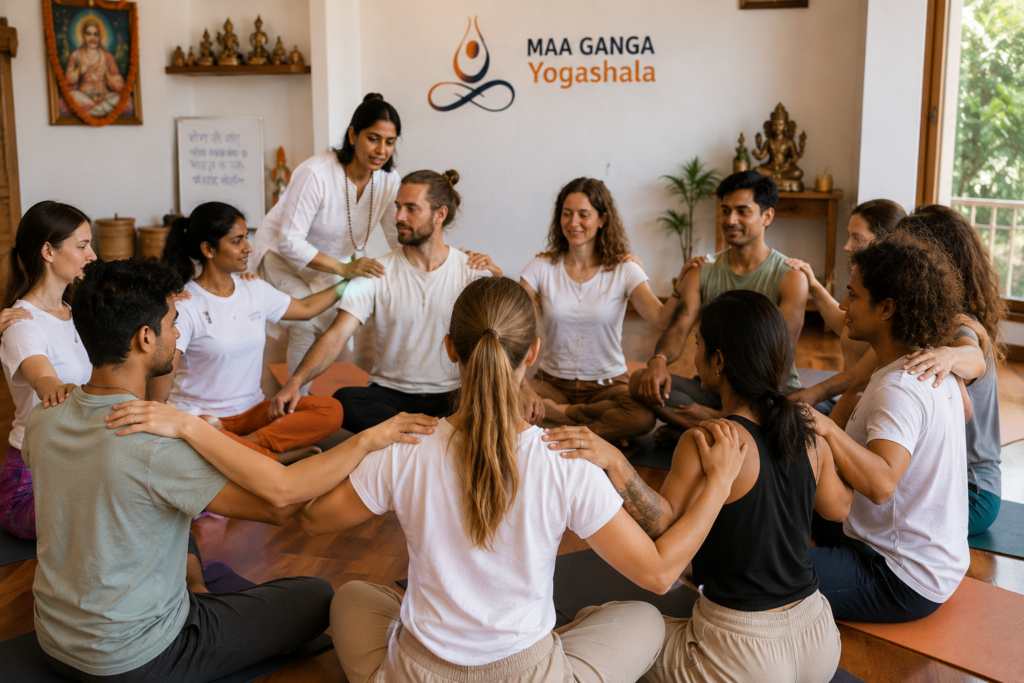
Learning these deeply personal skills requires the right environment. Rishikesh, known globally as the birthplace of yoga, offers an unmatched spiritual and educational atmosphere for this journey.
Practicing on the banks of the Ganga River grounds your nervous system, allowing you to absorb complex anatomical and ethical lessons with clarity. The immersion here is profound.
Finding the right accommodation during yoga teacher training Rishikesh ensures you have a peaceful sanctuary to rest after long days of hands-on practice. Comfort is vital for focus.
The deep roots of traditional instruction found here cannot be replicated in a standard Western studio. You learn the profound reverence for the physical vessel that traditional yoga commands.
Exploring Your Practice with Trusted Guidance
If you are considering training in Rishikesh, we highly recommend immersing yourself in an environment that prioritizes safety, ethics, and hands-on expertise.
Finding a school that aligns with these values makes all the difference in your educational journey. For those ready to begin their path, exploring a comprehensive 100-Hour Yoga Teacher Training in Rishikesh provides the perfect foundational step into the world of professional instruction.
FAQs About Physical Adjustments in Yoga
Do I have to use hands-on assists to be a good teacher?
No, you do not have to use physical contact to be effective. Many excellent instructors rely entirely on clear verbal cues and demonstrations. However, knowing how to adjust safely is an invaluable tool for your teaching arsenal, should you choose to use it.
What if I accidentally hurt a student?
This is the most common fear among new instructors. By relying strictly on the anatomical principles and consent protocols taught in certified programs, the risk of injury drops drastically. Always prioritize structural safety over aesthetic depth.
How do I handle a student who refuses physical contact?
You must respect their boundary immediately and without question. Offer them modified verbal cues or props instead. Creating a safe space means honoring every student’s autonomy over their own body at all times.
Can I learn these skills online?
While you can learn the theoretical anatomy online, mastering the physical pressure, leverage, and tactile feedback requires in-person practice. The nuances of touch simply cannot be transmitted through a screen effectively.
Conclusion: Step Into Your Teaching Power
Mastering yoga adjustments assists teacher training principles is a profound step in your educational journey. It transforms you from a simple speaker at the front of the room into a true guide and guardian of your students’ physical well-being.
By prioritizing consent, studying biomechanics, and practicing with intention, you build the trust necessary to lead powerful, impactful classes. Your hands become tools for healing, alignment, and deep physical realization.
Ready to begin? Explore our 200-Hour Yoga Teacher Training in Rishikesh or dive into our Home Page to find the perfect program and take your first step today.