Yoga Class Plan Template New Teacher: How to Build Your First Class
Starting your first teaching session can feel surprisingly difficult. A yoga class plan template new teacher can turn that uncertainty into a clear structure you can actually teach from.
You may know dozens of asanas, understand basic alignment, and feel comfortable practicing yourself. Teaching is different. You have to decide what comes first, how long each section should last, what cues your students need, and when to slow down.
The good news is that your first class does not need to be complicated.
A strong class plan gives you a roadmap while leaving enough flexibility to respond to the people in front of you. In this guide, you will learn how to create a practical yoga class sequence, structure timing, choose appropriate poses, write useful teaching cues, and avoid common mistakes new teachers make.
You will also see how training in a traditional yoga environment such as Rishikesh can help you develop the practical skills behind good class planning.
What Should a Yoga Class Plan Include?
A useful yoga class plan should answer five basic questions: Who are you teaching? What is the purpose of the class? What sequence supports that purpose? How much time do you have? How will you close the practice?
If you cannot answer those questions, adding more poses will not fix the problem.
Your plan should be simple enough that you can glance at it during teaching without losing connection with your students. You are not writing an academic essay. You are creating a teaching map.
A practical plan can include:
- Class level and expected experience
- Main intention or theme
- Approximate duration
- Centering and breath awareness
- Warm-up movements
- Main sequence
- Peak or focal posture
- Counterposes or cooling movements
- Pranayama or meditation
- Final relaxation
- Optional modifications and props
For example, if you are teaching a 60-minute beginner class focused on standing balance, you might spend the first 10 minutes settling and warming up, 30 minutes progressively preparing the body, 10 minutes exploring the main balance work, and the final 10 minutes cooling down and resting.
The exact numbers can change. The important point is progression.
Your students should not feel as though they have been dropped into a difficult posture without preparation.
If you are developing your professional teaching foundation, understanding recognized teacher-training pathways can also help you put class planning into a broader educational context. You can explore the Yoga Alliance resources for additional information about yoga teaching and professional development.
A useful rule is this: every posture should have a reason for being there.
If you cannot explain why a pose supports the class objective, consider removing it.
How to Build a Yoga Class Plan Step by Step
The easiest way to create your first sequence is to work backward from the experience you want your students to have.
Do not begin by writing down 30 poses.
Start with the destination.
1. Choose One Clear Class Objective
Your objective could be physical, breath-focused, meditative, or a combination.
Examples include:
- Building confidence with basic standing poses
- Preparing for a specific hip-opening posture
- Developing awareness of spinal movement
- Practicing gentle morning mobility
- Introducing breath-centered movement
- Creating a slower evening practice
One class does not need to teach everything.
If your theme is hip mobility, you do not need to add advanced inversions simply because you know how to teach them.
A focused class usually feels more coherent than a class containing every technique you have learned.
2. Identify the Peak or Focal Posture
A peak posture does not have to mean the most advanced pose.
It simply means the posture or experience toward which your sequence is building.
Suppose you choose Ardha Chandrasana, Half Moon Pose, as your focal posture.
You might prepare with:
- Gentle spinal movements
- Hamstring preparation
- Standing leg activation
- Hip mobility
- Warrior variations
- Balance drills
- Supported versions of the posture
This gives your sequence a logical arc.
3. Create a Simple Progression
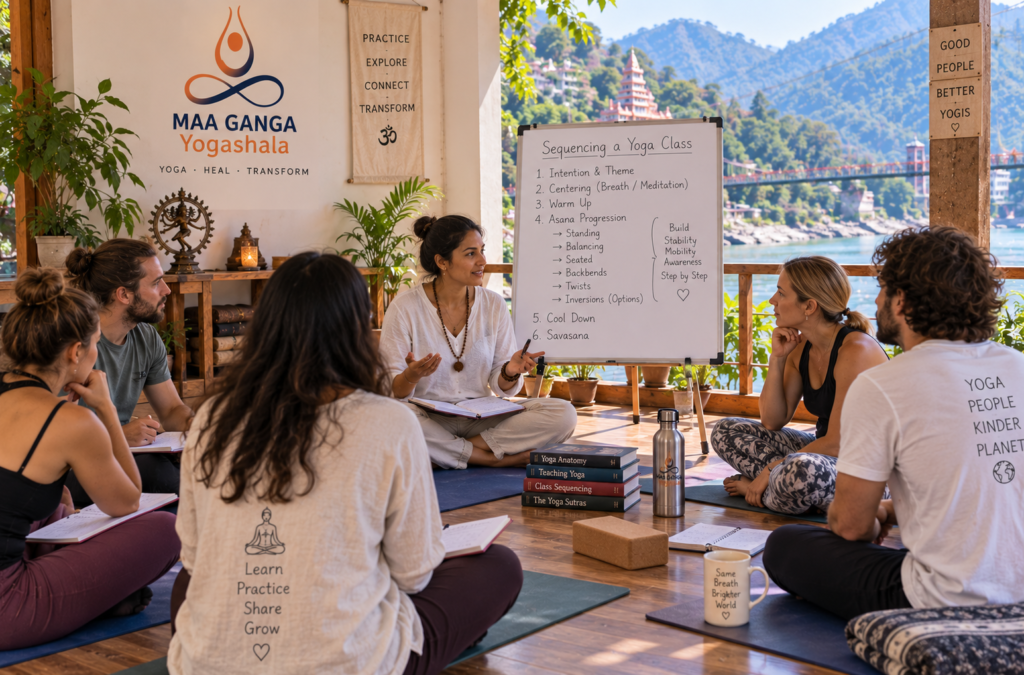
A beginner-friendly progression often looks like:
Arrive → Warm up → Mobilize → Build → Explore → Cool down → Rest
This structure is more useful than memorizing a fixed list of poses.
For example, a 60-minute class could look like this:
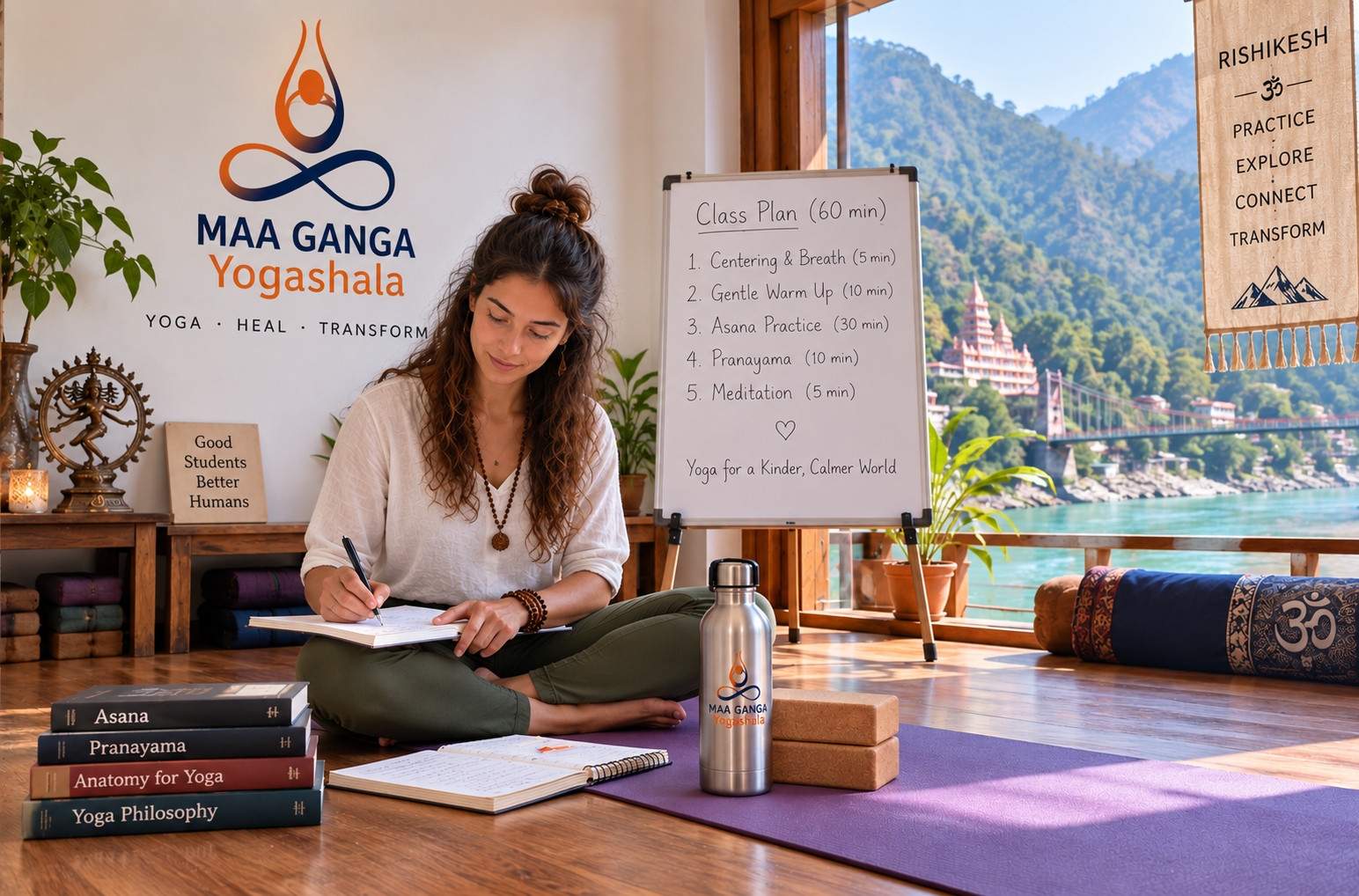
0–5 minutes: Arrival and centering
5–12 minutes: Breath awareness and gentle movement
12–22 minutes: Warm-up and mobility
22–38 minutes: Standing sequence
38–48 minutes: Main posture or theme
48–55 minutes: Cooling poses
55–60 minutes: Pranayama, meditation, or Savasana
Treat these timings as a starting framework, not a rigid law.
Your actual teaching speed will depend on the class.
4. Add Modifications Before You Need Them
A strong new teacher does not wait until a student struggles before thinking about alternatives.
Before class, identify easier and more accessible options.
For example:
Downward-Facing Dog: use a shorter stance, bend the knees, or use a wall.
Warrior III: keep fingertips on blocks or a wall.
Seated Forward Fold: bend the knees or sit on a folded blanket.
Balance postures: allow students to use a wall.
This makes your sequence more adaptable without changing its overall intention.
If you want to explore teaching considerations around safe and responsible instruction, our article on yoga teacher ethics training and professional boundaries provides another useful perspective.
Your goal is not to make every student perform the same shape.
Your goal is to teach the practice clearly enough that students can participate appropriately.
Yoga Class Plan Template New Teacher: A Practical Example
Once you understand the structure, you can turn it into a repeatable template.
Here is a simple 60-minute format you can adapt to different class themes.
60-Minute Beginner Yoga Class Template
1. Arrival — 5 minutes
Give students time to settle.
You might invite them to notice their natural breathing, relax unnecessary tension, and establish a comfortable seated or lying position.
Avoid filling every second with instructions.
Silence can be part of the class.
2. Breath and Gentle Movement — 7 minutes
Introduce simple breath awareness and movements that gradually bring attention into the body.
Examples include:
- Neck and shoulder movements
- Cat-Cow variations
- Gentle side bends
- Pelvic movements
- Easy seated twists
Keep the movements accessible.
3. Warm-Up — 10 minutes
Start preparing the areas you will use later.
If the main sequence contains standing postures, gradually transition from the floor to standing.
If your focal work involves the shoulders, introduce controlled shoulder and upper-back movements earlier.
Think preparation rather than exhaustion.
4. Main Sequence — 18 minutes
This is where your class develops.
Move from simpler shapes toward more challenging ones.
For a standing-focused class, you might use:
Mountain Pose → Chair Pose → Warrior I → Warrior II → Triangle → Balance variation
You can repeat movements instead of constantly introducing new poses.
Repetition gives students a chance to improve their understanding.
5. Focal Practice — 8 minutes
Now explore your main posture or theme.
Offer options.
Demonstrate when useful, but remember that your students need to experience the posture rather than simply watch you perform it.
6. Cooling — 7 minutes
Gradually reduce intensity.
Use seated or lying postures appropriate to what came before.
Avoid jumping directly from a demanding posture into Savasana.
Give the body and nervous system time to settle.
7. Savasana or Closing — 5 minutes
Keep the ending intentional.
Your final minutes can include quiet observation, gentle breath awareness, or a short meditation before Savasana.
You can use this same framework for many classes simply by changing the objective, focal posture, and preparation.
That is the real value of a yoga class plan template new teacher: it reduces planning time without forcing every class to look identical.
How to Write Better Teaching Cues for Your Yoga Sequence
A good sequence can still become difficult to teach if your verbal instructions are unclear.
New teachers often make one of two mistakes: they say far too much, or they give vague instructions such as “go deeper” without explaining what the student should actually do.
Your cues should be specific, useful, and timed appropriately.
Instead of:
“Straighten your leg and go deeper.”
Try:
“Press through the standing foot, lengthen through the crown of your head, and only straighten the knee as far as you can maintain steady breathing.”
The second instruction gives the student something actionable.
Use a Simple Cueing Order
For many postures, you can think:
Shape → Breath → Sensation → Option
For example:
“Step your right foot forward. Ground through both feet and lengthen your spine. Keep your breath steady. If the back heel feels uncomfortable, shorten your stance.”
You do not need to explain every anatomical detail.
Give the information that helps students practice safely and understand the purpose of the movement.
Also avoid speaking continuously.
Students need time to process your instructions.
Your teaching voice should support their practice, not compete with it.
If you are preparing for teaching professionally, studying anatomy alongside sequencing can be particularly useful. Understanding joints, movement patterns, and basic alignment principles can help you create more thoughtful classes. A dedicated yoga anatomy guide for teachers can help you deepen this area.
Remember that alignment is not simply about forcing every body into one visual shape.
You are teaching people, not photographs of poses.
Why Rishikesh Matters When You Are Learning to Teach Yoga
Where you train can influence how you understand yoga teaching.
Rishikesh offers an environment where yoga is not limited to a weekly fitness class. You encounter different approaches to asana, pranayama, meditation, philosophy, and daily practice.
That can be especially useful when you are learning to plan classes.
A teacher who only memorizes sequences may know what comes next but still struggle to explain why it belongs there.
A deeper training environment encourages you to think about purpose, progression, breath, awareness, and the relationship between practice and teaching.
You may also teach or practice alongside people from different countries and backgrounds. That experience can make you more aware of how differently students respond to instructions.
A cue that makes immediate sense to an experienced practitioner may confuse a complete beginner.
A posture that feels easy for one student may require modification for another.
This is one reason practical teaching experience matters.
The Ministry of Ayush also maintains official information about yoga and other Indian systems of traditional health and wellness. You can explore the Ministry of Ayush for broader context.
When you train in Rishikesh, you can also experience how yoga practice fits into a larger daily rhythm.
That does not automatically make someone a good teacher.
Training location is only one factor.
Your observation skills, consistency, ethics, communication, anatomy knowledge, and willingness to keep learning matter just as much.
A Practical Way to Improve Your Class Plans Before Teaching
Writing a plan once is not enough.
Your first version will probably be too long, too ambitious, or poorly timed.
That is normal.
The better approach is to test and revise your plan.
Before teaching, ask yourself:
Can a beginner understand the progression?
If you introduce several difficult poses quickly, simplify.
Does every pose serve the class objective?
If not, remove unnecessary movements.
Where could students become confused?
Mark those transitions clearly.
Where might students need a modification?
Write at least one alternative for demanding postures.
Does the timing actually work?
Practice the sequence yourself while using a timer.
A written 60-minute plan can easily become a 75-minute class when you explain every transition.
You should also leave a small buffer.
Real classes are unpredictable.
A student may ask a question. A transition may take longer. You may decide to repeat a movement because the group needs more preparation.
Your plan should support your teaching, not control it.
After every class, write three quick notes:
- What worked?
- Where did students struggle?
- What will you change next time?
This habit can improve your teaching faster than endlessly collecting new sequences.
Build Your Teaching Foundation with Maa Ganga Yogashala
If you want to develop your teaching skills in a dedicated Rishikesh environment, we offer structured teacher-training programs designed to take you beyond simply memorizing yoga poses.
You can explore our 200-Hour Yoga Teacher Training in Rishikesh if you want a more comprehensive foundation in practice, teaching methodology, philosophy, anatomy, and related areas.
For a shorter training pathway, you can also explore our 100-Hour Yoga Teacher Training in Rishikesh.
The important thing is to choose training that matches your current experience and your actual teaching goals.
A certificate by itself will not teach you how to read a room.
Practice, observation, feedback, and repeated teaching will.
FAQs About Yoga Class Planning for New Teachers
How long should a beginner yoga class plan be?
A beginner class can be 45, 60, or 75 minutes depending on the setting.
For a 60-minute class, divide the time between arrival, preparation, the main sequence, cooling, and relaxation. Do not spend most of the session teaching new poses.
How many yoga poses should I include in one class?
There is no universal number.
A slower beginner class may use relatively few postures with detailed transitions and repetition. A faster flow may include more.
The better question is whether the number of poses supports your objective without rushing students.
Should a new yoga teacher write every word they will say?
Usually, no.
Write key cues, transitions, modifications, and timing notes.
Trying to memorize an entire script can make you sound unnatural and distract you from observing students.
What should I do if I finish my sequence early?
Do not panic and start throwing random poses into the class.
Slow down.
Repeat an appropriate movement, allow more breath awareness, extend a safe relaxation period, or move gradually into the closing section.
A calm teacher is more valuable than a teacher trying desperately to fill every minute.
How can I become better at creating yoga class sequences?
Teach regularly, observe experienced teachers, study anatomy and teaching methodology, and review your classes afterward.
You can also deepen your formal education through a structured teacher-training program. For example, exploring a 200-hour yoga teacher training pathway in Rishikesh can give you more systematic exposure to sequencing and teaching practice.
Conclusion: Turn Your Plan Into Confident Teaching
A yoga class plan template new teacher is not meant to make your teaching rigid. It gives you enough structure to stay calm, organized, and responsive when you are standing in front of real students.
Start with one clear objective.
Choose a sensible focal posture.
Build preparation gradually.
Use simple cues.
Offer modifications.
Leave enough time for cooling and relaxation.
Then teach, observe, and revise.
That process will help you move from simply knowing yoga poses to understanding how to teach them.
If you are ready to develop those skills in Rishikesh, explore our 200-Hour Yoga Teacher Training in Rishikesh and take the next step toward becoming a more confident, thoughtful yoga teacher.