100 Hour YTT Daily Schedule Explained: What Happens Each Day in Detail
Introduction
100 hour YTT daily schedule explained: what actually fills your day? If you imagine a teacher training as a few yoga classes followed by plenty of free time, the reality is more structured. A well-designed 100-hour program combines asana, pranayama, meditation, philosophy, anatomy, mantra, meals, rest, and introductory teaching practice into one steady rhythm.
This guide breaks down what a typical training day can look like in Rishikesh, why each block matters, how the schedule changes as the course progresses, and what you should realistically expect from an 11-day residential immersion. You will also see where practice ends and study begins, how much personal time you get, and why the daily routine matters when you are choosing a school.
The goal is not to give you a romantic picture of yoga training. It is to help you decide whether this pace, structure, and level of commitment actually suit you.
100 hour YTT daily schedule explained: what a typical day looks like
A 100-hour YTT schedule is usually built around an early start because morning practice is easier to approach before the heat, noise, and distractions of the day increase. In a residential Rishikesh program, the day can begin around 5:00 AM and finish after dinner.
At Maa Ganga Yogashala, the published 11-day schedule follows this general rhythm:
| Time | Typical session |
|---|---|
| 5:00 AM | Wake up |
| 6:00 AM | Herbal tea |
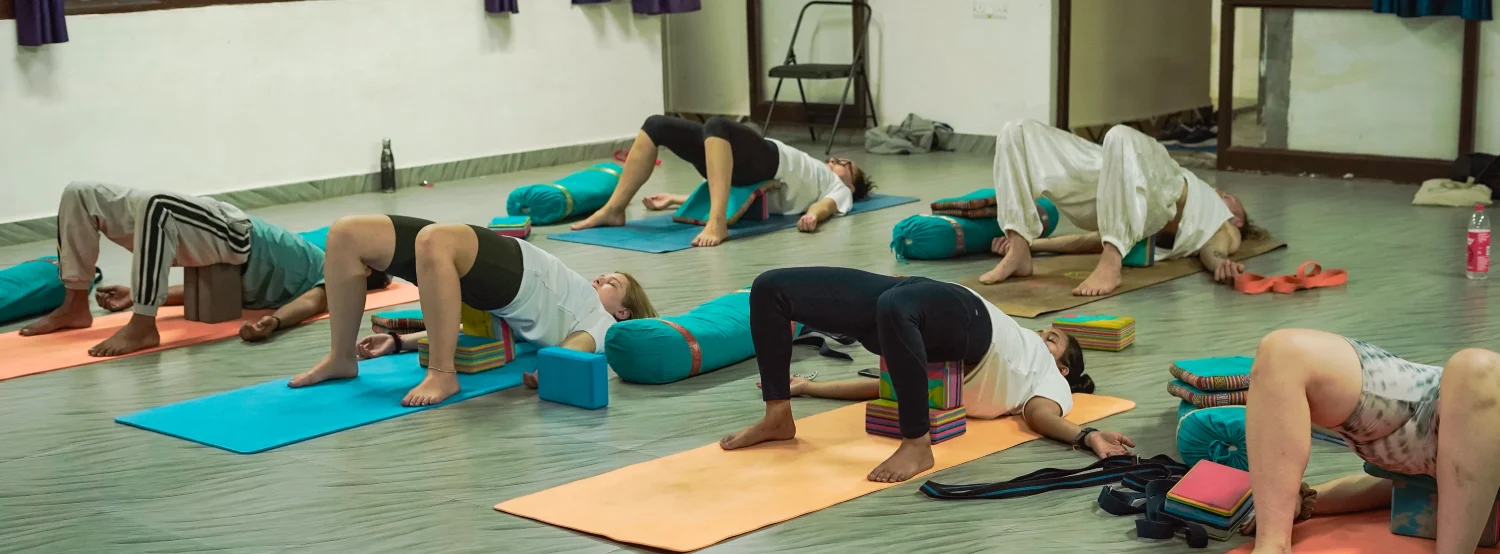
| 6:30–8:00 AM | Asana practice |
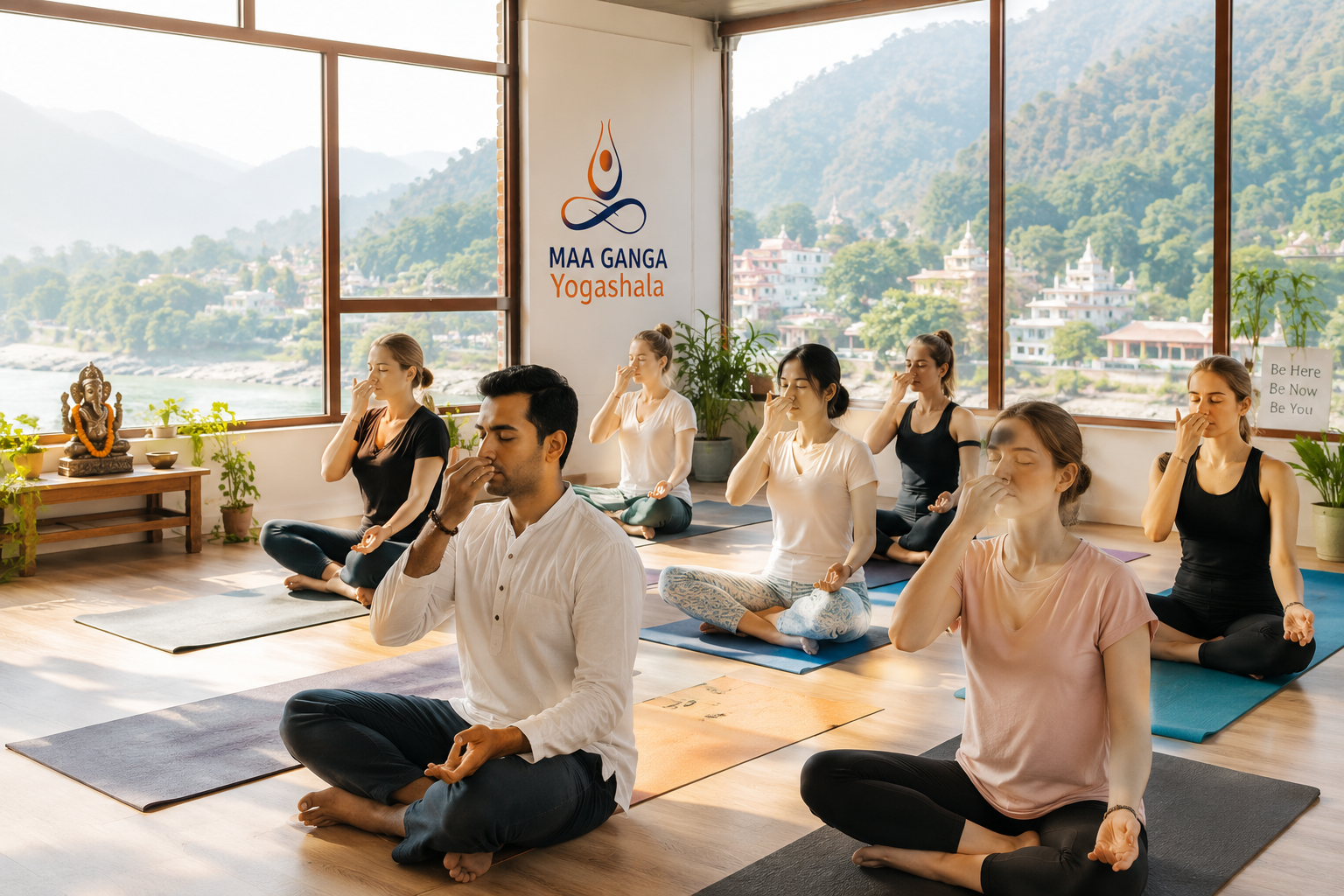
| 8:00–8:45 AM | Pranayama |
| 9:00–10:00 AM | Breakfast |
| 10:15–11:15 AM | Mantra or alignment workshop |
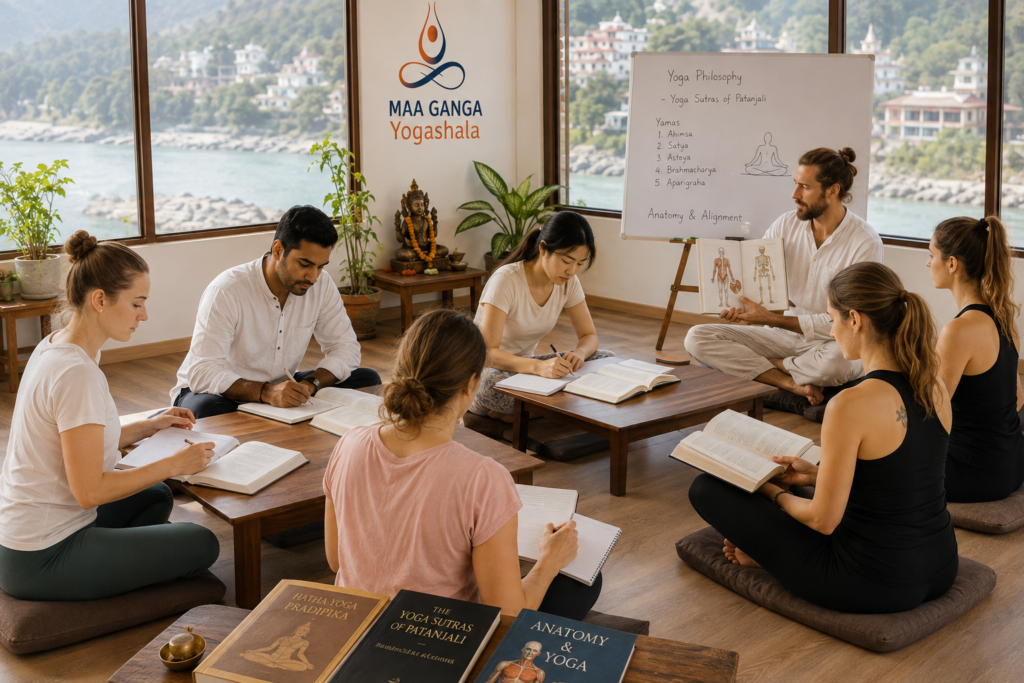
| 11:15 AM–12:00 PM | Yoga philosophy |
| 12:00–3:00 PM | Lunch and rest |
| 3:00–4:00 PM | Anatomy or teaching basics |
| 4:15–5:45 PM | Asana with alignment |
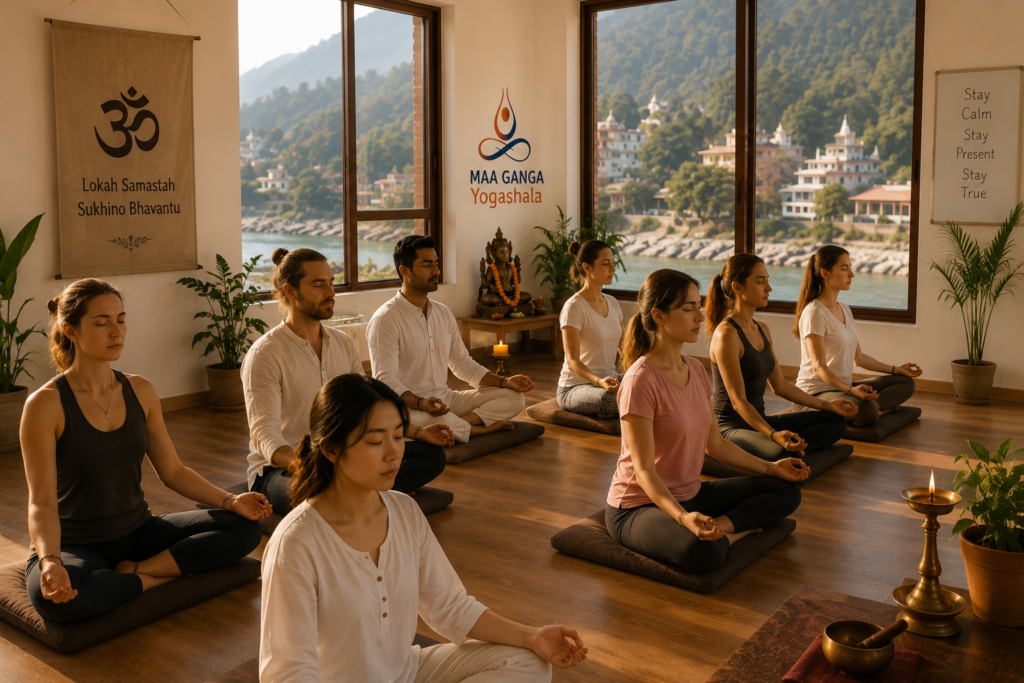
| 6:00–7:00 PM | Meditation |
| 7:30 PM | Dinner |
That schedule looks intense on paper, but notice the long midday break. You are not practising physically for every hour. Some sessions are discussion-based, some are technical, and some are deliberately quiet.
The important point is consistency. You wake early, practise while your body is fresh, study after breakfast, recover in the afternoon, practise again, and finish with meditation. By the end of several days, the routine itself becomes part of the training.
For broader context on how registered yoga schools structure teacher-training education, Yoga Alliance provides standards and credential information.
100 hour YTT schedule: what you actually study
The schedule is not simply “yoga twice a day.” A useful 100-hour program introduces several parts of yoga that support your physical practice and your understanding of how to practise safely.
Morning asana and pranayama
Your first major practice is usually asana. At this stage, the focus should be on foundations: alignment, breath coordination, entering and leaving postures, modifications, and learning how different movements feel in your own body.
You may work through joint and gland exercises, Surya Namaskar, standing postures, seated postures, forward bends, backbends, twists, and introductory inversions. You do not need to perform every posture perfectly. The real skill is learning how to practise without forcing your body.
Pranayama follows the physical practice in the published schedule. Techniques may include Kapalabhati, Bhastrika, Anuloma Viloma, and Nadi Shodhan, with breath retention introduced carefully where appropriate. This is why a teacher’s supervision matters: breathwork should be approached as a disciplined practice, not as a competition to hold your breath longer.
Philosophy, mantra, and Sanskrit
After breakfast, the learning becomes less physical. Philosophy sessions can introduce the broader Indian philosophical context and then connect ideas from Patanjali’s Yoga Sutras with your practice.
Mantra and Sanskrit sessions add another layer. You may learn pronunciation, meanings, and the names of asanas rather than simply memorising unfamiliar words.
This balance is important. If your entire course consists of posture demonstrations, you may finish with more flexibility but a shallow understanding of yoga.
Anatomy and teaching basics
Afternoon sessions can cover foundational anatomy, the musculoskeletal system, respiratory and nervous systems, and introductory yogic concepts such as koshas, chakras, and nadis.
Teaching basics may also appear toward the later part of the course. You can learn how to structure a simple class, give verbal cues, demonstrate, observe students, and provide basic adjustments or assists where appropriate.
If you want to understand what a 100-hour program should feel like before enrolling, this guide to questions before enrolling in a 100-hour YTT in India can help you evaluate a school more critically.
How the 11-day routine changes as you progress
Your first few days can feel very different from the final days. The schedule may stay broadly consistent, but the purpose of each session becomes more layered as you learn the basics.
Days 1–3: orientation and foundations
Early in the course, you are learning the language of the room. You become familiar with common Sanskrit names, basic alignment principles, breathing techniques, class etiquette, and the rhythm of residential training.
Do not judge your ability during these first days. Soreness, concentration problems, and mental fatigue are normal when you suddenly wake early and spend several hours learning.
Your main job is to observe carefully and build a safe base.
Days 4–7: repetition becomes understanding
By the middle of the course, repetition starts doing useful work. You may recognise alignment corrections before a teacher gives them. A familiar pranayama technique may feel different because you now understand what you are trying to accomplish.
This is also where the schedule can become mentally demanding. You are expected to listen, remember, practise, and ask questions rather than simply copy movements.
The afternoon asana session is especially useful because you get another opportunity to refine the same principles after a day of study.
For a deeper look at flow practice, Vinyasa fundamentals in a 100-hour YTT explains why sequencing and breath coordination matter.
If teaching is part of your long-term plan, learning the principles of yoga teacher ethics in a 100-hour training is just as important as learning how to cue a posture.
Days 8–11: integration and basic teaching awareness
Toward the end, the focus shifts from collecting information to connecting it. You may begin thinking about why a sequence is arranged in a particular order, how you would explain a posture, or how you would adapt a practice for a beginner.
A short observed teaching session can be particularly valuable because it exposes gaps that are difficult to notice when you are only practising yourself. You may also encounter a short assessment or evaluation process; understanding how 100-hour YTT exams and assessments work can help you prepare without unnecessary anxiety.
Remember the distinction between a 100-hour foundation and a full 200-hour professional teacher training. A 100-hour course can be an excellent introduction, but it should not automatically be presented as equivalent to an RYT-200 qualification. Yoga Alliance’s credentialing framework treats the 200-hour training as the foundational teacher-training level for RYT registration.
What happens between the yoga classes?
One of the biggest misunderstandings about residential YTT is that every hour is spent doing physical yoga. It is not.
The three-hour midday break is important. You can eat, shower, sleep, review notes, walk near the Ganga, or simply do nothing. If you use every break to explore Rishikesh, you may arrive at the afternoon session exhausted.
Rest is not wasted time here. Your body needs recovery after morning practice, and your brain needs quiet time to process new terminology and concepts.
Food also becomes part of your routine. A residential program may provide sattvic vegetarian meals, which means you can avoid spending your lunch break deciding where to eat or travelling across town.
Evenings are usually quieter. Meditation after the afternoon practice helps you shift away from physical effort and toward observation and stillness. After dinner, you have limited time before the next early start, so sleep becomes one of the most important performance tools you have.
The Ministry of AYUSH’s Common Yoga Protocol describes yoga as involving both physical and mental dimensions and discusses practices such as asana and pranayama within a broader framework. You can review the Ministry of AYUSH for official government information on yoga and related traditional systems.
Why Rishikesh makes this schedule easier to follow
Rishikesh is not automatically better just because it is famous. What makes the location useful is the combination of yoga culture, residential schools, access to teachers, and an environment where many travellers arrive specifically to study.
Tapovan, in particular, gives you access to a large yoga community while still allowing you to step away from ordinary routines.
The Ganga also changes the rhythm of your free time. Instead of spending every break inside a café or shopping centre, you can sit by the river, take a quiet walk, or simply watch the surroundings.
But there is a practical side to choosing Rishikesh. You are travelling, adapting to a new environment, and often adjusting to different food, weather, and social habits at the same time as your training. That is why a residential schedule with meals, accommodation, structured classes, and defined rest periods can be easier for a first-time student than trying to organise everything independently.
If you want a shorter immersion before committing to teacher training, a 3-day yoga retreat in Rishikesh can be a simpler way to experience the environment and your own response to a structured yoga routine.
Is a 100-hour YTT right for you?
A 100-hour course makes sense when you want depth without immediately committing to a longer teacher-training program.
You may be a beginner who wants a structured introduction, an experienced practitioner who wants to understand yoga beyond asana, or someone considering a 200-hour course but not yet sure whether residential training suits you.
It is also useful if your goal is personal practice rather than teaching professionally. You can use the course to build consistency, improve your understanding of pranayama and meditation, and learn foundational philosophy.
However, you should be realistic about what 100 hours can accomplish. You will not master every posture, become an experienced teacher, or absorb the entire philosophical tradition in 11 days.
The better question is whether you will leave with a stronger foundation and a clearer next step.
Before enrolling, check the curriculum, daily timetable, teacher credentials, accommodation, food, certificate details, assessment method, refund terms, and what is actually included in the fee.
If your long-term goal is professional teaching, compare the shorter course with a 200-hour Yoga Teacher Training in Rishikesh before you book.
A realistic daily mindset for your YTT
The students who get the most from a schedule like this are not necessarily the strongest or most flexible. They are the ones who can stay curious when something feels difficult.
You may wake up tired. You may struggle with a posture. You may forget Sanskrit terminology five minutes after learning it. You may discover that sitting still is harder than holding a balance.
That is normal.
Use the schedule as a framework rather than a test of toughness. Arrive on time. Drink enough water. Eat properly. Ask questions. Take notes after classes while the details are fresh. Rest during the midday break instead of trying to prove that you can keep going.
Also pay attention to the teaching style. A good instructor should explain why a technique is being taught, offer sensible modifications, and create space for questions. You should never feel pressured to ignore pain simply because everyone else is continuing.
The daily routine works best when discipline and self-awareness exist together.
A structured 100-hour YTT in Rishikesh
If you are considering training in Rishikesh, Maa Ganga Yogashala offers an 11-day residential 100-hour program built around daily asana, pranayama, philosophy, meditation, anatomy, mantra, and introductory teaching practice.
We focus on a clear daily rhythm, residential support, and enough practice and study to understand what comes next. Accommodation, meals, course materials, a completion certificate, and a scheduled excursion are included according to the published program terms.
You can review the full program details, dates, inclusions, and current availability before making a decision.
FAQs about a 100-hour YTT daily schedule
What time does a 100-hour YTT day usually start?
A residential program can start very early, often around 5:00 AM. Morning asana and pranayama may begin around 6:30 AM, followed by breakfast and classroom study. The exact timetable varies by school and batch.
How many hours of yoga do you practise each day?
Not all instructional hours are physical practice. A typical day can include morning and afternoon asana, pranayama, meditation, philosophy, anatomy, mantra, and teaching-related sessions. The physical workload is balanced by classroom learning and rest.
Do you get free time during a residential YTT?
Yes. A well-structured schedule should include breaks. In the published timetable, the midday period from 12:00 PM to 3:00 PM is reserved for lunch and rest. You can use it to recover, review notes, or spend quiet time by the river.
Is a 100-hour YTT enough to become a yoga teacher?
It depends on what you mean by “yoga teacher.” A 100-hour course can introduce teaching fundamentals and give you a strong foundation, but it should not be confused with a 200-hour teacher-training qualification used for RYT-200 registration. If professional teaching is your goal, compare the curriculum and credential requirements carefully.
What should you bring to a 100-hour YTT in Rishikesh?
Bring comfortable yoga clothes, a light layer for changing weather, personal toiletries, reusable water bottle, notebook, basic medicines you normally use, and footwear suitable for walking. Keep your packing practical; you will spend most of your time studying, practising, resting, and living in a simple routine.
Conclusion: understand the schedule before you commit
A 100 hour YTT daily schedule explained properly should show you more than class timings. It should reveal the rhythm of the whole experience: early practice, focused study, recovery, afternoon refinement, meditation, community, and sleep.
When you understand that rhythm before arriving, you can choose a program that matches your energy, experience, and goals instead of choosing one only because the destination sounds appealing.
If you are ready to experience that structure for yourself, explore our 100-hour Yoga Teacher Training in Rishikesh, review the current program details, and take the next step toward a more grounded yoga practice.