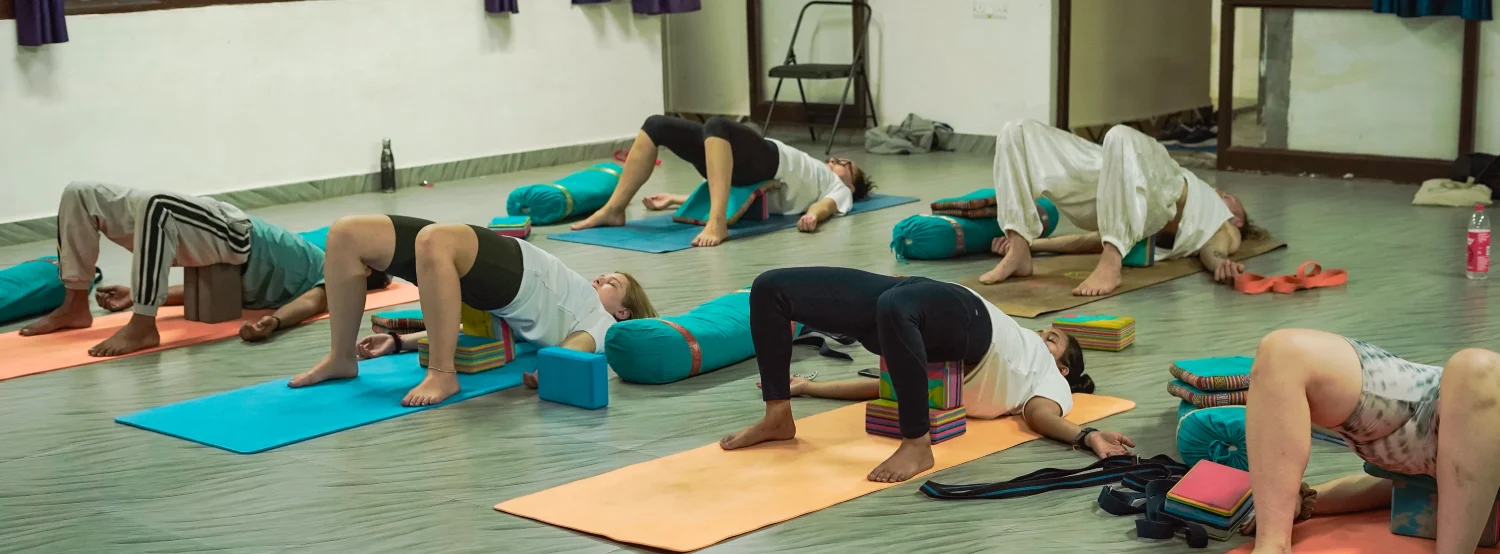
100 hour YTT exam assessment evaluation: How Are Students Evaluated?
Preparing for your 100 hour YTT exam assessment evaluation often brings up feelings of anxiety, curiosity, and pressure. You might wonder if you need to memorize a textbook of Sanskrit terms or perform flawless advanced postures to pass.
Understanding exactly how your instructors grade your progress removes the fear of the unknown. When you know the criteria, you can direct your focus toward genuine learning rather than stressing over a final score.
Most traditional ashrams and modern schools look at your holistic development over the course of your stay. Your evaluation is not just a single, intimidating test at the end of the month.
Instead, it is a continuous process that measures your dedication, theoretical understanding, and ability to safely guide others. Let us break down the exact components of your upcoming evaluation so you can step onto your mat with confidence.
Demystifying the 100 hour YTT exam assessment evaluation
The primary goal of any recognized 100 hour YTT exam assessment evaluation is to ensure you meet global competency and safety guidelines. It is not designed to trick you or make you fail.
Teachers want to confirm that you have absorbed the foundational principles required to lead a basic class or advance to a 200-hour program. This standard is heavily influenced by international governing bodies.
Organizations like Yoga Alliance set specific contact hour requirements that schools must fulfill. Your evaluation verifies that you were present, engaged, and capable of applying these required hours into practice.
A standard evaluation typically splits into three core pillars. These are your written examination, your practical teaching demonstration, and your daily behavioral assessment.
Each pillar carries a specific weight in your final grade. By balancing these three areas, instructors get a comprehensive view of who you are as both a student and an emerging guide.
You do not need to be the most flexible person in the room to achieve top marks. Your instructors care far more about your understanding of alignment, your communication skills, and your willingness to grow.
Knowing this structure allows you to study smarter. You can allocate your evening study time efficiently, balancing reading anatomy chapters with practicing your verbal cues.
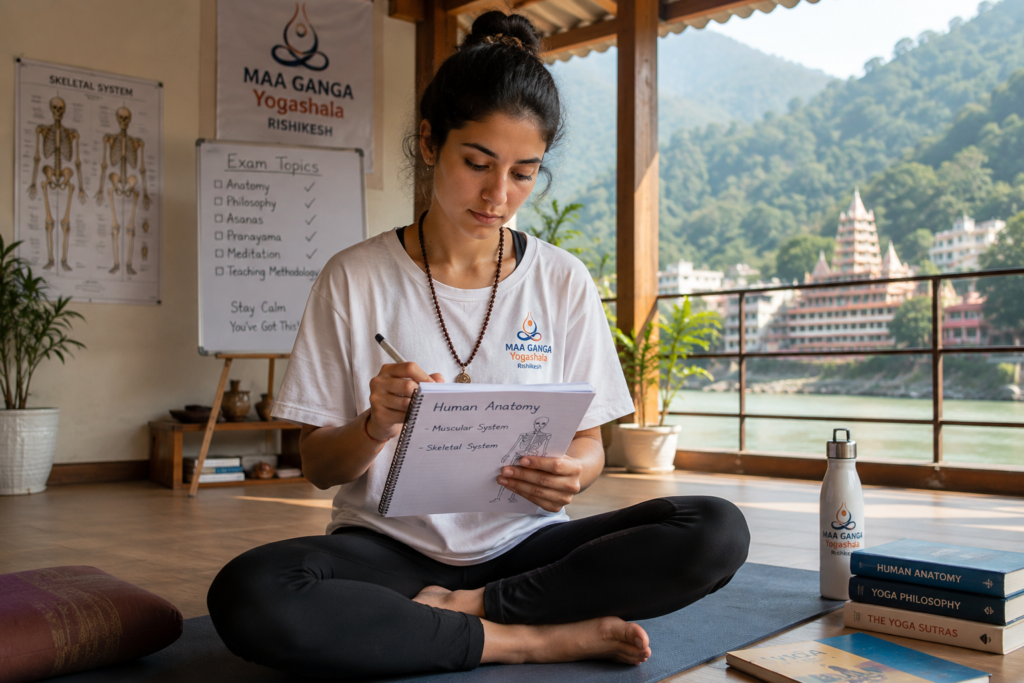
Written and Practical Components of Your Evaluation
The written portion of your assessment usually happens in the final days of your training. It tests your retention of the philosophical and anatomical concepts discussed in lectures.
You can expect multiple-choice questions, short essays, and fill-in-the-blank sections covering Patanjali’s Yoga Sutras, the chakra system, and basic human anatomy. Instructors want to see that you understand the underlying mechanics of the practice.
For example, you might be asked to explain the function of the diaphragm during pranayama or list the Yamas and Niyamas. To get a head start on understanding the curriculum depth, review the Maa Ganga Yogashala 100 Hour Course Structure: 7 Best Facts.
The practical component, often called the practicum, is where you step into the role of the teacher. You will be asked to sequence and lead a short physical class for your peers.
This is often the most nerve-wracking part for students. However, it is also the most rewarding, as you finally put your accumulated knowledge into vocal action.
Your assessors will watch your body language, listen to the clarity of your voice, and observe how you manage the energy of the room. They want to see if you can guide bodies safely into and out of postures.
Continuous Daily Observation Metrics
What many students do not realize is that the assessment begins on day one. Your daily observation metrics carry significant weight in your final evaluation.
Instructors constantly monitor your punctuality, your attitude during challenging classes, and your respect for the shala environment. Showing up five minutes late to a morning meditation session repeatedly will impact your standing.
This aspect of the grading reflects the traditional yogic concept of discipline, or Tapas. A true teacher embodies the practice off the mat just as much as on it.
Assessors also look at your participation during group discussions and philosophy lectures. Are you asking thoughtful questions? Are you actively listening when your peers speak?
Furthermore, your physical progression is noted, though not in the way you might think. Instructors look at how you respect your own bodily limits and injuries.
Pushing yourself into pain to achieve a pose demonstrates a lack of self-awareness, which is a red flag for a future teacher. For a deeper, clinical understanding of why listening to your body prevents chronic issues, medical journals on PubMed offer fascinating insights into yoga-related injury prevention.
Ultimately, your behavior, karma yoga (selfless service like cleaning your props), and overall demeanor form the foundation of your daily grade. Consistency is your greatest asset here.
Mastering Your Teaching Practicum
Your teaching practicum is the centerpiece of your evaluation. Typically, you will be assigned a specific timeframe, usually 15 to 30 minutes, to teach a segment of a class.
You might be asked to lead the centering and warm-up, a dynamic standing sequence, or the cool-down and savasana. You must prepare a logical, safe, and effective sequence beforehand.
During this test, instructors grade your ability to use clear, concise, and direct verbal cues. Rambling or overly poetic instructions can confuse beginners, so clarity is prioritized.
They also assess your observational skills. Are you staring at your own notebook, or are you scanning the room to see if a student is struggling in downward dog?
If you notice misalignment, you are expected to offer either a verbal correction or a safe, hands-on adjustment. Handling these moments smoothly shows immense competence.
It is completely normal to stumble over your words or mix up your left and right during this test. If you are feeling anxious, reading up on Teaching First Yoga Class Tips Nervousness: 7 Best Secrets can provide you with practical grounding techniques.
Remember to breathe. Your instructors are not expecting a flawless performance from a 100-hour student; they are looking for potential, safety, and confidence.
How to Mentally Prepare for Your Final Tests
Mental preparation is just as vital as reviewing your anatomy notes. Burnout is common in intensive training environments, which can negatively impact your test performance.
Start by setting a strict study schedule early in the program. Do not leave all your reading and sequence planning for the weekend before the exams.
Form small study groups with your peers to quiz each other on Sanskrit names and philosophical concepts. Explaining a concept out loud to a friend is one of the best ways to solidify it in your own mind.
Practice teaching your sequence in your room, visualizing a room full of students. Speak your cues out loud to get used to the sound of your own teaching voice.
Prioritize your sleep, especially in the final week. A rested mind recalls information much faster than a mind running on caffeine and stress.
Finally, remember why you signed up for this journey in the first place. Reconnect with your initial intention, and let that passion shine through during your practical evaluation.
Why Rishikesh Matters for Your Growth
Taking your exams in Rishikesh adds an unquantifiable layer of depth to your experience. The energy of this ancient city naturally supports intensive study and self-reflection.
Located on Badrinath Road in Tapovan, the surrounding Himalayan foothills provide a quiet, focused environment away from the chaotic distractions of modern city life. You are immersed in a culture dedicated entirely to spiritual growth.
The proximity to the sacred Ganga River offers a profound place to decompress after long days of studying. Many students find that sitting by the water helps them process complex philosophical concepts.
To understand why this location is so vital to your energetic development, explore the Ganga River Yoga Rishikesh Spiritual Significance: 5 Facts. The environment essentially becomes your silent, supportive co-teacher.
Studying in the yoga capital of the world means your assessors are often deeply rooted in authentic, traditional lineages. Their feedback carries generations of wisdom.
You absorb this knowledge not just through textbooks, but through the very atmosphere of the ashrams and the daily rituals happening all around you.

Your Trusted Path in India
If you are considering starting your foundational training, choosing the right environment is crucial for your success. You need a space that challenges you academically while supporting you emotionally.
At our school, we prioritize your true understanding over rigid, stressful testing. Our experienced instructors guide you through every step of your evaluation, ensuring you feel prepared and confident.
We invite you to explore our main home at https://maagangayogashala.com/ to see our facilities and teaching philosophy.
If you are ready to begin, our 100-Hour Yoga Teacher Training in Rishikesh offers the perfect structured, supportive environment to ace your assessments and deepen your practice.
FAQs on YTT Exams
What happens if I fail the final written exam?
Reputable schools want you to succeed. If you struggle with the written test, instructors will typically review your mistakes with you and provide a secondary assignment or a verbal re-test to ensure you understand the material.
Do I need to demonstrate advanced poses perfectly?
No. Your evaluation tests your ability to teach safely, not your personal acrobatic skills. You are graded on your understanding of alignment and modifications, not your ability to perform a perfect handstand.
How much Sanskrit do I need to memorize?
You are expected to know the basic Sanskrit names for foundational poses, like Tadasana or Adho Mukha Svanasana. However, absolute fluency is not required at the 100-hour level.
Can introverts succeed in the teaching practicum?
Absolutely. Many excellent teachers are introverts. For more insights on common concerns before training, read Questions before enrolling 100 hour YTT India: 7 Best Facts.
How long does it take to get exam results?
Most schools provide your results and feedback within a day or two of your final practicum. This is usually followed by a beautiful graduation ceremony to celebrate your hard work.
Ready to Pass Your 100 hour YTT exam assessment evaluation?
Facing your 100 hour YTT exam assessment evaluation is a powerful stepping stone in your yoga journey. It is a moment to celebrate how far you have come and to acknowledge the vast amount of knowledge you have absorbed.
You already possess the inner dedication required to succeed. The true key is consistent daily practice, an open mind, and choosing a certified school that aligns with your learning style.
Ready to begin? Explore our complete 200-Hour Yoga Teacher Training in Rishikesh and take the first step today.
If you prefer a shorter introduction to our teaching style before committing to an exam, join us for a rejuvenating 5 Days Yoga Retreat in Rishikesh. Your transformative journey awaits.