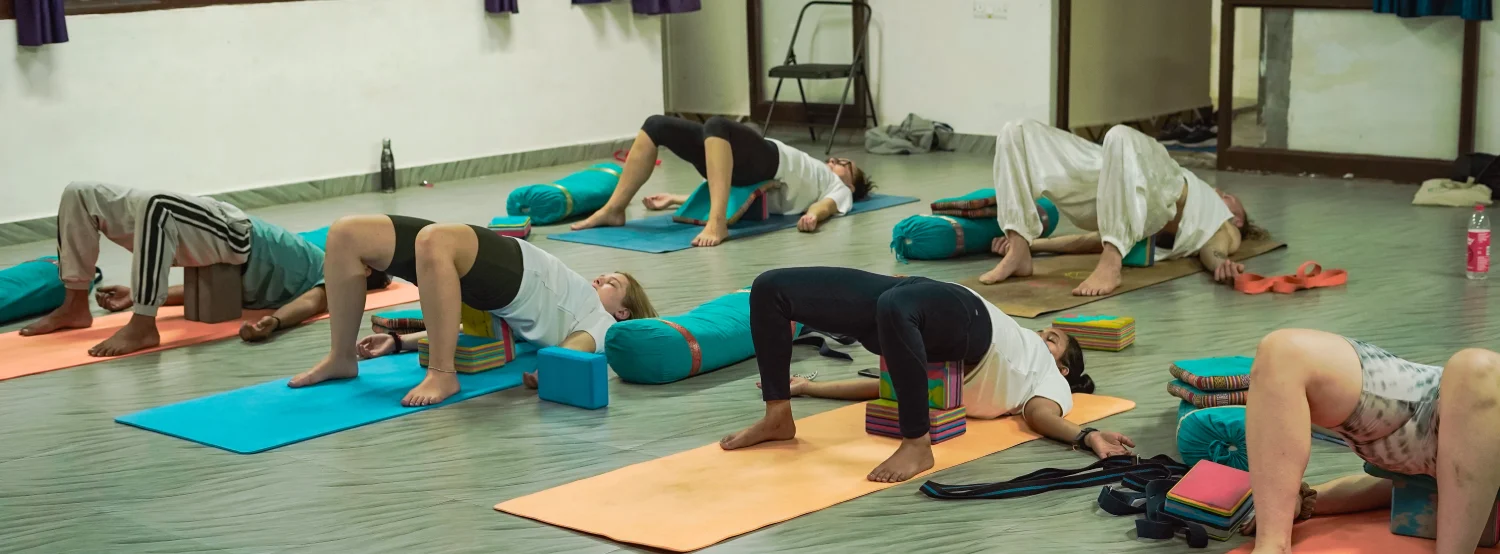

100 Hour YTT Experienced Practitioners: What Is Different?
Introduction
100 hour YTT experienced practitioners often need something different from a beginner entering a yoga teacher training course for the first time. If you already practise regularly, understand common asanas, and recognise how your body responds to movement and breath, repeating familiar poses may not be enough. You may want to understand the principles behind your practice, refine your alignment, explore yoga philosophy, or develop the skills to guide others.
A 100-hour Yoga Teacher Training (YTT) course can provide a structured way to revisit familiar foundations while exploring them with greater depth. However, the real value depends on the curriculum, the quality of instruction, your previous training, and what you want to achieve.
Some experienced practitioners want to deepen their personal practice without immediately committing to a full-length certification. Others have completed a 200-hour course and want focused continuing education. Still others are exploring whether teaching yoga could become part of their professional future.
Understanding these differences helps you choose a course that matches your experience rather than simply your physical ability. Here is what you should examine before choosing a 100-hour programme in Rishikesh, India.

1. How Is a 100-Hour YTT Different for Experienced Yoga Practitioners?
For an experienced practitioner, the difference should be in the depth of learning, not merely the difficulty of the postures.
A well-designed programme can help you move beyond knowing how to perform an asana towards understanding why it is taught, which variations suit different bodies, and how breath, attention, stability, and mobility influence the experience.
You may already know familiar sequences such as Sun Salutations or standing postures. The next step is to examine their details: how weight transfers through your feet, how the pelvis and spine coordinate, and when a modification supports safer movement.
Your experience can also help you recognise patterns that newer students may not yet notice. You might identify unnecessary muscular tension, understand when flexibility compromises stability, or recognise when a pose needs to be adapted rather than pushed further.
From practising poses to understanding principles
An experienced practitioner benefits from asking more precise questions:
- Why does one alignment cue work for one student but not another?
- How can you modify a posture without losing its central intention?
- When should you prioritise stability over range of motion?
- How do breath and concentration affect the quality of a practice?
These questions encourage observation instead of imitation. They also help you identify gaps in your understanding, even if your physical practice is already strong.
What about certification?
Before enrolling, clarify whether the programme is designed for personal development, continuing education, or a particular professional qualification. A course’s stated hours do not automatically establish that it meets every certification or registration requirement.
You can review the relevant standards and guidance through the official Yoga Alliance website. Check the current requirements directly rather than assuming that completing any 100-hour course grants a particular teaching credential.
The best programme for you is one that clearly explains its learning outcomes and fits your existing training.
2. What Should Experienced Practitioners Expect from a 100-Hour YTT?
A 100-hour course should offer more than a longer version of your regular yoga class. Look for a curriculum that connects physical practice with anatomy, breathwork, philosophy, and teaching awareness.
Your previous experience may allow you to engage with these subjects more critically. Instead of learning a technique for the first time, you can examine whether your understanding is accurate and how the technique applies in different situations.
Asana refinement and alignment
You may already be comfortable with standing poses, forward bends, backbends, and seated postures. However, comfort in a pose does not necessarily mean you understand its mechanics.
An experienced practitioner should look for opportunities to study:
- Joint positioning and individual anatomical differences.
- The relationship between strength, flexibility, balance, and control.
- Variations that accommodate different levels of mobility.
- The difference between productive muscular effort and excessive strain.
- How to adapt a sequence according to energy, experience, and individual needs.
For example, if you regularly practise deep forward folds, you might explore how hip movement, spinal positioning, hamstring flexibility, and the use of props influence the posture. The aim is not to achieve a more impressive shape. It is to develop better awareness and more informed choices.
Pranayama and concentration
Breathwork can also become more nuanced as your practice develops. You might explore the relationship between breathing rhythm, attention, relaxation, and the pace of movement.
However, advanced breath retention or forceful breathing should never be treated as a badge of experience. These techniques require appropriate instruction and individual assessment.
Yoga philosophy beyond memorisation
Philosophy becomes more useful when you connect its ideas with everyday practice. You might examine how the Yoga Sutras discuss concentration, discipline, and the fluctuations of the mind, then reflect on how these ideas influence your behaviour on and off the mat.
The Indian government’s Ministry of AYUSH provides an official starting point for exploring India’s traditional systems of health and wellness. Use reliable educational sources alongside your teacher’s explanations, and distinguish traditional philosophical concepts from modern scientific claims.
A strong programme should help you connect theory and practice rather than treating each subject as an isolated classroom requirement.
3. Will a 100-Hour YTT Challenge You Differently Than Regular Practice?
Yes, potentially. But the challenge may be intellectual, observational, and emotional rather than purely physical.
When you practise independently, you can choose familiar sequences, avoid uncomfortable subjects, and spend more time on the styles you enjoy. Structured training introduces a different expectation: you must engage with subjects selected for learning, including those that expose weaknesses in your understanding.
Learning to observe instead of perform
Imagine that you can comfortably hold Warrior II for several breaths. In a training environment, you may be asked to explain its purpose, observe how another student enters the posture, recognise a possible compensation, and offer an appropriate modification.
That is a different skill from performing the pose yourself.
Teaching requires clear communication, patience, and an understanding that your preferred technique will not suit every student. You must learn to observe without assuming that every body should look the same.
Feedback can reveal your blind spots
Constructive feedback may highlight habits you have developed over years of practice. Perhaps you rely heavily on flexibility, move too quickly through transitions, or use complicated instructions when a simple cue would work better.
Treat feedback as information rather than a judgment of your ability. Experienced students sometimes find this difficult because they are accustomed to being confident in their preferred style.
A useful self-assessment before enrolling
Ask yourself these questions:
- Can you explain the purpose of the postures you practise most frequently?
- Can you identify when a variation is more appropriate than the full expression of a pose?
- Do you understand basic contraindications and when to refer a student to a qualified healthcare professional?
- Can you communicate instructions clearly without relying entirely on demonstrations?
- Are you comfortable receiving feedback and changing an established habit?
Your answers can help you identify what you need from training. You do not need to be an expert in every area before enrolling. Recognising your learning gaps is part of being an experienced practitioner.
For additional preparation, explore this guide to questions to ask before enrolling in a 100-hour YTT in India. It can help you assess whether a programme’s expectations match your goals.
4. Can a 100-Hour YTT Help You Become a Better Yoga Teacher?
A 100-hour course can help you develop useful teaching foundations, but the result depends on its curriculum and your prior qualifications. It does not automatically make you a qualified teacher or replace a required foundational certification.
If you already teach informally, assist a teacher, or have completed previous training, you may benefit from structured opportunities to practise explaining postures, planning sequences, and responding to different student needs.
Teaching methodology matters
Look for a course that includes practical teaching opportunities, not just lectures and personal asana practice.
Useful elements may include:
- Verbal cueing and demonstration.
- Sequencing with a clear purpose.
- Appropriate use of props and variations.
- Class planning and time management.
- Observation and constructive feedback.
- Professional boundaries and awareness of student safety.
These skills matter because knowing yoga and teaching yoga are not identical. You might understand a posture perfectly but struggle to explain it in language a beginner can follow.
Know what your qualification actually allows
If your goal is to teach professionally, confirm the entry requirements for your intended role before paying for a course. Ask whether the provider issues a certificate of completion, whether the hours can count towards further training, and whether a relevant registration organisation recognises the programme.
If you have not completed foundational teacher training, a 100-hour course may be a useful educational step without being sufficient for your intended career. If you already hold a 200-hour qualification, ask whether an advanced or continuing-education programme would better suit your needs.
You can also explore how to market yourself as a yoga teacher if you are considering teaching professionally. Marketing becomes more effective when you can clearly explain your training, teaching approach, and the students you are prepared to serve.
The sensible approach is to select education based on the qualification you need, rather than assuming that accumulating course hours will automatically improve your career prospects.
5. Why Choose Rishikesh for a 100-Hour Yoga Teacher Training?
Rishikesh offers a distinctive setting for studying yoga because it brings together established yoga schools, traditional learning environments, and a community of practitioners from India and abroad.
For an experienced student, the attraction is not simply the opportunity to practise yoga in a famous destination. It is the chance to dedicate time to structured learning away from your usual routine.
A setting that supports focused study
In Tapovan, you can find yoga schools, practice spaces, vegetarian food options, and opportunities to explore different approaches to yoga. The wider Rishikesh area also offers access to the Ganga, Himalayan foothills, and a long-standing spiritual culture.
The setting can encourage reflection, but it does not guarantee high-quality teaching. Your learning will depend far more on the teachers, curriculum, feedback, class size, and daily schedule than on the location alone.
Before choosing a school, examine what is included in the fee, how much supervised practice you receive, and whether the course provides enough time for rest and independent study.
Residential training versus learning at home
A residential programme can help you establish a consistent routine. Instead of fitting yoga around work, family commitments, and other responsibilities, you can dedicate a defined period to practice and study.
However, intensive training also requires recovery. Long daily schedules, unfamiliar food, travel fatigue, and repeated physical practice can become demanding. Ask about rest periods, medical support, dietary arrangements, and how instructors adapt sessions for different levels of experience.
If you want a shorter introduction to studying yoga in the area, compare the course with a five-day yoga retreat in Rishikesh. A retreat may suit personal renewal, while a teacher-training programme generally has more structured educational objectives.
You can also read about the differences between a 100-hour YTT and a weekend workshop before deciding how much time you can realistically commit.
6. How to Choose the Right 100-Hour YTT for Your Experience
Not every course labelled 100-hour YTT is designed for the same student. Some emphasise asana and foundational teaching skills, while others focus on a particular style or provide supplementary study for existing teachers.
Your first task is to identify the outcome you want. Are you trying to deepen your personal practice, improve your understanding of anatomy, prepare for a longer teacher-training course, or develop skills relevant to teaching?
Once you have a clear goal, compare programmes using the following criteria.
| What to check | What you should look for |
|---|---|
| Curriculum | Clearly defined subjects, learning outcomes, and practical sessions |
| Teaching faculty | Relevant qualifications, experience, and transparent instructor profiles |
| Practical learning | Opportunities for supervised practice, feedback, and reflection |
| Daily schedule | A realistic balance of classes, meals, rest, and independent study |
| Certification | Written clarification of the certificate awarded and any applicable recognition |
| Total cost | Tuition, accommodation, meals, materials, transport, and additional charges |
| Student support | Clear policies for illness, injuries, missed sessions, and assessment |
Do not choose a course solely because it advertises advanced poses or a prestigious location. Neither guarantees deeper learning.
Ask for a sample timetable and a detailed syllabus before paying a deposit. If a provider cannot explain what you will learn, how progress is assessed, and what the certificate represents, treat that as a reason to investigate further.
You should also ask whether experienced practitioners receive differentiated instruction or whether everyone follows exactly the same sessions regardless of previous training.
A well-matched course should challenge you without encouraging you to push beyond your physical limits. It should also make clear what it cannot provide.

7. What to Expect from Maa Ganga Yogashala in Rishikesh
If you are considering residential yoga education in Tapovan, compare the available programme details against your goals, experience, and budget.
Maa Ganga Yogashala offers a 100-hour yoga teacher training course in Rishikesh. Before enrolling, review the current syllabus, dates, daily timetable, accommodation arrangements, and certificate details to determine whether the course is appropriate for your background.
If you are completely new to structured teacher training and eventually want a more comprehensive foundation, you can also compare the 200-hour yoga teacher training programme. The right choice depends on your previous education and the qualification you ultimately want to pursue.
Take time to ask questions before making a booking. Your course should be a considered educational decision, not simply an appealing travel experience.
8. Frequently Asked Questions About 100-Hour YTT for Experienced Practitioners
Is a 100-hour YTT suitable if you have practised yoga for years?
Yes, provided the curriculum matches your needs. Years of personal practice can give you useful body awareness, but they do not automatically provide knowledge of anatomy, teaching methodology, or yoga philosophy. Choose a course that addresses the areas you want to develop rather than assuming that physical ability alone makes a programme suitable.
Do you need to complete a 200-hour YTT first?
Not necessarily for every 100-hour programme. Entry requirements depend on the school’s policy and the course’s purpose. However, if your objective is professional teaching or a particular registration credential, verify the applicable requirements before enrolling. A standalone 100-hour certificate should not be assumed to equal a 200-hour foundational qualification.
Will a 100-hour YTT improve your asana practice?
It can improve your understanding of alignment, movement options, stability, and modifications. Progress depends on the quality of instruction, the time available for practice, and your willingness to work on weaknesses. More difficult poses are not the only measure of improvement.
Can you teach yoga after completing a 100-hour course?
That depends on your existing qualifications, the course’s scope, and the requirements relevant to your intended teaching role. Completing 100 hours does not automatically establish that you meet every professional or registration requirement. Ask the provider what the certificate represents and verify any additional qualifications you may need.
How should you prepare for training in Rishikesh?
Maintain a sustainable practice, revise basic postures, and arrive prepared to learn rather than demonstrate your ability. Bring comfortable clothing, any personal practice equipment you need, and a list of questions about the syllabus. Avoid increasing training intensity suddenly before travelling, and allow time to adjust to the local climate and daily schedule.
Conclusion: Choose a Course That Takes Your Practice Further
For 100 hour YTT experienced practitioners, the real difference should be the quality and depth of learning, not simply the number of challenging poses included in a timetable.
Your experience gives you a foundation to examine alignment more carefully, understand yoga philosophy more thoughtfully, develop teaching awareness, and identify habits that may be limiting your progress. The right programme should help you build on that foundation while remaining honest about its scope and certification outcomes.
Before enrolling in Rishikesh, compare the syllabus, instructors, practical teaching opportunities, schedule, total cost, and qualification requirements. A course that fits your goals is more valuable than one chosen solely for its name or location.
Ready to take your practice further? Explore our 100-Hour Yoga Teacher Training in Rishikesh, review the programme details, and contact Maa Ganga Yogashala to discuss whether it suits your experience and learning goals.