
Svadhyaya Self Study Yoga Teacher Training: The Practice of Self-Study That Transforms You
Introduction
Svadhyaya self study yoga teacher training begins with a question that can be more challenging than holding an advanced yoga posture: How well do you really know yourself?
You might know how to perform Trikonasana, practise pranayama or guide someone through Surya Namaskar. But can you recognise the thoughts, emotional reactions and habits influencing the way you practise and teach? This is where Svadhyaya becomes meaningful.
In yogic philosophy, Svadhyaya refers to self-study, self-observation and the study of wisdom that helps you understand your inner nature. It encourages you to look beyond physical performance and examine the relationship between your thoughts, actions and values.
During yoga teacher training, this practice becomes particularly relevant. You are not simply learning techniques to teach other people. You are also examining your own approach to discipline, communication, patience and personal growth.
Understanding Svadhyaya can help you develop a more thoughtful practice, become a responsible yoga teacher and build a relationship with yoga that continues beyond your training programme.
1. What Is Svadhyaya in Yoga? Understanding the Practice of Self-Study
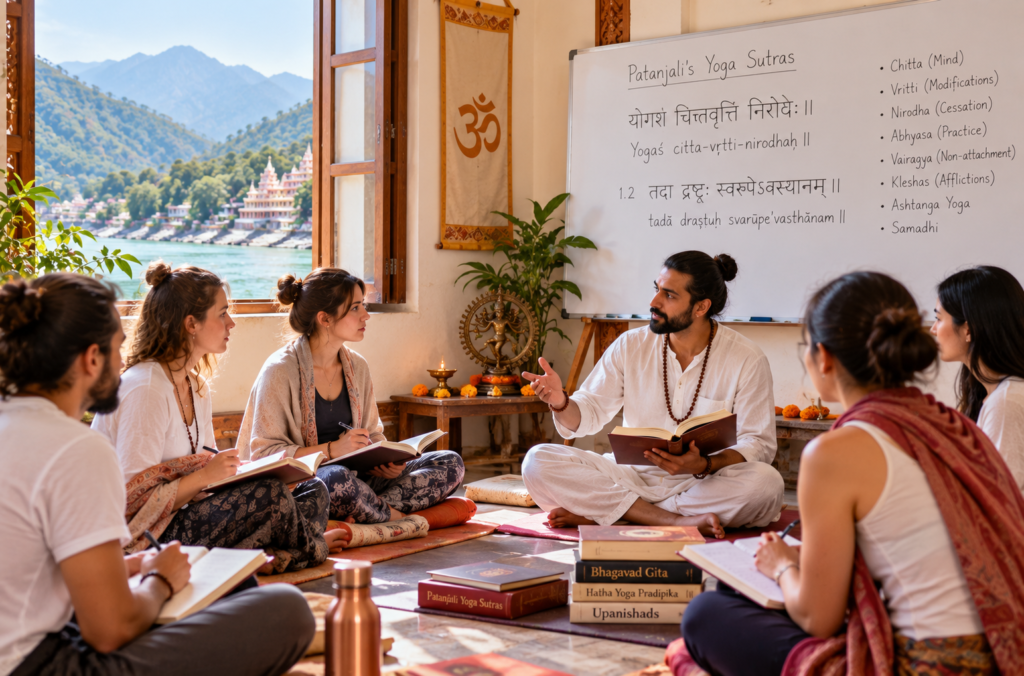
Svadhyaya is one of the five Niyamas described in Patanjali’s Yoga Sutras. The Niyamas are personal observances that form part of the eight-limbed path of yoga.
The Sanskrit word is commonly understood through two parts: sva, meaning self, and adhyaya, meaning study or recitation. Together, they describe a practice involving the study of oneself and engagement with meaningful teachings.
However, Svadhyaya is more than reading philosophical texts or memorising Sanskrit verses. It asks you to examine how knowledge relates to your everyday behaviour.
For example, you might understand that patience is important in yoga. But what happens when your body struggles with a posture? Do you become frustrated, compare yourself with others or accept your current limitations?
That moment of observation is an opportunity to practise self-study.
Svadhyaya and Patanjali’s Yoga Sutras
Patanjali discusses Svadhyaya in two particularly relevant places:
- In Yoga Sutra 2.32, Svadhyaya is identified as one of the five Niyamas.
- In Yoga Sutra 2.44, the practice of Svadhyaya is associated with a deeper connection to one’s chosen ideal or understanding of the divine.
These references show that self-study has both practical and contemplative dimensions.
You can explore the broader historical and philosophical context of yoga through Encyclopaedia Britannica. For a yoga teacher, understanding this philosophical foundation provides context for teaching beyond physical postures.
The important distinction is that Svadhyaya is not about constantly criticising yourself. It is about observing honestly, recognising patterns and learning without unnecessary judgement.
2. Svadhyaya in Yoga Teacher Training: Why Self-Study Matters
A yoga teacher training programme introduces you to several disciplines simultaneously. You study asana, pranayama, meditation, anatomy, alignment, teaching methodology and yoga philosophy.
It is tempting to measure your progress through visible achievements: completing an advanced posture, remembering Sanskrit terminology or delivering your first practice class.
However, your development as a teacher also depends on what happens internally.
Svadhyaya helps you understand how your personality, assumptions and emotional responses influence your teaching.
Recognising Your Strengths and Limitations
Imagine that you are practising with a group of students. Someone performs a posture more easily than you. You might immediately compare your flexibility or strength with theirs.
Through self-observation, you begin recognising this reaction instead of allowing it to control your practice.
You learn that another student’s progress does not reduce your own achievements.
The same awareness becomes useful when teaching. You stop expecting every student to have the same physical abilities, learning speed or motivation.
Understanding Your Teaching Personality
Self-study also helps you identify your natural teaching tendencies.
You might discover that:
- You explain instructions clearly but struggle to manage time.
- You understand alignment but find it difficult to communicate adjustments.
- You are patient with beginners but become uncomfortable when students ask unexpected questions.
- You focus heavily on physical performance and overlook relaxation.
Recognising these tendencies gives you something specific to improve.
This is why reflection should be part of your regular training routine rather than an activity reserved for the end of the course.
For a structured introduction to the philosophical subjects covered in teacher education, explore our discussion of Patanjali’s Yoga Sutras and their practical lessons in yoga teacher training.
3. How to Practise Svadhyaya During Yoga Teacher Training
You do not need complicated rituals or hours of additional study to begin practising Svadhyaya. Consistent observation and honest reflection can make the practice meaningful.
The key is to connect what you learn in class with what you experience in your daily life.
1. Maintain a Yoga Reflection Journal
A journal provides a simple way to examine your experiences.
After your morning practice or a teaching session, spend five to ten minutes answering questions such as:
- What did I learn about myself today?
- Which situation challenged my patience?
- Did I compare my progress with someone else’s?
- Was I fully attentive during my practice?
- What would I approach differently tomorrow?
Avoid writing what you think a yoga teacher should say. Record what you actually experienced.
For example, instead of writing, “I had a peaceful meditation session,” you might write, “My attention wandered repeatedly towards tomorrow’s examination, and I found it difficult to return to my breath.”
That observation gives you a more useful starting point.
You can develop this habit further through yoga journaling and inner-work practices during a retreat in Rishikesh.
2. Observe Your Reactions During Asana Practice
Your physical practice can reveal patterns in your behaviour.
Notice what happens when:
- You cannot maintain a posture for as long as expected.
- Your balance becomes unstable.
- Your body feels tired during a demanding sequence.
- Your instructor corrects your alignment.
- Another practitioner progresses faster.
Do you become impatient, defensive or discouraged?
Instead of immediately reacting, observe the feeling and consider what may be causing it.
This does not mean ignoring physical discomfort or forcing yourself through pain. Self-study should improve your awareness of limitations, not encourage unsafe practice.
3. Study Yogic Texts With Reflection
Reading yoga philosophy is an important aspect of Svadhyaya.
You can begin with selected passages from the Yoga Sutras of Patanjali and the Bhagavad Gita. Read a short passage, understand its meaning and consider how its teaching applies to your life.
For example, when studying the idea of discipline, examine whether your daily routine reflects your stated intentions.
Reading without reflection can become an exercise in memorisation. Reflection helps turn philosophical knowledge into practical understanding.
4. Practise Mindful Breathing and Meditation
Meditation creates an opportunity to observe your attention.
Sit comfortably, maintain a natural breathing rhythm and notice where your mind moves. You may become aware of planning, memories, worries or repeated thoughts.
Rather than trying to eliminate every thought, recognise when your attention wanders and gently return to your chosen point of focus.
Over time, this can help you become more familiar with your mental habits.
5. Request Honest Feedback
Self-observation is valuable, but your perspective is not always complete.
During practice teaching, ask instructors and fellow trainees for specific feedback.
Instead of asking, “Was my class good?”, ask:
- Were my verbal instructions understandable?
- Did I provide sufficient preparation before difficult postures?
- Was my class sequence appropriate for the students?
- Did I communicate respectfully?
- Was my timing consistent?
Combine external feedback with personal reflection. This gives you a more balanced understanding of your development.

4. Five Ways Svadhyaya Can Improve You as a Yoga Teacher
Self-study is not limited to your personal development. It can influence the way you interact with students and approach your responsibilities as an instructor.
Here are five practical benefits.
1. Greater Emotional Awareness
Teaching involves interacting with people who have different personalities, expectations and physical abilities.
You may encounter students who struggle to follow instructions, arrive late or feel discouraged.
If you understand your emotional triggers, you are less likely to respond impulsively.
Svadhyaya encourages you to recognise your reactions before they influence the learning environment.
2. More Compassionate Teaching
Every student enters a yoga class with a different background.
Some may be experienced practitioners, while others may be attending their first session. Some might have physical limitations or feel uncomfortable practising in a group.
Self-study helps you recognise your own assumptions and avoid expecting everyone to follow the same path.
You become more attentive to individual needs rather than judging students by their physical performance.
3. Better Communication
A knowledgeable teacher does not automatically become an effective communicator.
You may understand a posture perfectly but struggle to explain its alignment in simple language.
Reflecting on your teaching sessions helps you identify unclear instructions, unnecessary explanations and moments when students needed additional guidance.
With practice, your teaching becomes more organised and accessible.
4. A More Authentic Teaching Approach
Yoga teachers sometimes imitate instructors they admire.
Learning from experienced teachers is valuable, but copying another person’s personality or teaching style can prevent you from developing your own approach.
Through Svadhyaya, you recognise your strengths, values and preferred methods of communication.
Your teaching becomes more authentic while remaining grounded in responsible instruction and established yogic principles.
5. Continued Learning After Certification
Completing a teacher training course does not mean you have mastered every aspect of yoga.
You will encounter new students, teaching environments, questions and challenges throughout your career.
A habit of self-study encourages you to keep examining your knowledge and identifying areas that need further development.
This also connects with the practical experience discussed in practice teaching and teaching internships during a 200-hour YTT.
5. Why Practise Svadhyaya in Rishikesh During Yoga Teacher Training?
Your learning environment can influence how consistently you practise self-study.
Rishikesh offers an interesting setting because yoga is part of its educational, spiritual and cultural landscape. Located in Uttarakhand, near the Himalayan foothills and along the Ganga River, the city attracts practitioners from India and different parts of the world.
However, the value of training in Rishikesh is not simply its location. What matters is how you use the environment and the learning opportunities available to you.
An Environment That Encourages Reflection
The natural surroundings can provide opportunities to slow down and create space for personal reflection.
A quiet morning walk, a few minutes of meditation or time spent writing in your journal can help you maintain a more attentive routine.
You do not need to romanticise the location. Rishikesh is also a busy destination with traffic, visitors and commercial activity. Your personal discipline remains important.
Learning Alongside International Practitioners
A residential training programme may introduce you to students from different countries, cultures and professional backgrounds.
Listening to their experiences can challenge your assumptions about yoga and how it is practised around the world.
You may discover that people approach the same philosophical concept differently.
These conversations can make your own understanding more thoughtful, provided you remain open to discussion rather than assuming that one perspective is universally correct.
Connecting Philosophy With Daily Discipline
A well-structured training schedule allows you to study philosophy alongside practical subjects.
Instead of treating Svadhyaya as an isolated lecture, you can connect it with your asana practice, meditation, teaching assignments and daily interactions.
The Ministry of AYUSH provides a broader Indian institutional context for yoga and traditional systems of health and wellness. Exploring such resources can help you understand the wider landscape in which yoga education operates.
Ultimately, the location may support your practice, but consistent self-observation is something you must develop yourself.
6. Choosing a Yoga Teacher Training Programme That Supports Self-Study
Not every yoga teacher training programme approaches personal development in the same way.
When comparing schools, look beyond attractive photographs, advertised facilities and the number of postures included in the curriculum.
Consider whether the programme provides opportunities to understand yoga as a complete discipline.
Here are some questions worth asking before enrolling:
- Is yoga philosophy included in the teaching schedule?
- Are Patanjali’s Yoga Sutras discussed with practical explanations?
- Do students receive opportunities for meditation and self-reflection?
- Are there regular practice-teaching sessions?
- Does the faculty provide individual feedback?
- Is there enough time to ask questions and discuss philosophical concepts?
A programme that focuses exclusively on physical techniques may leave you with an incomplete understanding of yoga teaching.
Is a 100-Hour or 200-Hour Course More Suitable?
Your previous experience and learning objectives should guide this decision.
A 100-hour programme can provide an introduction to yoga disciplines or help experienced practitioners deepen selected aspects of their practice. However, you should not automatically assume that every 100-hour course provides the same qualification or teaching eligibility.
Explore the 100-hour Yoga Teacher Training in Rishikesh if you want to understand the shorter training option.
If your objective is to develop a broader foundation for teaching, a comprehensive 200-hour programme may be more appropriate.
You can examine the 200-hour Yoga Teacher Training in Rishikesh to understand the longer training pathway.
Before making a decision, compare the actual curriculum, teaching hours, instructor qualifications, accommodation, student support and certification arrangements.
7. Bringing Svadhyaya Into Your Life After Yoga Teacher Training
One common mistake is treating self-study as something that ends when your training programme finishes.
In reality, the most useful application of Svadhyaya begins when you return to your normal routine.
You may no longer have a structured timetable, daily philosophy lectures or instructors providing regular feedback. Maintaining the habit will require personal commitment.
Create a Realistic Daily Routine
You do not need to dedicate an entire hour to reflection every day.
Start with a manageable routine:
Morning:
- Spend five minutes observing your breathing.
- Set one realistic intention for the day.
- Notice your physical and mental condition before beginning practice.
During the day:
- Observe your reactions during conversations and difficult situations.
- Notice when comparison, impatience or unnecessary expectations appear.
- Practise responding thoughtfully instead of reacting immediately.
Evening:
- Spend five to ten minutes writing in your journal.
- Identify one thing you understood about yourself.
- Consider one area for improvement tomorrow.
Keep Learning Without Becoming Overly Critical
Self-study should not turn into constant self-analysis.
There is a difference between recognising an unhelpful habit and judging yourself harshly for having it.
If you become frustrated during meditation, simply acknowledge the frustration. If you make a mistake while teaching, examine what happened and identify a practical improvement.
You are not expected to become perfect.
The purpose is to develop greater awareness and make more conscious choices over time.
Most importantly, remember that Svadhyaya is not a competition. Your progress cannot be measured by how many philosophical books you finish or how many minutes you spend meditating.
Consistency and honest observation matter more than impressive numbers.
8. Begin Your Self-Study Practice With Maa Ganga Yogashala in Rishikesh
If you are considering yoga teacher training in Rishikesh, the learning environment and philosophical foundation of your programme deserve careful attention.
At Maa Ganga Yogashala, located in Tapovan on Badrinath Road, Rishikesh, we offer yoga education for practitioners who want to explore different aspects of yoga beyond physical postures.
Our approach brings together traditional yoga disciplines, practical learning and opportunities to develop a deeper understanding of your practice.
Whether you are beginning your teaching journey or looking to strengthen your existing knowledge, we encourage you to examine the curriculum, teaching methodology and programme structure before choosing your course.
Explore Maa Ganga Yogashala to learn more about our school, training programmes and learning environment.
9. Frequently Asked Questions About Svadhyaya and Yoga Teacher Training
What does Svadhyaya mean in yoga?
Svadhyaya means self-study. It is one of the five Niyamas in Patanjali’s Yoga Sutras and involves examining your thoughts, behaviour and understanding while studying meaningful yogic teachings.
Is Svadhyaya important during yoga teacher training?
Yes. It helps you understand your strengths, limitations, emotional responses and teaching habits. This awareness can support better communication, more responsible teaching and continued personal development.
How can beginners practise Svadhyaya?
Beginners can start with a short reflection journal, mindful breathing, meditation and reading selected passages from yogic texts. Observing everyday reactions is another simple way to develop the practice.
Is journaling a part of Svadhyaya?
Journaling is a useful modern method of practising self-reflection, although Svadhyaya is broader than writing. It also includes studying yogic teachings, observing your behaviour and examining your understanding.
Can Svadhyaya improve your yoga teaching skills?
It can support teaching development by helping you recognise communication problems, emotional reactions and assumptions about students. However, it should complement practical teaching experience, anatomy knowledge and professional feedback.
10. Conclusion: Make Self-Study an Essential Part of Your Yoga Practice
Svadhyaya self study yoga teacher training reminds you that becoming a yoga teacher involves more than learning postures and completing a certification programme.
It requires the willingness to examine your habits, understand your reactions and remain open to learning.
Through regular reflection, philosophical study, meditation and practice teaching, you can develop a clearer understanding of yourself and your responsibilities as an instructor.
Rishikesh provides an environment where you can explore these dimensions of yoga while learning alongside practitioners from different backgrounds. However, the real value of self-study comes from the consistency you bring to your practice.
If you are ready to develop a stronger foundation in yoga philosophy, practical teaching and personal discipline, explore our 200-hour Yoga Teacher Training in Rishikesh at Maa Ganga Yogashala.
Begin with curiosity, practise with awareness and allow self-study to remain part of your life long after your training ends.