Practice teaching internship 200 hour YTT: What to Expect During Your Training
Have you ever wondered whether knowing yoga poses is enough to teach a confident, well-structured class? A practice teaching internship 200 hour YTT helps bridge the gap between practising yoga yourself and guiding other people safely, clearly, and confidently.
A 200-hour yoga teacher training course is not simply about learning asanas, pranayama, meditation, and philosophy. You also need to learn how to communicate instructions, sequence a class, observe students, and respond when something does not go as planned.
For many aspiring teachers, practice teaching is the point where theory becomes real. You might feel nervous before your first teaching session, struggle to remember your sequence, or discover that explaining a posture is harder than performing it. These are normal parts of learning.
In this guide, you will discover what a teaching internship involves, how practical assessments work, which skills you can expect to develop, and how to prepare for teaching after graduation. You will also learn what to look for when choosing a yoga teacher training programme in Rishikesh, India.
What Is a Practice Teaching Internship in a 200-Hour YTT?
A practice teaching internship is the practical component of yoga teacher training in which you begin applying your knowledge by leading yoga sessions, receiving feedback, and improving your teaching technique.
Unlike a personal yoga practice, teaching requires you to pay attention to the entire room. You must explain movements, manage timing, observe students, and create a sequence that makes sense for different experience levels.
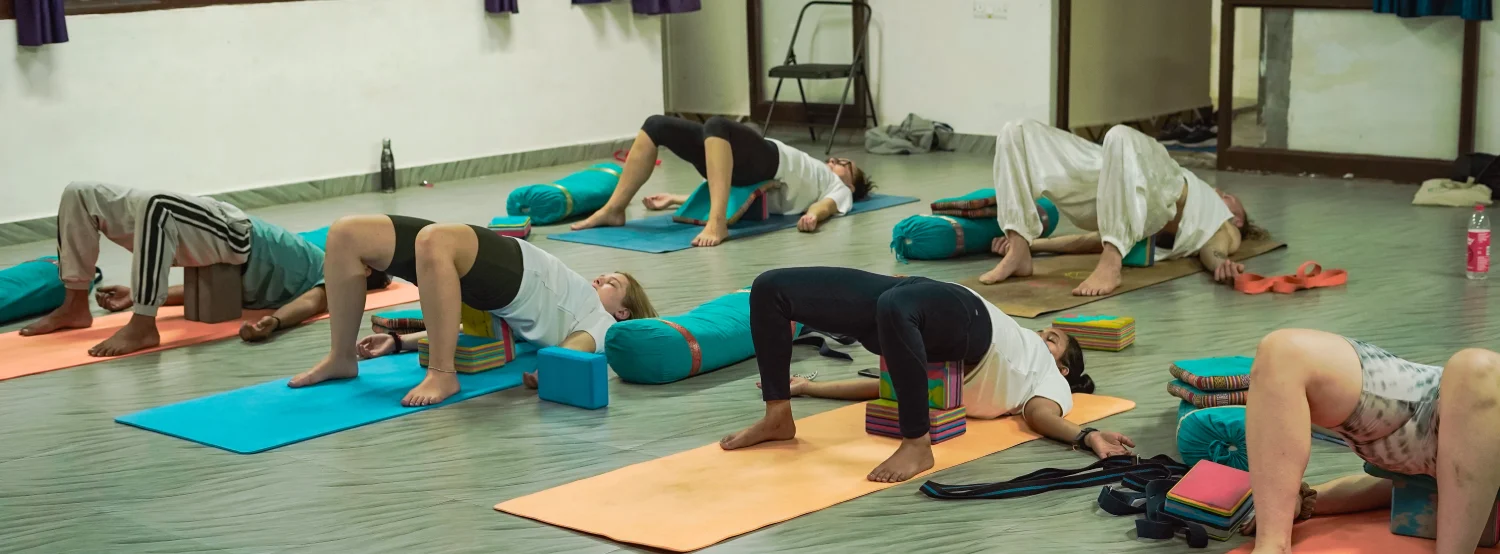
During a typical 200-hour programme, practical teaching may include several activities:
- Short teaching demonstrations: You practise introducing a pose, explaining alignment, or guiding a breathing exercise.
- Peer-led classes: You take turns teaching classmates while others participate as students.
- Complete class practice: You lead a structured session from opening centring through the main sequence to relaxation.
- Instructor observation: Your teachers assess your communication, sequencing, awareness, and ability to respond to feedback.
- Reflection and revision: You identify weaknesses, adjust your lesson plan, and practise again.
The exact format depends on the school’s curriculum. Some programmes schedule formal teaching assessments, while others distribute practical demonstrations across the training.
It is important to distinguish practice teaching from employment. A student practicum is primarily an educational activity; it does not automatically mean you will teach paying clients or receive a paid internship. Ask the school what supervised teaching opportunities are actually included.
If you are comparing certification programmes, review the curriculum and practical components of a 200-hour yoga teacher training course in Rishikesh before enrolling. You can also explore the Maa Ganga Yogashala homepage to understand the school and its available offerings.
For international students, another useful reference is Yoga Alliance’s official website, where you can learn about its registration framework and teacher-training standards. Remember that completing a course, receiving a certificate, and qualifying for a particular professional registration are related but distinct matters.

How Does the Practice Teaching Internship Work During a 200-Hour YTT?
The practical teaching component usually develops progressively. You are not expected to walk into the training centre on day one and lead a flawless 60-minute class.
Instead, you build competence through smaller exercises, guided instruction, peer practice, and increasingly complete teaching sessions. The sequence below illustrates a common approach, although individual schools may organise their schedules differently.
Stage 1: Observe and understand
Initially, you learn by watching experienced teachers. Notice how they introduce a class, demonstrate movements, explain breathing, and transition between poses.
Pay attention to the difference between performing a posture and teaching it. A teacher might spend only a few seconds in a position while students need several clear instructions to enter it safely.
Stage 2: Teach individual components
You may begin by explaining a familiar asana, guiding a short warm-up, or leading a breathing exercise.
These small exercises help you practise speaking clearly without having to manage an entire session. You also learn to use simple, actionable cues instead of long explanations.
Stage 3: Plan and lead a sequence
As your confidence grows, you start connecting individual poses into a logical class. You must consider preparation, intensity, transitions, rest, and the needs of your intended students.
Your instructor may ask you to explain why you chose particular postures rather than simply reproduce a memorised sequence.
Stage 4: Receive feedback and repeat
After teaching, you discuss what worked and what needs improvement. You might discover that your instructions were unclear, your pacing was too fast, or your final relaxation was rushed.
The next attempt gives you an opportunity to apply that feedback. Repetition matters because confidence develops through deliberate practice, not simply through completing a syllabus.
What does a typical practice session look like?
A session might involve a brief lesson-plan review, a student-led teaching segment, observations from classmates, and feedback from the instructor.
Some sessions focus on one skill, such as verbal cueing or transitions. Others assess whether you can connect multiple skills into a coherent class.
The goal is not to make every student teach identically. It is to develop the judgement needed to guide a class responsibly while building your own teaching style.
Which Skills Will You Develop Through Practical Yoga Teaching?
The real value of a teaching practicum lies in the skills you can demonstrate afterwards. Learning the names of poses is important, but professional teaching requires a much broader set of abilities.
1. Clear verbal communication
Students cannot follow instructions they do not understand. You learn to give concise directions, introduce unfamiliar movements, and explain transitions without overwhelming the room.
For example, instead of offering several alignment corrections simultaneously, you might give one clear instruction and allow students time to respond.
2. Class sequencing and time management
A useful class has a beginning, a middle, and an end. You need to decide how much time to allocate to centring, warm-ups, standing postures, seated work, and relaxation.
Practice teaching helps you recognise when a sequence is too ambitious for the available time. You also learn to adjust without making students feel hurried.
3. Observation and student awareness
Teaching requires more than looking at the front of the room. You need to notice when students are confused, struggling to follow a transition, or choosing a modification.
You will not be able to monitor every detail simultaneously, especially when you are new. However, developing observation skills helps you make better decisions and offer more appropriate options.
4. Safer instruction and appropriate modifications
A responsible teacher understands that students have different abilities, mobility levels, previous experiences, and limitations.
You practise offering alternatives, avoiding pressure to achieve advanced postures, and using consent-based approaches to physical adjustments. You also learn to recognise when a student should stop an activity and seek appropriate professional advice.
5. Confidence under pressure
Your first class may feel uncomfortable. You might forget the next posture or lose track of your planned timing.
Practice teaching gives you a controlled environment in which to recover from mistakes. Over time, you can become more comfortable pausing, checking your notes, or simplifying the sequence rather than pretending everything is perfect.
These abilities are easier to develop when a training programme provides meaningful feedback, opportunities to repeat exercises, and instructors who explain the reasons behind their corrections.
How Are Teaching Practice, Assessments, and Feedback Evaluated?
Practical assessment is not just about whether you can perform a challenging posture. It is about whether you can guide other people through a class with clarity, appropriate preparation, and an understanding of your responsibilities.
The assessment process varies between schools, so you should request the actual evaluation criteria before enrolling. A typical practical assessment may consider the following areas.
| Assessment area | What your instructor may look for |
|---|---|
| Lesson planning | Logical sequence, suitable duration, and a clear class objective |
| Verbal instruction | Understandable cues, appropriate pacing, and clear transitions |
| Asana knowledge | Accurate explanations and awareness of common alignment concerns |
| Class management | Timekeeping, preparation, and the ability to maintain a coherent session |
| Student awareness | Modifications, observation, and appropriate responses to difficulties |
| Professional conduct | Respect, boundaries, inclusivity, and willingness to receive feedback |
What happens if you make mistakes?
You should expect mistakes. The purpose of practice teaching is to identify them while you still have an instructor available to guide you.
Perhaps you forget a transition, use an unclear instruction, or spend too long explaining a pose. Your teacher may ask you to reflect on the problem, demonstrate an improved approach, or repeat the exercise.
A constructive assessment should help you understand both what went wrong and how to improve it. If feedback is vague, ask for a specific example and one practical change you can implement in your next session.
Do not assume that every school offers unlimited retakes or identical assessment procedures. Confirm the attendance rules, grading requirements, resubmission opportunities, and consequences of missing a practical session.
Is practical teaching required to graduate?
That depends on the programme’s curriculum and certification requirements. Many structured teacher-training programmes include practical demonstrations and assessments, but the exact pass criteria and number of teaching hours can differ.
Before paying your fees, establish what counts as supervised teaching, whether you must lead a complete class, and how your performance is evaluated.
For broader context on yoga-related health and wellness initiatives in India, you can also visit the Ministry of AYUSH website. Use official sources to distinguish general guidance from the specific curriculum and assessment rules set by your training school.
How to Prepare for Your First Teaching Practice Session
You do not need to eliminate every nervous feeling before you teach. You need a preparation process that makes the session manageable, even when your confidence is still developing.
Start with a simple lesson plan. Choose a clear objective, such as introducing foundational standing postures or guiding a gentle beginner-friendly sequence. Trying to demonstrate every pose you know usually makes a first lesson harder than necessary.
Write down your sequence. Include the opening, warm-up, main poses, transitions, counterbalancing movements where appropriate, and final relaxation. Add brief notes about the purpose of each section.
Practise speaking aloud. Mentally rehearsing a class is not the same as teaching it. Speak your instructions while moving through the sequence, and notice where you become confused or use unnecessarily complicated language.
Rehearse transitions. Students often struggle more with moving between poses than with holding a familiar posture. Make sure you can explain how to enter and leave each position without rushing.
Prepare alternatives. Consider how students with different experience levels might participate. Offer reasonable options without suggesting that every student must achieve the deepest version of a pose.
Ask for focused feedback. After your practice, request comments on two or three specific areas. For example, ask whether your instructions were clear, whether the sequence flowed logically, and whether you managed your time effectively.
A practical first-class checklist
Use this checklist before leading a teaching session:
- My class has a clear objective and suitable duration.
- I have rehearsed the sequence and its transitions.
- I can explain each movement in simple language.
- I have considered suitable modifications and rest options.
- I know how I will open and close the class.
- I am prepared to pause, simplify, or adapt if necessary.
- I have arranged to receive feedback after teaching.
If you are concerned about nervousness, explore these practical tips for teaching your first yoga class. You can also use a yoga class plan template for new teachers to organise your sequence and refine it throughout your training.

Why Rishikesh Is a Meaningful Place to Learn Yoga Teaching
Rishikesh offers an environment in which yoga study, daily practice, and opportunities for cultural learning can come together. Its yoga schools, ashrams, spiritual traditions, and setting near the Ganga attract practitioners from India and abroad.
For a student learning to teach, the location can enrich the experience, but it does not replace a strong curriculum. A beautiful view of the Himalayas will not improve your teaching skills unless you put in the work of planning classes, practising instructions, and learning from feedback.
The most useful training environment is one that balances physical practice with anatomy, teaching methodology, philosophy, and supervised practical work.
You may also benefit from learning alongside students with different backgrounds. International participants can bring varied yoga experiences, while Indian practitioners may have different levels of familiarity with traditional concepts and Sanskrit terminology. Explaining ideas to people with different levels of understanding can strengthen your communication skills.
At the same time, living in Rishikesh requires practical preparation. Consider accommodation, meals, transport, weather, course intensity, and time away from work or family. A residential programme may have a demanding daily schedule, so allow enough time for rest and independent study.
If you are not ready to commit to a full teacher-training course, a shorter five-day yoga retreat in Rishikesh can offer an introduction to a structured yoga routine. You can also compare it with a three-day yoga retreat in Rishikesh. A retreat, however, should not be confused with a professional teacher-training qualification.
Your priority should be to choose an environment where you can learn consistently, ask questions freely, and receive honest feedback about your progress.
Choosing a 200-Hour YTT School for Meaningful Teaching Practice
Not every programme offers the same level of practical instruction. If teaching is your primary goal, compare schools on the quality of their teaching practicum rather than selecting a course solely because of its location, price, or marketing claims.
Begin by examining the published curriculum. Look for teaching methodology, class sequencing, communication skills, anatomy, and supervised practice. Ask whether students lead complete classes or only perform short demonstrations.
Next, investigate instructor involvement. Will your teacher observe your class and provide individual feedback? Can you ask questions after an assessment? Are you given opportunities to improve and demonstrate progress?
Class size also matters. A large cohort may provide a lively learning environment, but it can limit individual feedback if teaching sessions are poorly organised. Ask how practical sessions are divided and how much direct observation each student receives.
You should also clarify the total cost. Understand what tuition includes, whether accommodation and meals are covered, and whether there are additional charges for assessments, materials, or certificates. The guide to 200-hour YTT fees in India and what is included can help you prepare better questions.
Finally, distinguish between a course certificate and a promise of employment. A 200-hour qualification can establish a foundation for teaching, but it does not guarantee students, clients, a job, or a particular salary.
A useful school will explain its training structure honestly and help you understand what you can reasonably expect to do by graduation.
Begin Your Teaching Practice with Maa Ganga Yogashala
Choosing a training programme is a personal decision, especially when your goal is to move from practising yoga to teaching it professionally. You need a course that supports your development through structured learning, consistent practice, and opportunities to understand your strengths and weaknesses.
At Maa Ganga Yogashala, located in Tapovan on Badrinath Road, Rishikesh, our yoga teacher training offering provides a starting point for exploring a structured approach to yoga education and practice. You can review our 200-Hour Yoga Teacher Training in Rishikesh to learn more about the course before deciding whether it matches your goals.
Before enrolling, ask about the current curriculum, supervised teaching hours, practical assessment criteria, class size, accommodation, and certification arrangements. These details will help you make an informed decision instead of relying on assumptions about what a teaching internship includes.
FAQs About Practice Teaching in a 200-Hour YTT
How much teaching practice should you expect in a 200-hour YTT?
The amount of practical teaching varies by school and curriculum. Ask for a breakdown of supervised teaching hours, peer-led classes, demonstrations, and formal assessments. Confirm whether those hours involve observing, assisting, or independently leading a session, because these activities provide different levels of teaching experience.
Do you need previous teaching experience before joining?
Generally, you do not need to be an experienced yoga teacher to enrol in an entry-level teacher-training programme. You should, however, check the school’s prerequisites for personal practice, physical readiness, and course participation. A willingness to learn, accept feedback, and practise consistently is important.
Will you teach a real yoga class during the internship?
You may teach classmates or participate in supervised teaching sessions, depending on the programme. Teaching members of the public or paying clients is not automatically included. Ask the school exactly who participates in practice classes, whether external students are involved, and what supervision is provided.
Does completing a 200-hour YTT guarantee a yoga teaching job?
No. Completing a course can provide foundational knowledge and a certificate, but employment depends on your skills, professional requirements, location, experience, and ability to find opportunities. You may need further practice, networking, continuing education, and experience before building a sustainable teaching career.
How can you become more confident before your final assessment?
Prepare a realistic lesson plan, rehearse aloud, practise transitions, and ask for feedback on specific teaching skills. Avoid making your first assessment unnecessarily complicated. Clear communication, thoughtful sequencing, and an ability to adapt are more valuable than trying to impress students with advanced poses.
Conclusion: Turn Your Yoga Knowledge into Teaching Skills
A practice teaching internship 200 hour YTT is an opportunity to discover what it really means to guide a yoga class. You learn to organise a sequence, communicate clearly, observe students, make appropriate adaptations, and respond constructively to feedback.
Your first teaching session may feel awkward. That is not evidence that you are unsuited to teaching; it is a reason to practise, reflect, and improve. What matters is whether your training gives you the guidance and opportunities needed to develop responsibly.
If you are ready to take the next step, explore our 200-Hour Yoga Teacher Training in Rishikesh. Review the curriculum, clarify the practical teaching requirements, and choose a programme that aligns with your learning goals.
Start preparing for your future as a yoga teacher today. Make an informed choice, commit to consistent practice, and build your teaching skills one class at a time.