Online vs In Person 200 Hour YTT: Which Path Brings True Growth?
Deciding between an online vs in person 200 hour YTT is one of the most crucial choices you will ever make for your personal practice. You are standing at a major crossroads in your yoga journey.
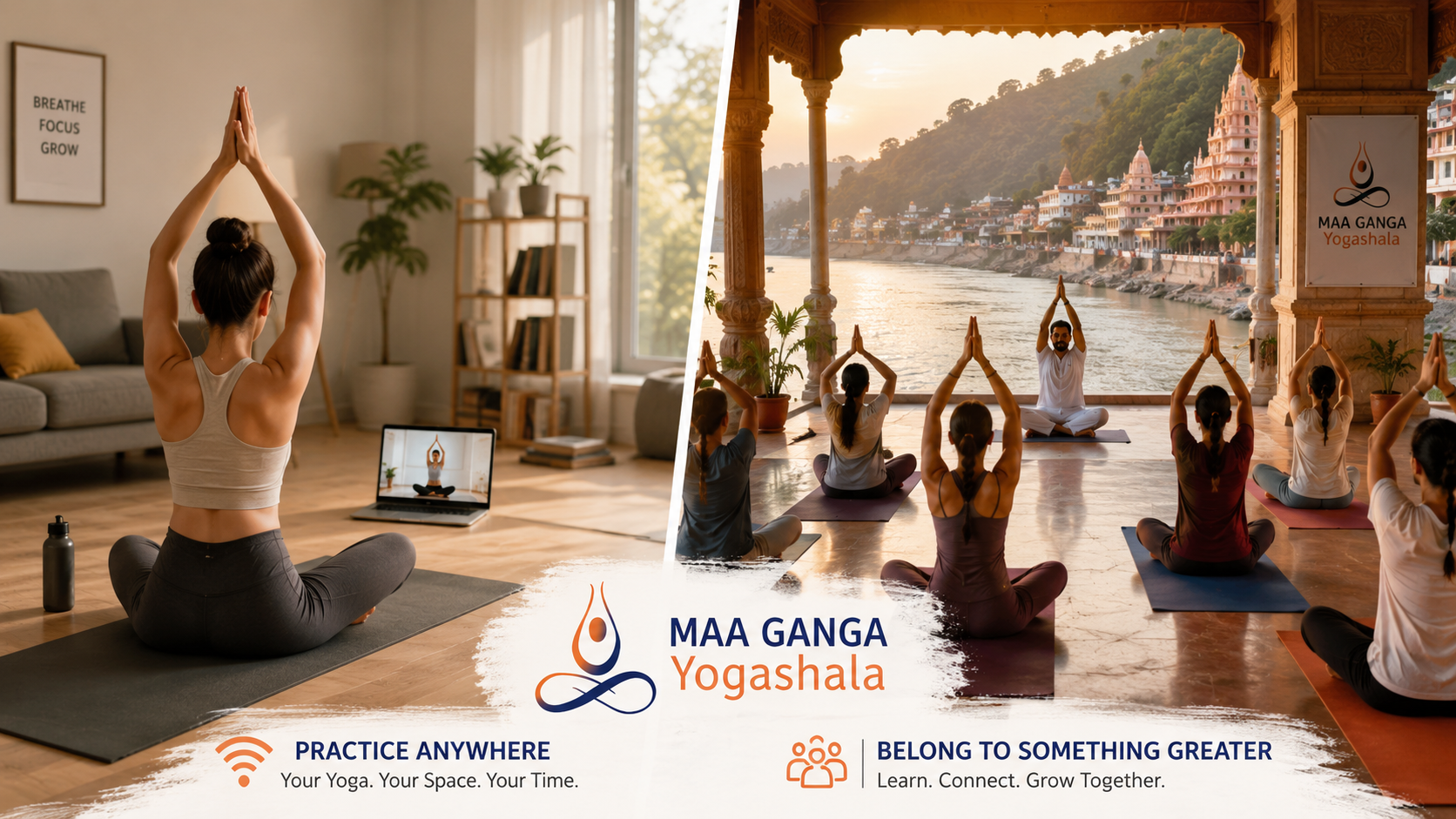
One path offers the ultimate convenience, allowing you to unroll your mat right in your living room. The other demands you pack your bags, leave your comfort zone, and step into the vibrant energy of a traditional ashram.
Both routes will grant you a certification to teach. But only one will completely reshape how you breathe, move, and deeply understand the ancient science of yoga.
You might be wondering if a screen can truly transmit the subtle, powerful energy of a master teacher. You might also question if the significant investment of traveling to India is genuinely worth the time and effort.
This comprehensive guide will walk you through the undeniable, practical realities of both formats. We will thoroughly explore the vital differences in physical adjustments, philosophical depth, and community connection.
By the end of this guide, you will know exactly which training style aligns with your future teaching goals.
The Core Foundation: Online vs In Person 200 Hour YTT
When you evaluate an online vs in person 200 hour YTT, you must look far beyond the printed syllabus. The core foundation of yoga is not just about memorizing sequences and Sanskrit names.
It is about a deeply rooted lineage of knowledge passed directly from a master teacher to a receptive student. In an online format, you undoubtedly receive incredible flexibility and control over your environment.
You dictate the daily schedule. You can pause a difficult lecture to take meticulous notes, or easily replay a complex anatomy breakdown until you understand it.
However, this modern convenience comes with a profound, often overlooked trade-off. You are learning in a digital vacuum. Your primary relationship is with a glowing rectangle rather than a living, breathing guide.
Institutions like Yoga Alliance have adapted their global standards to recognize both formats in recent years. This means your printed certificate holds identical weight on paper regardless of how you choose to study.
Yet, a piece of paper does not teach a room full of anxious beginners how to breathe properly. Only lived, hands-on experience does that.
When you are physically present in a traditional shala, the most vital learning happens in the quiet spaces between the scheduled classes. You actively absorb the quiet discipline of the lead teacher.
You observe exactly how they compassionately handle a student’s emotional breakdown during a deep hip-opening sequence. You physically feel the changing pacing and energy of the room.
These subtle, invisible nuances form the absolute bedrock of your future teaching career. They are entirely absent when you simply log off a video call and walk back into your kitchen.
Furthermore, your physical environment dictates your mental focus. At home, you remain constantly bound by your daily responsibilities. The laundry, the incoming emails, and the family demands constantly pull your mind away from the present moment.
An offline certification forces a complete, necessary pattern interrupt in your daily life. You leave your entire world behind to focus entirely on a single, singular goal.
This total immersion creates a powerful psychological container for deep internal work. You cannot simply escape into your normal routines when the physical practice gets challenging. You must learn to sit with the discomfort.
The ability to remain calmly present through difficulty is exactly what you will eventually teach your own future students. Building that mental capacity requires an unbroken, immersive environment.
Mastering Alignment: Online vs In Person 200 Hour YTT Realities
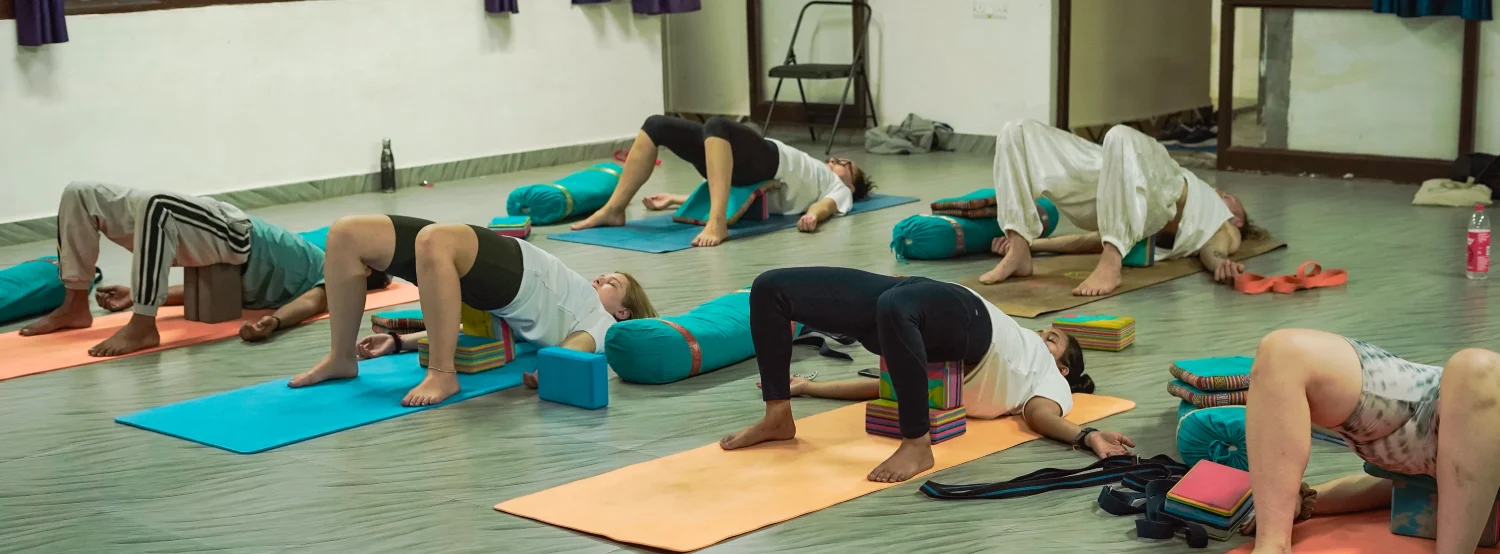
The most glaring, practical difference in any online vs in person 200 hour YTT is the reality of physical touch. Yoga is fundamentally an experiential, fully embodied practice. It is not a theoretical or intellectual exercise.
When you practice alone at home, your laptop camera only captures a very specific, limited angle of your body. The teacher on the screen simply cannot see the dangerous micro-bend in your lower back.
They cannot see the uneven weight distribution in the arches of your feet. If you repeatedly practice a complex transition like Chaturanga with a collapsed shoulder online, nobody will physically correct you.
You risk building your entire teaching foundation on dangerous biomechanical habits. In a physical studio space, a skilled teacher constantly walks the room.
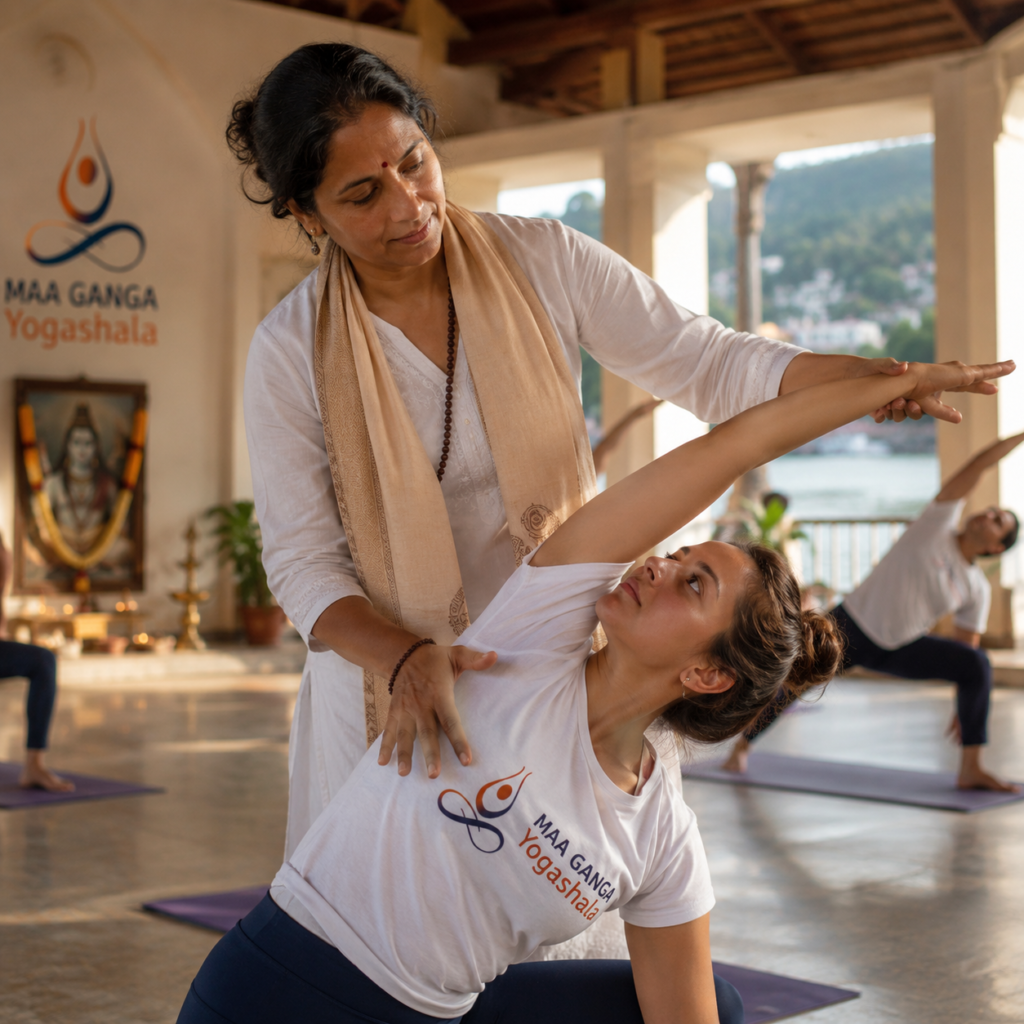
They use precise, hands-on adjustments to instantly guide your body into the safest, most effective alignment. You feel exactly where the muscular engagement should happen.
That physical memory embeds itself deeply and permanently into your nervous system. You cannot replicate that powerful tactile feedback through verbal screen cues alone.
To understand the intensive, progressive nature of this physical work, explore our 200 Hour YTT Duration Timeline. It details exactly how consistent, daily physical correction builds true mastery over time.
Moreover, successfully learning how to adjust others requires continuous physical practice. You must actually feel different bodies, different flexibilities, and different skeletal limitations.
You have to practice placing your hands safely and confidently on your peers. You learn exactly how much pressure is helpful, and how much is too much.
You discover how to support a newer student without making them feel vulnerable or exposed. A virtual training completely removes this crucial tactile module from your reality.
You might watch an excellent high-definition video on adjustments, but watching is never the same as doing. When you finally stand at the front of your own class, you need absolute confidence in your hands.
You need to know exactly how to guide a student deeper into an intense asana safely. Without an in-person training ground, you are left merely guessing.
Guessing in yoga anatomy quickly leads to student injuries and a loss of professional trust. A traditional immersion ensures you develop the confident, highly precise touch of a seasoned professional guide.
The Energetic Sangha: Why Community Changes Everything
The word yoga directly translates to union. Yet, logging into an isolated virtual portal is an inherently solitary, disconnected experience.
Choosing an online vs in person 200 hour YTT fundamentally alters how you connect with others during your most vulnerable moments. In a traditional setting, you enter a “Sangha” — a dedicated community of like-minded seekers.
You sweat together, you struggle together, and you break through massive mental barriers together. The collective energy in a room full of intensely dedicated practitioners is truly palpable.
When you are completely exhausted during the ninth repetitive sun salutation, the synchronized, collective breath of the room literally carries you forward. You cannot feel that collective breath through a computer speaker.
You are entirely reliant on your own solitary willpower. Beyond the physical mat, the social bonds formed during a traditional yoga immersion are incredibly profound.
You share nourishing meals, you share your deepest doubts, and you share massive personal realizations. These peers rapidly become your global support network for the rest of your teaching career.
They understand exactly what you went through because they were sitting on the mat right next to you. The isolation of an online certification often leaves new teachers feeling adrift and entirely unsupported.
You might have a friendly chat box, but you do not have a physical shoulder to lean on after a heavy, unexpected emotional release.
You can read more about how this profoundly supportive environment shapes your journey in our guide to Tapovan Rishikesh Yoga. The specific location itself actively fosters these deep, lifelong connections.
Emotional releases are a completely normal, expected part of any intensive yoga training. Ancient poses store old trauma, and deep, focused breathing inevitably releases it.
When this happens in a physical shala, a highly skilled teacher actively holds space for you. They expertly ground the chaotic energy of the room.
They ensure you feel entirely safe, seen, and supported throughout the process. When it happens alone in your quiet bedroom, it can be overwhelmingly isolating and frightening.
The physical presence of a compassionate teacher and supportive peers provides a crucial, irreplaceable psychological safety net. This energetic exchange is the invisible curriculum of your training.
It is never formally written on a syllabus, but it is the most absolutely vital component of your growth as a human being.
Diving Deep: Philosophy Beyond the Textbooks
Studying ancient yogic texts is a strict requirement for any valid certification. However, the method of delivery drastically changes your actual comprehension in an online vs in person 200 hour YTT.
Yoga philosophy is not meant to be passively consumed like a television show. It is meant to be actively debated, fiercely questioned, and deeply experienced.
When you read about the Eight Limbs of Yoga Philosophy through a PDF online, it often remains dry intellectual theory. You memorize the complicated Sanskrit terms simply to pass a multiple-choice quiz.
In a physical, traditional setting, a master teacher breathes vibrant life into the Yoga Sutras. They share powerful real-world examples from their own decades of practice.
They challenge your personal interpretations and push you to think critically. You can raise your hand and ask exactly how non-attachment applies to modern, everyday grief.
A dynamic, highly organic conversation unfolds that simply cannot happen in a pre-recorded, static video module. Furthermore, your physical environment heavily influences your cognitive absorption and retention.
Extensive studies published on platforms like PubMed emphasize that immersive, distraction-free environments significantly enhance deep learning. When you are completely disconnected from your daily stressors, your brain enters a highly receptive state.
You are not just temporarily memorizing ancient concepts; you are actively living them every single hour of the day. The philosophical teachings naturally seep into your daily actions and interactions.
You actively practice non-violence (Ahimsa) when dealing with your own tired, aching body. You actively practice truthfulness (Satya) in your vulnerable interactions with your new peers.
The intensive ashram environment forces you to confront your own ego constantly. You cannot simply turn off your camera or hide behind a muted microphone when things get difficult.
Your true nature is exposed, challenged, and ultimately refined into something stronger. This constant, real-time application of philosophy is the true bridge between a casual yoga practitioner and a masterful guide.
It requires continuous friction. It requires real, unscripted human interaction to truly take root in your soul.
The True Cost: Investment vs Real Return in YTT Formats
It is impossible to discuss training formats without addressing the financial and time commitments involved. Online programs are undeniably cheaper upfront and require zero travel expenses.
You save money on flights, accommodation, and time taken off from your regular employment. For many practitioners, this makes the dream of certification accessible when it otherwise would be impossible.
However, you must evaluate the long-term return on your educational investment. A cheaper program that leaves you feeling unconfident to physically teach a live class ultimately costs you more.
If you graduate but feel too insecure to rent a studio space or guide a student manually, the certification loses its practical value. The higher upfront cost of an immersive training includes far more than just the curriculum.
You are paying for round-the-clock mentorship, direct access to master teachers, and a dedicated environment designed solely for your growth. You are investing in real-time error correction that prevents future liabilities.
When you graduate from an intensive, in-person program, the confidence you project naturally attracts dedicated students. This confidence rapidly translates into a much faster return on your initial investment as you build your career.
Why Rishikesh? The Unmatched Power of the Yoga Capital
If you decide that a traditional, in-person immersion is your true path, the geographical location becomes your most crucial choice. Rishikesh is not just another bustling city; it is a highly charged, living entity.
Practicing your daily sadhana here offers an experience that absolutely no western commercial studio can ever replicate. The air itself feels thick with decades of continuous, unbroken spiritual practice.
From the exact moment you arrive, the sensory shift is absolute and undeniable. The resonant sound of temple bells echoes constantly off the towering Himalayas.
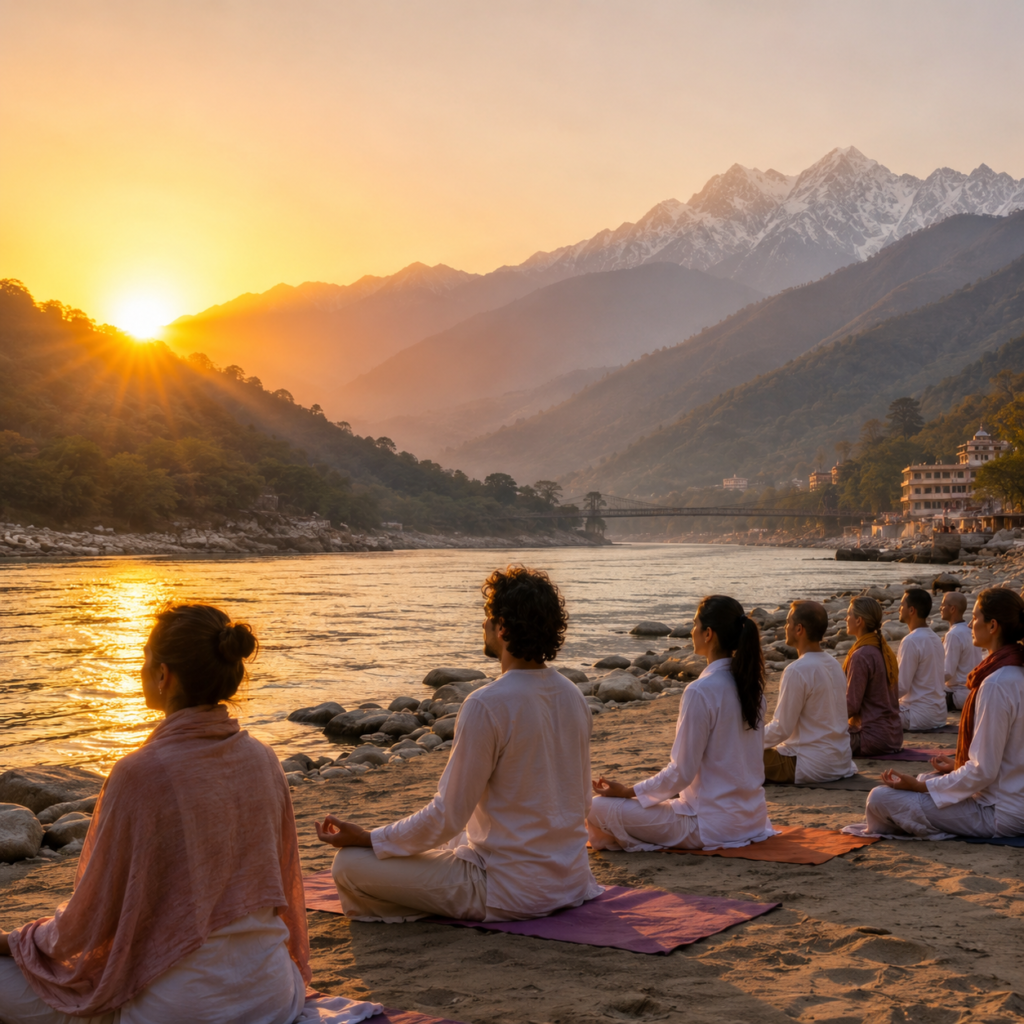
The sacred, rushing waters of the Ganga river provide a constant, deeply grounding rhythm to your daily life. This specific region is the recognized birthplace of the exact traditions you are studying.
To study here is to drink directly from the purest source of the knowledge. When you finally step off the mat for the day, your profound education continues seamlessly.
You witness wandering, dedicated sadhus on the streets. You actively participate in powerful, heart-opening evening Aarti ceremonies by the water.
The entire town uniquely revolves around the singular pursuit of spiritual growth. This intense level of cultural immersion completely shifts your western worldview.
It quickly strips away the heavily commercialized, superficial layers of modern fitness yoga. It powerfully reconnects you with the devotional, deeply spiritual roots of the ancient practice.
You learn very quickly that yoga is a complete, holistic lifestyle, not just a one-hour physical workout. For those looking to safely taste this powerful energy before committing to a full month, a 5 Days Yoga Retreat in Rishikesh provides the perfect introduction.
It gently allows your western nervous system to acclimate to the powerful, shifting vibrations of the Himalayas. You quickly realize exactly why millions of dedicated seekers have traveled to these exact riverbanks for centuries.
The unique geographical energy of Rishikesh acts as a spiritual accelerant. What might take years to mentally process in a quiet city apartment often surfaces within days here.
It is an intense, beautiful, and profoundly challenging environment. It rightfully demands your full presence and rewards you with absolute, unshakable clarity.
Taking the Next Step With Authentic Guidance
Deciding exactly where to train is incredibly overwhelming, especially with thousands of modern schools claiming to be the absolute best. You need a safe environment that fiercely honors tradition while providing expert, compassionate modern guidance.
If you are seriously considering training in Rishikesh, Maa Ganga Yogashala offers a true sanctuary for dedicated practitioners. We focus intensely on authentic teachings, small intimate class sizes, and deep personal attention.
Our lead teachers have completely dedicated their entire adult lives to these profound practices. They do not just mechanically teach the required syllabus; they embody the yogic lifestyle completely.
Beyond standard global certifications, we actively guide our students through profound internal energetic shifts. For example, our highly focused Chakra Balancing sessions help clear deeply rooted energetic blockages during your transformative stay.
We completely understand the massive, terrifying leap of faith it takes to travel across the entire world for this specific education. Our entire team is deeply dedicated to ensuring you feel supported, safe, and continuously challenged from the moment you arrive.
If you find yourself short on time but hungry for authenticity, you can also start your journey with our immersive 100-Hour Yoga Teacher Training in Rishikesh.
Frequently Asked Questions About YTT Formats
Is online YTT globally recognized by all studios?
Yes, online certifications are widely recognized globally if the school is fully registered with the appropriate international yoga alliances. However, you must always verify the specific teaching requirements in your own home country. Some premium, high-end studios strongly prefer hiring teachers with traditional, in-person training backgrounds specifically due to the extensive hands-on practicum experience it provides.
Can I realistically teach immediately after an in-person course?
Absolutely. A major, undeniable advantage of traditional training is the extensive, daily live practicum. You spend countless hours physically teaching your peers in real-time under expert supervision. This builds massive, unshakable confidence. By graduation day, you are fully prepared to confidently lead a room safely. You can read more about building a successful, sustainable Yoga Teacher Career After 200 Hour TTC.
Do I need highly advanced physical skills for an in-person YTT?
No, absolutely not. Teacher training is fundamentally about learning how to teach effectively, not performing visually impressive acrobatic feats. A traditional, authentic school warmly welcomes all body types, ages, and skill levels. In fact, learning exactly how to modify difficult poses for your own physical limitations makes you an infinitely better, vastly more empathetic teacher for your future diverse students.
Will I deeply miss out on community if I choose an online program?
Often, yes. While digital online communities certainly exist, they very rarely replicate the profound, enduring bonds formed during a physical, offline immersion. Sharing daily meals, navigating intense physical soreness, and experiencing raw emotional breakthroughs physically together creates a highly unique, lifelong global support system that virtual chat platforms simply struggle to match.
Conclusion and Your Path Forward
Choosing between an online vs in person 200 hour YTT ultimately comes down to exactly what kind of teacher you genuinely want to become. A virtual program will undoubtedly give you the intellectual knowledge and the official, required paperwork needed to start your teaching journey.
It is a highly convenient, accessible path for those with strict boundaries on their time and location. However, if you genuinely want to master the subtle, powerful arts of physical adjustment, read the shifting energy of a crowded room, and undergo a genuine personal transformation, an immersive environment is entirely non-negotiable.
The necessary friction of real, unfiltered human connection is exactly where the deepest learning always occurs. You must honestly decide if you want to merely learn about yoga, or if you want to truly live it.
Traveling to the very source strips away your comfortable, familiar zone. It demands absolutely everything you have, and in return, it beautifully rebuilds you from the ground up.
If you are seeking that rare level of profound, cellular change, we are here to expertly guide you. The sacred banks of the Ganga are waiting patiently for your practice.
Ready to begin? Explore our traditional 200-Hour Yoga Teacher Training in Rishikesh and take the very first step toward true mastery today.