
Binaural Beats vs Singing Bowls Healing: Which Healing Frequency Works Better?
Introduction
Binaural beats vs singing bowls healing is a surprisingly useful comparison if you use sound to settle your mind, deepen meditation, or support a yoga practice. You may put on headphones and hear two slightly different tones, or sit in a room while a singing bowl produces a rich, physical vibration—and wonder which one actually works better.
The honest answer is that neither method wins for everyone. They create sound in very different ways, and your response depends on what you want from the session, how you listen, and how comfortable you feel with the practice.
Binaural beats are an audio illusion created when slightly different frequencies are presented separately to each ear. Singing bowls create complex acoustic tones and harmonics that you can hear and, at close range, sometimes feel as vibration.
You will learn how these approaches differ, what current evidence can and cannot tell you, when each may fit meditation or yoga, and why Rishikesh is a natural place to explore sound-based practices without treating them as magic cures.
Binaural Beats vs Singing Bowls Healing: What Is Actually Happening?
Before choosing a method, it helps to separate the experience from the claims surrounding it. Both approaches use sound, but the way the sound reaches you is fundamentally different.
With binaural beats, you normally listen through headphones. One ear receives one steady tone and the other ear receives a tone with a slightly different frequency. Your brain perceives a third rhythmic fluctuation corresponding to the difference between those tones. For example, if the two tones differ by 6 Hz, the perceived beat is around 6 cycles per second.
That does not mean your brain is being “forced” into a particular state. Marketing sometimes makes binaural beats sound like a switch that instantly creates meditation, sleep, focus, or healing. Evidence is more nuanced. Research has explored effects on anxiety, attention, sleep, and pain perception, but study designs and results vary.
Singing bowls work differently. A bowl is struck or rubbed around its rim, producing a fundamental tone plus multiple harmonics. The sound changes according to the bowl’s size, material, shape, technique, and the room around you. You do not need headphones, and the experience is often social or guided.
If you want a broader understanding of yoga’s professional standards and training context, you can also explore Yoga Alliance.
The biggest practical distinction is simple: binaural beats are highly controlled electronic audio, while singing bowls are an acoustic, embodied experience. One is convenient and repeatable; the other is more dependent on the instrument, practitioner, environment, and your physical proximity to the sound.
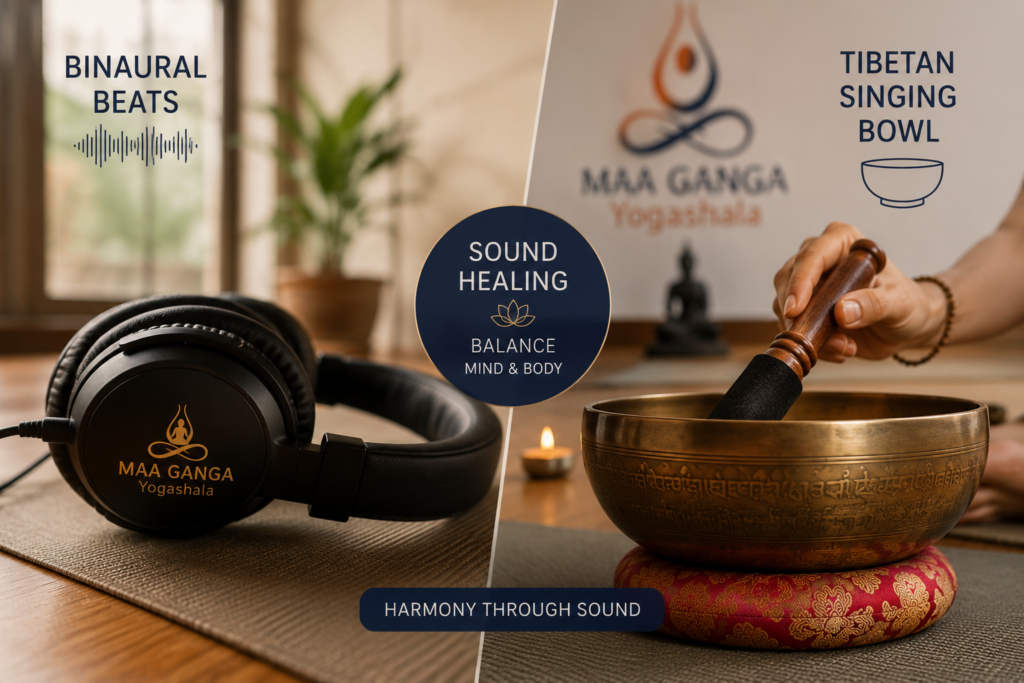
Binaural Beats or Singing Bowls for Meditation?
Your goal matters more than the label “healing frequency.” If you want a predictable background for a solo meditation, binaural beats can be convenient. You can choose a track, use headphones, sit quietly, and repeat roughly the same setup whenever you practice.
That consistency can be useful. If your mind becomes less distracted when you hear a steady sound, the audio may become a familiar cue for sitting down and slowing your breathing. But the benefit may come partly from the ritual, reduced distraction, expectation, and time spent resting—not necessarily from a special frequency doing something mysterious to your brain.
Singing bowls can offer a different kind of attention anchor. Instead of following a digital track, you listen to the attack of the bowl, the decay, the changing harmonics, and the silence that follows. That fading sound can give you a natural reason to notice when your attention wanders and return to listening.
Which one feels more immersive?
You may find bowls more immersive if you respond strongly to acoustic sound and prefer a shared practice space. The sound exists in the room, so you can hear changes in volume and resonance rather than receiving an identical recording every time.
Binaural beats may suit you better when privacy, portability, and repeatability matter. You can practice in a hotel room, before bed, or after a long day of travel without carrying a bowl.
Neither option is automatically deeper. If headphones make you uncomfortable, a binaural session can become distracting. If you dislike strong resonant sounds, a bowl may not feel relaxing either.
For practical preparation ideas before attending a sound session, see our guide to sound healing session preparation tips. If you are comparing formats, our guide to group vs private sound healing sessions can help you decide which setting fits you.
Singing Bowls vs Binaural Beats: What Does the Evidence Say?
This is where you should be skeptical of exaggerated promises. Sound can influence mood and attention, but that does not automatically prove that a particular frequency heals a disease, balances every chakra, or repairs a specific organ.
Some studies of binaural beats report possible effects on anxiety, cognition, sleep, or pain-related outcomes. However, results are not uniform, and the quality of evidence differs between outcomes. Listening to a track can also overlap with familiar relaxation practices such as slow breathing, meditation, or simply taking a break.
Research on singing bowls and related sound-based interventions has also reported promising findings for relaxation, perceived stress, mood, and well-being. Yet many studies are small, use different protocols, or measure subjective outcomes. That means you should treat the evidence as encouraging rather than definitive.
A useful rule is this: if a teacher says sound may help you relax, focus inward, or create a supportive meditation environment, that is a reasonable claim. If someone promises that one exact frequency will cure a medical condition, replace medication, or guarantee a spiritual awakening, be cautious.
You can explore the broader public-health and traditional-medicine context through the Indian Ministry of AYUSH at AYUSH, while keeping complementary practices separate from evidence-based medical treatment.
Sound practices can be valuable without needing extraordinary claims. A calmer nervous system, a few minutes of uninterrupted attention, and a consistent meditation ritual are already meaningful outcomes.
How to Choose the Right Sound Healing Method for You
Instead of asking which method is universally “better,” match the method to your situation. Start with the outcome you actually want.
Choose binaural beats when:
- You prefer practicing alone and want a portable option.
- You like consistent audio that can be repeated easily.
- You are comfortable using headphones.
- You want sound to provide a subtle background while you meditate, breathe, or rest.
- You want to experiment with different audio tracks and observe your own response.
Choose singing bowls when:
- You enjoy acoustic instruments and live sound.
- You want a guided or group experience.
- You find the gradual decay of a bowl helpful for concentration.
- You prefer meditation without headphones.
- You want the sound environment itself to become part of the practice.
You can also combine them, but there is no need to layer several frequencies just because more sound seems more powerful. A simple practice is often easier to evaluate.
Try one method for several sessions and keep your expectations modest. Before starting, rate your stress or mental restlessness from 1 to 10. Afterward, record how settled, alert, or distracted you feel. You are not running a clinical trial, but this simple observation can reveal whether a practice genuinely suits you.
Also remember that “healing frequency” is often used loosely online. A frequency measured in hertz is a physical property of a sound. The claim that a particular number has a universal healing effect is a much stronger statement and needs much stronger evidence.
Why Rishikesh? Sound, Yoga, and a Better Practice Environment
Rishikesh can make sound practices feel different because your surroundings encourage slower attention. You can explore our Rishikesh yoga programs if you want to build sound work into a wider practice. If you have several days available, a 5-day yoga retreat in Rishikesh gives you more time to settle into a steady rhythm.
That context matters. Your experience of a singing bowl is not only about the bowl. It includes the teacher’s pacing, the room’s acoustics, your posture, your breathing, and whether you arrive mentally prepared to listen.
The same is true for binaural beats. Headphones cannot compensate for constant notifications, poor posture, rushing through the session, or choosing an uncomfortable audio track. The technology is only one part of the practice.
If you want to connect sound with a broader yoga routine, learning about the spiritual significance of the Ganga in Rishikesh can add useful cultural context to your time in the city. You can also read about sound healing and chronic pain research if you want to separate promising findings from stronger medical claims.
You also do not need to turn every session into a mystical event. A ten-minute practice in which you sit comfortably, breathe naturally, listen carefully, and notice your mental state can be more useful than a complicated ritual you rarely repeat.
Explore Sound Healing in Rishikesh with Maa Ganga Yogashala
If you want to experience sound practice in a structured yoga setting, we offer sound healing in Rishikesh as part of a broader approach to relaxation, awareness, and yogic practice.
A Simple 7-Day Sound Practice Experiment
You do not need to make a major commitment to find out which approach suits you. A short personal experiment can be more useful than relying on someone else’s claim about the “best” frequency.
For seven days, keep the basic conditions similar. Practice at roughly the same time, sit in the same comfortable position, and give yourself 10–20 quiet minutes. On three days, use binaural beats with headphones. On three different days, use a singing bowl recording or attend a live session. Keep one day completely silent.
Before each session, rate your mental restlessness, stress, and ability to concentrate from 1 to 10. Afterward, rate them again. Also record whether the sound felt soothing, distracting, emotionally neutral, or physically uncomfortable.
Look for patterns rather than dramatic changes. Perhaps binaural beats help you settle when you practice alone, while live bowls keep you more attentive. Perhaps silence works better than either. That is useful information, not a failure of sound healing.
This experiment also protects you from confirmation bias. If you expect a particular frequency to produce an extraordinary result, you may interpret normal fluctuations as proof. Tracking your experience gives you a more grounded basis for deciding what belongs in your regular routine.
Stop if a sound causes headache, dizziness, anxiety, or significant discomfort. And if you are dealing with a medical or psychological condition, discuss appropriate treatment with a qualified healthcare professional rather than using sound as a substitute.

FAQs
Are binaural beats better than singing bowls?
Not universally. Binaural beats are convenient, controlled, and easy to repeat, while singing bowls provide an acoustic and often more immersive experience. Your preference, purpose, and environment matter more than choosing a universal winner.
Do singing bowls really have healing frequencies?
Singing bowls definitely produce measurable sound frequencies and harmonics. However, claims that particular bowl frequencies universally heal specific physical or mental conditions go beyond what current evidence can confidently establish. Use sound healing as a complementary wellness practice, not as a replacement for medical care.
Can you use binaural beats without headphones?
Traditional binaural beats depend on delivering different tones separately to each ear, so stereo headphones or earbuds are normally needed for the intended effect. A speaker can still play relaxing music or tones, but that is not the same binaural setup.
How long should a sound healing session last?
There is no single scientifically established ideal duration for everyone. A short 10–20 minute session can be a practical starting point. You can gradually adjust based on your comfort, attention, and response rather than assuming longer always means better.
Can sound healing be combined with yoga?
Yes. Sound can be used alongside meditation, pranayama, restorative yoga, or relaxation practices. The important point is to keep the practice appropriate to your needs and avoid treating sound as a guaranteed medical treatment.
Conclusion: Which Healing Frequency Works Better for You?
Binaural beats vs singing bowls healing is not really a contest with one permanent winner. Binaural beats give you controlled, portable audio that can support a consistent solo practice, while singing bowls offer rich acoustic sound and a more embodied, room-based experience.
If you are curious, test both without exaggerated expectations. Notice which one helps you settle, listen, breathe, and stay present. The most useful “healing frequency” is not necessarily the one with the most impressive claim attached to it; it is the practice you can use safely and consistently.
If you are ready to deepen your yoga practice in Rishikesh, explore our 200-Hour Yoga Teacher Training in Rishikesh and take the next step toward a more intentional practice in Tapovan.