Binaural Beats vs Singing Bowls Healing: Which Healing Frequency Works Better?
Binaural beats vs singing bowls healing sounds can look similar on a wellness playlist, but they work through very different listening experiences. One uses two slightly different tones delivered separately to your ears; the other uses the rich, physical sound and resonance of a struck or played bowl.
If you are choosing a practice for meditation, relaxation, sleep, or a sound-healing session, the better question is not simply which frequency is more powerful. It is which method fits your goal, your environment, and the kind of attention you want to cultivate. You will learn how binaural beats create an auditory beat, how singing bowls produce layered tones, what current research actually supports, and when each approach may be useful.
You will also see why claims about a single “healing frequency” deserve caution. Sound can influence attention, mood, breathing, and relaxation, but neither headphones nor a singing bowl should be presented as a cure for a medical condition.
Binaural Beats vs Singing Bowls Healing: What Is Actually Different?
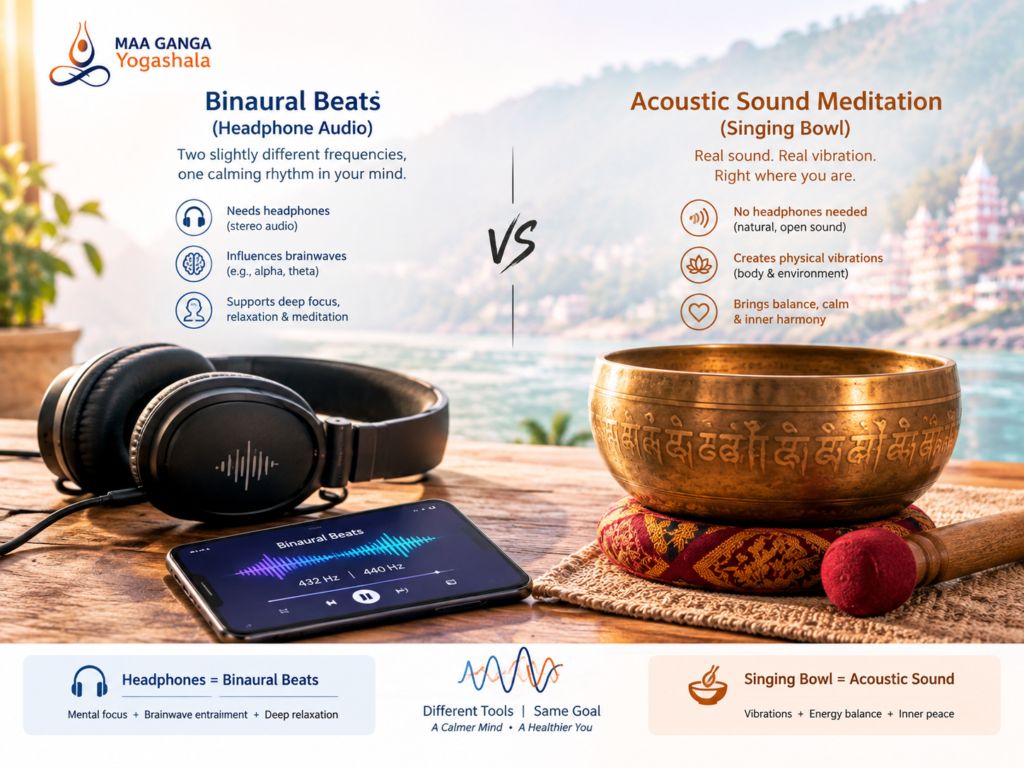
Binaural beats and singing bowls both use sound, yet you experience them in fundamentally different ways.
With binaural beats, you normally hear two tones with slightly different frequencies, one in each ear through headphones. Your auditory system perceives a rhythmic difference between them. For example, tones of 200 Hz and 206 Hz can create a perceived 6 Hz beat. The 6 Hz figure is not a separate tone being played into the room; it is a perceptual effect created by the interaction of the two tones.
That is why headphones matter. If the two tones are mixed together before reaching your ears, you are no longer getting the classic binaural-beat setup.
Singing bowls work differently. A bowl produces a fundamental tone plus overtones and changing resonance. When you strike or rub the bowl, the sound develops, decays, and interacts with the room. You can hear it directly through your ears, while the physical vibration and acoustic character become part of the experience.
Research on binaural beats is promising but not definitive. A meta-analysis indexed by PubMed found an overall medium effect across studies examining cognition, anxiety, and pain perception, while also showing that study conditions and exposure times matter. More recent reviews continue to report potential benefits for anxiety, sleep, and cognition but emphasize small samples and substantial differences between studies. PubMed research is therefore more useful for understanding possibilities than for proving that one frequency works universally.
The practical distinction is simple: binaural beats are designed around an auditory illusion, while singing bowls give you a broader acoustic and sensory experience.
Binaural Beats vs Singing Bowls for Relaxation and Meditation
When you compare these approaches for relaxation, your personal response matters more than a dramatic claim about “the best frequency.”
Binaural beats can be convenient when you want a controlled, repeatable environment. You can choose a track, put on headphones, close your eyes, and remove many external distractions. This can make them useful for meditation, quiet study, breath awareness, or winding down before sleep.
They may also appeal to you if you enjoy structured practices. A track can be the same length every time, and you can experiment with different beat frequencies without changing the rest of your routine.
Singing bowls create a less controlled but often more immersive environment. Their sound has texture, decay, silence between strikes, and natural variation. Instead of following a perfectly repeating audio track, you can use the changing sound as an object of meditation.
This difference can be important. If your mind is constantly chasing thoughts, a sustained bowl tone can give your attention something concrete to notice: the beginning of the sound, its strongest resonance, the gradual fading, and the moment silence returns.
A 2017 observational study of Tibetan singing bowl meditation reported reductions in tension, anger, fatigue, and depressed mood after sessions, along with increased reported spiritual well-being. The study was not proof that singing bowls treat anxiety or depression, but it adds useful evidence that the practice can influence subjective relaxation and mood.
For meditation, you might therefore prefer binaural beats when you want consistency and privacy, and singing bowls when you want a richer, more embodied sound experience.
Do You Need a Specific Frequency?
This is where online sound-healing advice can become misleading.
You will often see claims that a particular number of hertz is automatically connected to a specific chakra, organ, emotion, or healing outcome. Those claims can be meaningful within a spiritual tradition or personal practice, but you should not confuse them with established clinical evidence.
Your response to sound is affected by volume, duration, expectations, musical preference, attention, environment, and your nervous system. A frequency that feels calming to one person may feel irritating or distracting to another.
A better approach is to treat frequency as one variable rather than a magic switch. Start with a comfortable volume, a short session, and a clear intention. Then observe whether your breathing becomes easier, your attention steadies, or your body feels more settled.
Singing Bowls vs Binaural Beats: What Does the Research Say?
If you want an evidence-based answer, the honest verdict is that both methods have interesting research behind them, but neither has earned the label of a universally superior healing technology.
Binaural-beat research has examined anxiety, pain, attention, cognition, and sleep. A 2019 meta-analysis covering 22 studies found a significant overall effect across cognition, anxiety, and analgesia outcomes. A 2026 systematic review of music and binaural-beat interventions in young adults also reported benefits in at least one outcome in most included studies, while highlighting heterogeneity and limited certainty.
Recent research on theta-frequency binaural beats is particularly relevant because theta-range activity is often associated with relaxed or meditative states. For a general reference on how sound is understood as a physical phenomenon, you can also consult Britannica.
Singing bowls have a growing evidence base as well. A 2025 systematic review identified 19 clinical studies from eight countries and found that research has mainly focused on mental-health and psychological outcomes. Earlier controlled work has also reported changes in heart rate and blood pressure during or after Himalayan singing bowl exposure.
There is an important catch: the quality and size of studies vary. A 2020 systematic review concluded that the available singing-bowl research was too limited and methodologically weak to support firm clinical recommendations. That caution still matters.
So what should you take from the evidence?
Use these practices as complementary wellness tools, not replacements for medical care. If you have persistent anxiety, severe insomnia, chronic pain, hearing problems, or another health concern, speak with an appropriate healthcare professional.
For broader context, you can also explore sound healing session preparation tips and the differences between group and private sound healing, while keeping the distinction between promising findings and proven treatment clear.
Which One Is Better for Your Goal?
The simplest way to choose is to match the tool to the situation.
If your priority is deep relaxation before sleep, binaural beats may be convenient because you can use a low-volume track in a quiet room without needing a facilitator or physical instrument. Singing bowls can also work well if their resonance helps you slow down, but a bright or unpredictable sound may keep some people alert.
If your priority is meditation, singing bowls can provide a natural anchor for attention. You can listen to each strike without needing to “do” anything with the sound. Binaural beats can serve a similar role when you prefer headphones and a consistent audio environment.
If you are attending a group sound-healing session, singing bowls have an obvious advantage because everyone can share the same acoustic space. A facilitator can vary timing, volume, silence, and instrument choice according to the session.
If you are travelling, studying, or practicing privately, binaural beats are easier to carry. A phone and headphones can give you access to a repeatable session almost anywhere.
Your best option may even be a combination. You might use a short breathing practice, followed by gentle bowl sounds, and finish with silent meditation. Or you may prefer binaural beats for personal practice and live sound healing when you attend a retreat.
The key is not to chase stronger and stronger frequencies. A quieter, comfortable practice that you actually repeat is usually more useful than an intense session you dislike.
Why Rishikesh Makes Sound Healing Especially Relevant
Rishikesh gives sound practices a distinctive setting because yoga, meditation, chanting, breathwork, and contemplative traditions are part of the broader wellness culture you encounter here.
That does not mean the Ganga or the Himalayan environment automatically makes a sound frequency medically stronger. You should be skeptical of claims that a location itself guarantees healing.
What the setting can change is your ability to create a dedicated practice. When you step away from your normal routine, put your phone aside, sit comfortably, and give yourself uninterrupted time, relaxation may become easier simply because the conditions support it.
In Tapovan, you can combine sound-based practices with yoga, pranayama, meditation, and restorative routines rather than treating sound as a standalone solution. That broader approach is often more practical: you are working with breath, posture, attention, rest, and environment together.
If you are planning your first yoga retreat in Rishikesh, your sound practice can become one part of a wider schedule rather than the entire focus. A shorter retreat can give you a concentrated introduction, while a longer program gives you more time to establish a consistent daily rhythm.
For a longer reset, a 5-day yoga retreat in Rishikesh gives you more time to settle into a consistent rhythm.
A Practical Way to Try Both Without Overthinking It
You do not need an expensive setup to compare the two methods fairly.
Try each practice on separate days under similar conditions. Choose a quiet room, keep the session around 15–20 minutes, and use a comfortable listening volume. Do not test one method after a stressful meeting and the other after a perfect night’s sleep and then assume the sound caused the difference.
For binaural beats, use headphones and select a simple track without distracting music if you want to focus on the beat itself. For singing bowls, sit or lie comfortably and allow the sound to fade naturally instead of trying to force a particular mental state.
Before each session, rate your tension and mental restlessness from 1 to 10. Afterward, record the same ratings. You can also note how easy it was to maintain attention, whether you felt sleepy, and whether you actually enjoyed the practice.
After five or six sessions, patterns become more useful than one impressive experience.
If you are sensitive to sound, begin gently. Stop if you experience discomfort, headache, dizziness, agitation, or other unusual symptoms. You do not gain extra benefits by increasing volume.
And remember that the goal is not to prove that one technology is superior. The goal is to discover which practice helps you build a sustainable routine.

Learn Sound Healing in a Yoga Environment
If you want to move beyond listening to online tracks and understand how sound can be incorporated into a broader yoga practice, structured learning can help you develop better judgment around technique, context, and intention.
At Maa Ganga Yogashala, we offer yoga and wellness experiences in Tapovan, Rishikesh, where you can explore practices in a setting designed around yoga, meditation, and personal practice. Our sound healing program is a natural starting point if you want to explore sound-based relaxation more intentionally.
If you are considering teacher training rather than a short experience, a comprehensive 200-hour program can give you a broader foundation in yoga practice, meditation, and teaching.
The important distinction is that sound healing should complement your yoga practice, not replace the fundamentals. Your breath, awareness, movement, rest, and ability to observe your own response still matter.
FAQs About Binaural Beats and Singing Bowls
Are binaural beats better than singing bowls?
Neither is universally better. Binaural beats offer a controlled headphone-based experience, while singing bowls provide live or recorded acoustic resonance. Your goal and personal response should determine which you use.
Do singing bowls produce binaural beats?
Not in the classic technical sense simply because a bowl is ringing. Binaural beats require slightly different tones presented separately to the two ears. A singing bowl can produce beating or interference patterns between frequencies, but that is not automatically the same mechanism as headphone-based binaural beats.
Which is better for sleep?
Either may help you create a calming bedtime routine, but evidence does not establish one universal winner. Choose the option that relaxes you without becoming stimulating or distracting. Keep the volume comfortable and avoid treating sound as a cure for persistent sleep problems.
Can sound healing balance your chakras?
Chakra balancing is a spiritual and yogic framework rather than a medically established mechanism. If you find sound useful during chakra-focused meditation, you can use it as part of your personal practice, but avoid claims that a specific frequency has been clinically proven to repair or balance a particular chakra.
You can learn more about this approach through our chakra balancing practice while keeping spiritual language separate from medical claims. If you prefer a deeply restful complementary practice, you can also explore Yoga Nidra for relaxation and awareness.
Can you combine binaural beats and singing bowls?
Yes. There is no general rule that says you must choose one forever. You can use singing bowls for the beginning of a meditation and binaural beats during a quiet personal practice. Just keep the sound comfortable and avoid layering so many audio elements that your attention becomes distracted.
Conclusion: Choose the Sound That Helps You Practice
Binaural beats vs singing bowls healing is not really a contest between one magical frequency and another. Binaural beats give you a controlled auditory experience based on slightly different tones reaching each ear, while singing bowls offer layered resonance, changing overtones, silence, and a more physical acoustic presence.
Current research suggests that both approaches may support relaxation and certain psychological outcomes, but the evidence is not strong enough to claim that one frequency works for everyone. Your intention, listening environment, consistency, comfort, and individual response all matter.
If you want to explore sound in a deeper yoga setting, start with a practice you can repeat rather than chasing dramatic promises. If you are ready to experience yoga, meditation, and sound practices in Rishikesh, explore our 200-Hour Yoga Teacher Training in Rishikesh and take the next step toward a more grounded personal practice.