Teaching Beginner Yoga Class After 100 Hour YTT: Practical Tips That Work
Introduction
Teaching beginner yoga class after 100 hour YTT can feel very different from practising yoga yourself. You might understand the poses, breathing techniques, and basic sequencing, yet standing in front of your first group brings a new challenge: helping people move safely while explaining everything clearly.
The truth is that you do not need to perform advanced asanas or sound like an experienced teacher to guide beginners effectively. You need preparation, patience, clear communication, and the ability to recognise when a student needs an easier option.
Your first classes are opportunities to turn what you learned during training into practical teaching skills. You will discover how to plan a manageable sequence, give understandable instructions, offer modifications, manage different ability levels, and build confidence without pretending to know everything.
You will also learn when a 100-hour qualification may be insufficient for your intended teaching role and how further training can strengthen your foundation. These distinctions matter because a good class should leave students feeling supported, not pressured to achieve difficult postures.
Whether you practise in India, teach a small community group, or hope to work with international students, the same principle applies: make your first priority the people in front of you.

1. Teaching Beginner Yoga Class After 100 Hour YTT: Know Your Scope
Your training gives you a foundation, but teaching requires judgement. Before accepting a class, understand what your course covered, what you can teach competently, and where additional supervision is necessary.
A 100-hour yoga teacher training course can introduce foundational asanas, breathing practices, yoga philosophy, anatomy, and teaching methodology. However, a 100-hour certificate does not automatically establish that you have completed every requirement for independent professional teaching or a particular registration category.
Check your school’s certification details, the applicable Yoga Alliance requirements, and the expectations of the studio or employer where you intend to teach. You can consult the official Yoga Alliance website for information about its credential and registration framework.
Start with a class you can manage
For your first sessions, choose familiar, foundational movements rather than complex transitions or advanced inversions. A simple Hatha-inspired class can be easier to control than a fast-paced sequence with continuous movement.
For example, you might include:
- Comfortable seated breathing and a brief introduction.
- Gentle neck, shoulder, and spinal movements.
- Mountain Pose, supported Warrior variations, and a simple standing sequence.
- A comfortable seated stretch or gentle supine posture.
- Relaxation and a gradual return to sitting.
The exact sequence should depend on your training, the students’ needs, and any relevant health considerations.
Avoid teaching techniques simply because they appeared in your course. If you cannot explain a pose’s purpose, demonstrate an appropriate modification, or identify when a student should stop, seek guidance before including it.
Be honest about your experience
You do not need to announce every insecurity to your students, but you should never misrepresent your qualifications. If someone asks about a condition outside your competence, acknowledge the limitation and recommend appropriate professional guidance.
Your credibility grows when your teaching decisions are responsible. Knowing your boundaries is a professional skill, not a weakness.
2. How to Plan Your First Beginner Yoga Class
A well-planned class reduces your nervousness because you know what comes next. Instead of improvising every movement, you can focus on observing students and adjusting your instructions.
Begin with one clear objective. Your first class might focus on basic standing postures, gentle mobility, or learning to coordinate movement with breathing. Avoid combining too many goals in a single session.
Use a simple 45-minute structure
Here is one possible framework for a gentle introductory class. Adjust the timings to your experience and the group’s needs.
| Class stage | Time | Purpose |
|---|---|---|
| Welcome and check-in | 5 minutes | Understand experience and comfort |
| Gentle warm-up | 8 minutes | Prepare joints and movement |
| Foundational postures | 15 minutes | Practise alignment and balance |
| Floor-based movements | 7 minutes | Explore comfortable mobility |
| Relaxation | 7 minutes | Allow a gradual cooldown |
| Closing | 3 minutes | Finish calmly and invite questions |
This is a planning example, not a medically prescribed sequence. Some groups will need more time for instruction, while others may require a shorter session.
Before class, write down your opening words, pose order, key cues, easier options, and closing instructions. Keep the plan accessible so you do not need to memorise every sentence.
For a more detailed framework, use this yoga class plan template for new teachers. It can help you organise the session without making the practice unnecessarily complicated.
Rehearse the transitions, not just the poses
A sequence can look logical on paper but feel awkward when taught aloud. Practise moving from one posture to the next, including how students will stand up, sit down, or return to the mat.
Check that props are available before the class begins. A block or folded blanket can make some positions more comfortable, but students should never be encouraged to force a stretch to match your demonstration.
Your aim is not to fill every second with activity. A beginner class needs enough time for people to understand, practise, and ask questions.
3. Give Clear Instructions and Offer Safe Modifications
Beginners cannot always translate a Sanskrit pose name or a demonstration into a movement they understand. Your words should make the next action clear without overwhelming students with technical details.
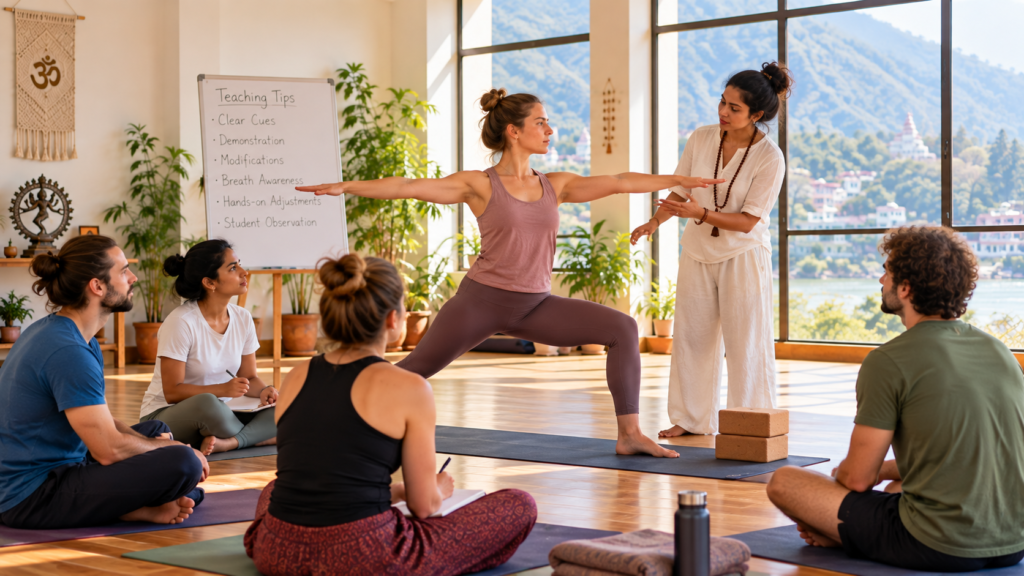
Give one or two useful cues at a time. For example, instead of delivering a long explanation of Mountain Pose, begin with: “Stand comfortably with your feet grounded. Let your shoulders relax and keep your knees soft.”
Once students settle into the position, add another cue if necessary. This gives them time to process your instructions.
Demonstrate first, then observe
A short demonstration can help students understand the overall movement. However, spend most of your teaching time watching the room rather than holding the pose yourself.
Look for visible discomfort, loss of balance, confusion, breath-holding, or repeated attempts to copy a movement that seems unsuitable. Invite students to pause whenever they need to.
Never assume that every beginner has the same mobility, strength, balance, or previous experience. A student who appears physically capable may still be unfamiliar with yoga’s movement patterns.
Offer options without labelling students
Useful modifications give students control over their practice. You might offer a chair or wall for balance, a shorter stance in a standing pose, or a smaller range of movement when a stretch feels uncomfortable.
For example, in a standing forward fold, a student could bend their knees and rest their hands on their thighs or on blocks rather than reaching toward the floor.
Use neutral language such as “Choose the version that feels comfortable today.” Avoid describing a modification as an inferior version of the pose.
Also, do not treat discomfort as proof that a posture is working. Sharp pain, dizziness, unusual breathlessness, or other concerning symptoms are reasons to stop the activity and respond appropriately.
For more on inclusive instruction, the official Ministry of AYUSH website is a useful starting point for exploring India’s yoga-related resources and guidance. Use appropriate professional training and current safety guidance when planning classes; a general information website is not a substitute for individual medical advice.
Respect consent and personal boundaries
Ask before offering hands-on adjustments, explain what you intend to do, and accept a student’s refusal without question. Verbal cues, demonstrations, and optional props often provide sufficient guidance for a beginner session.
Your goal is to support awareness and comfortable movement, not to force every student into an identical shape.
4. Build Confidence Through Practice, Feedback, and Reflection
Your first class may not flow exactly as planned. You might forget a cue, spend too long explaining a posture, or discover that students need more preparation than expected. These are ordinary teaching challenges, but they become useful only when you review them honestly.
Prepare for the moments that make new teachers nervous
Many first-time instructors worry about forgetting the sequence, answering unexpected questions, or being judged by experienced practitioners.
Reduce that pressure with a short pre-class checklist:
- Arrive early and check the room, mats, and props.
- Write down the sequence and essential cues.
- Prepare at least one accessible alternative for each challenging movement.
- Ask about relevant needs or limitations without requesting unnecessary private medical details.
- Keep water nearby and allow time for questions.
If you lose your place, return to a familiar posture or pause briefly. You do not need to keep talking merely to avoid silence.
For more practical strategies, read these tips for teaching your first yoga class when you feel nervous.
Review every class after it ends
Set aside five minutes to record what happened. Ask yourself three questions: What worked? Where did students seem confused? What will I change next time?
Pay attention to pacing, transitions, clarity, and student comfort. If you consistently struggle to explain anatomy or respond to a particular concern, seek feedback from an experienced teacher instead of relying on guesses.
With the group’s permission, you may collect brief feedback such as whether the pace felt comfortable or which instructions were easiest to follow. Avoid pressuring students to praise your teaching.
Keep developing your teaching skills
A 100-hour course is a starting point, not a guarantee of mastery. Depending on your goals, you may benefit from additional supervised practice, anatomy education, inclusive teaching methods, and a longer teacher-training programme.
If you plan to work in a studio or teach internationally, check the actual qualification and registration requirements relevant to that position. Do not assume every employer or country follows the same rules.
5. Why Rishikesh Matters for Your Yoga Teaching Foundation
Rishikesh attracts yoga practitioners from India and overseas because it offers access to yoga schools, traditional teaching environments, retreats, and communities of people interested in practice. For a new teacher, this environment can provide opportunities to learn from different teaching approaches.
However, the location alone does not make a training programme good. The quality of instruction, curriculum, supervised practice, feedback, and student support matters more than attractive surroundings or promotional claims.
If you are choosing a course in Tapovan or elsewhere in Rishikesh, ask specific questions before enrolling. Who teaches anatomy and teaching methodology? How much time do students spend practising instruction? Are students assessed on their ability to guide a class? Can you receive feedback before teaching independently?
These questions are particularly important if you are an international student travelling to India or an Indian practitioner investing a significant amount of money in professional training.
Consider the learning environment, accommodation, schedule, and total cost together. A programme that offers useful supervised teaching experience may be more valuable than one that promises rapid certification without explaining how practical skills are assessed.
If you already hold a 100-hour certificate, identify the gaps in your current knowledge before paying for another course. You may need targeted mentoring, more teaching practice, or a longer qualification rather than another introductory programme covering familiar material.
Your objective should be to leave training better prepared to serve students, not simply to collect certificates.
6. Take Your Next Step with Maa Ganga Yogashala
If you are considering further yoga education in Rishikesh, Maa Ganga Yogashala offers yoga teacher training options in Tapovan, including its 100-hour Yoga Teacher Training in Rishikesh. Review the programme details carefully to determine whether the curriculum fits your experience and learning goals.
Before enrolling, ask about teaching practice, assessment methods, instructor qualifications, certification, and the appropriate progression from your existing training. These details will help you make an informed decision rather than choosing solely on price or location.
7. FAQs About Teaching Beginners After 100-Hour YTT
Can you teach yoga after completing a 100-hour YTT?
Possibly, depending on your training, competence, the class you intend to teach, and the requirements of the employer or registration body. A 100-hour course does not automatically satisfy every professional credential requirement. Confirm the applicable standards and seek supervision when you are not ready to teach independently.
How long should your first beginner yoga class be?
A 30–45-minute session can be a manageable starting point for a new teacher. Choose a duration that allows you to explain movements, observe students, offer modifications, and finish without rushing. The right length depends on the group’s needs and your level of experience.
Which yoga style is suitable for beginner classes?
A gentle, foundational Hatha-style session may be suitable when it falls within your training and competence. Keep the sequence simple, use clear instructions, and avoid advanced postures or rapid transitions until you can teach them safely and effectively.
How can you manage students with different abilities?
Offer options, demonstrate accessible movements, and invite students to work within comfortable limits. Avoid comparing students or assuming that everyone should achieve the same range of motion. Seek appropriate professional guidance when a student’s needs fall outside your competence.
Should you complete a 200-hour YTT after a 100-hour course?
It may be a sensible next step if your goal is a broader teaching foundation or a credential required by a prospective employer or registration organisation. Compare the curriculum, assessment, practical teaching opportunities, total cost, and applicable credential requirements before deciding.
Conclusion: Start Teaching with Preparation, Not Pressure
Teaching beginner yoga class after 100 hour YTT becomes more manageable when you focus on clear instructions, simple sequencing, accessible modifications, and honest reflection. You do not need to impress students with advanced poses. You need to help them understand their options, practise comfortably, and develop confidence at their own pace.
Prepare every class, observe rather than constantly demonstrate, respect individual boundaries, and seek experienced feedback when you reach the limits of your knowledge. Keep learning, and make responsible teaching decisions even when they require you to say that you do not know something.