Vinyasa Fundamentals 100 Hour YTT: What You Will Master in Rishikesh
Mastering the vinyasa fundamentals 100 hour YTT is the defining step between struggling through a yoga class and moving with absolute, effortless grace. Have you ever wondered why certain sequences leave you feeling energized and deeply grounded, while others leave your joints aching and your energy depleted?
The secret lies entirely in the foundational mechanics of breath, movement, and intelligent anatomical alignment. Many practitioners jump straight into advanced arm balances and deep backbends without first understanding how to properly bear weight in their hands or stabilize their core.
This oversight leads directly to plateauing in your physical practice and, worse, chronic injuries in the shoulders and lower back. By stepping back to study the essential building blocks of dynamic movement, you unlock a completely new level of strength and fluidity.
You will discover how to transition between postures seamlessly, rather than just forcing your body into static shapes. This comprehensive breakdown sets the stage for a lifetime of sustainable, powerful practice.
Whether you intend to guide others professionally or simply want to elevate your personal time on the mat, mastering these core principles changes everything about how you experience yoga.
Core Elements of Vinyasa Fundamentals 100 Hour YTT
Understanding the vinyasa fundamentals 100 hour YTT begins with deconstructing the very definition of the word “vinyasa.” Translated from Sanskrit, “vi” means “in a special way,” and “nyasa” means “to place.”
Therefore, vinyasa is not just a fast-paced fitness routine; it is the highly deliberate placement of the body and mind in space. You learn that every single transition between poses holds the exact same importance as the peak posture itself.
Rushing through a transition to achieve a final shape completely misses the point of a flow-based practice. You will spend hours breaking down the biomechanics of the traditional sun salutations (Surya Namaskar A and B).
These sequences serve as the absolute baseline for all dynamic movement in modern yoga. If your sun salutations are misaligned, every subsequent sequence you build upon them will carry those same structural flaws.
Organizations like Yoga Alliance mandate strict anatomical guidelines for foundational training because protecting the structural integrity of the joints is paramount.
You will learn to identify the difference between muscular tension and skeletal compression. Tension can be stretched and worked through over time, but compression means bones are hitting bones—a hard limit you must never push past.
Mastering this distinction allows you to practice safely for decades. You also dive deep into the concept of drishti (focused gaze) and bandhas (energy locks).
Engaging your pelvic floor (Mula Bandha) and lower core (Uddiyana Bandha) creates an internal lift that makes “floating” forward or backward on your mat entirely possible. Without these internal locks, vinyasa feels heavy, exhausting, and physically punishing.
The Science of Breath in Vinyasa Fundamentals 100 Hour YTT
The second pillar of the vinyasa fundamentals 100 hour YTT is the absolute mastery of breath-synchronized movement. In a true vinyasa practice, the breath dictates the pace of the physical body, not the other way around.
If you lose control of your breathing, you have lost the yoga practice—it simply becomes gymnastics. You will extensively study Ujjayi Pranayama, often called the “victorious breath” or “ocean breath.”
This technique involves slightly constricting the back of the throat to create an audible, textured sound. This friction warms the air before it enters your lungs, building profound internal heat (tapas) that prepares your muscles for deep elongation.
The sound of the Ujjayi breath acts as an anchor for your wandering mind. When your thoughts drift to your grocery list or daily stress, the sound of your own breathing pulls your consciousness directly back to the present moment.
You will learn the strict physiological rules of linking breath to movement. Inhalations are biologically tied to movements that expand the chest, lift the gaze, or extend the spine (like Upward Facing Dog or raising your arms).
Exhalations are inherently grounding and contractive, perfectly pairing with forward folds, deep twists, or lowering the body toward the earth (like Chaturanga Dandasana).
Understanding this biological rhythm allows you to flow without feeling breathless or fatigued. It creates a state of moving meditation where the nervous system remains calm despite intense physical exertion.
This knowledge drastically improves your 100 Hour YTT certificate’s international recognition, as studios globally expect their teachers to understand the physiological impact of proper breathwork.
Alignment Principles for Safe and Dynamic Flow
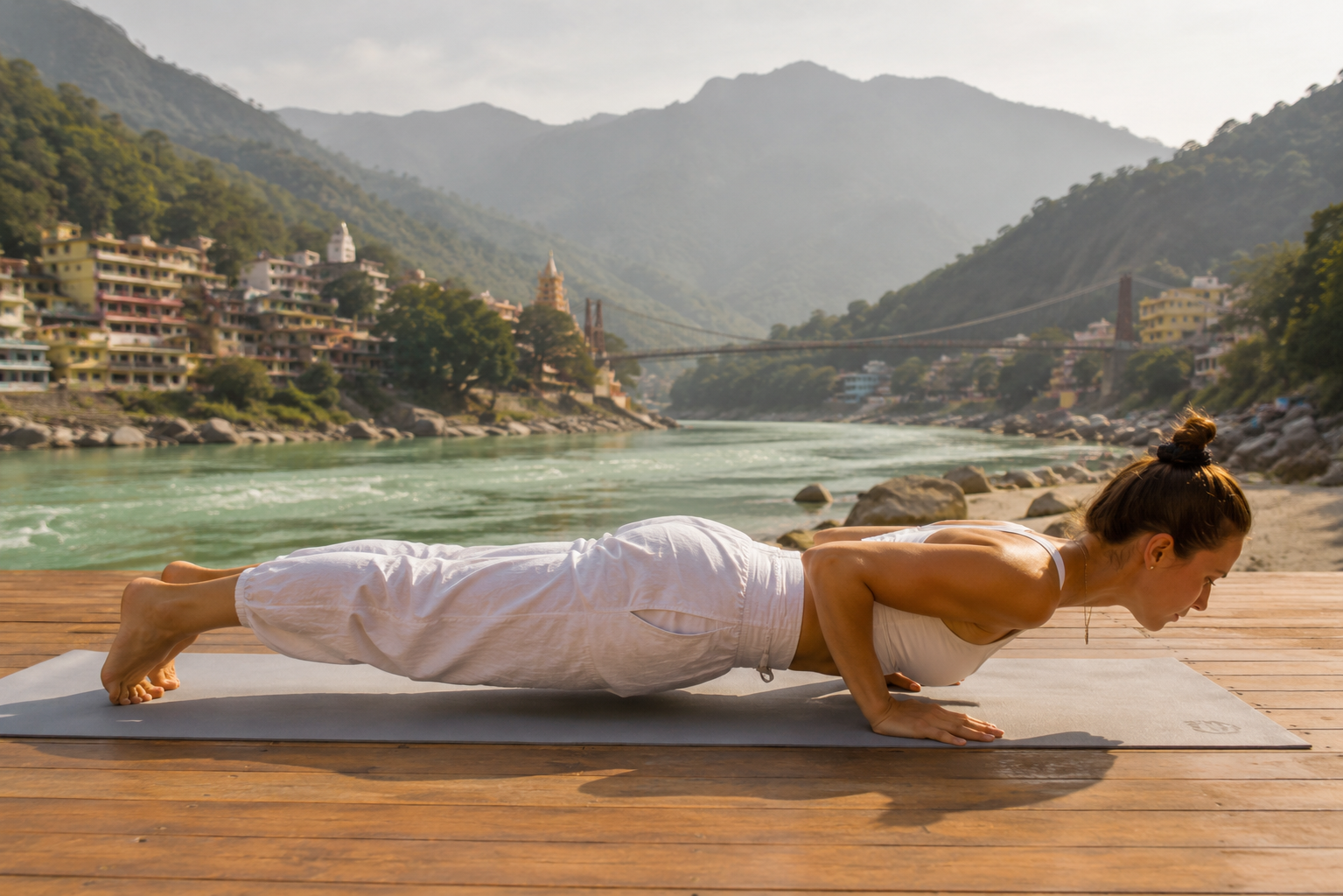
Alignment in dynamic yoga is rarely static; it must hold up while the body is in constant motion. The most critical, and most frequently butchered, transition in all of vinyasa is the lowering from high plank into Chaturanga Dandasana.
You will spend dedicated time learning how to shift your body weight forward onto your toes before bending your elbows. If you lower straight down, your elbows flare out, placing severe, unnatural stress directly on the rotator cuff and anterior deltoids.
Proper alignment requires the elbows to stack directly over the wrists, grazing the ribcage as you lower only halfway down. If the shoulders dip below the elbows, the joint is compromised.
Research clearly shows that repetitive misalignment in weight-bearing postures leads to chronic shoulder impingements. Medical databases like PubMed contain numerous studies detailing common yoga injuries resulting from poor structural mechanics during these repetitive transitions.
You will also explore the critical differences between Cobra pose (Bhujangasana) and Upward Facing Dog (Urdhva Mukha Svanasana). Many students collapse into their lower backs during Upward Dog because they fail to engage their quadriceps and lift their thighs off the mat.
By actively driving the tops of the feet into the floor and engaging the legs, you protect the lumbar spine completely.
Understanding these nuanced mechanics is not just for advanced practitioners; it is absolutely vital for beginners to prevent early injury. You learn how to modify these demanding transitions using blocks, straps, or simply lowering the knees to the mat.
A strong foundation in alignment means recognizing that every single body in the room has a different skeletal structure, and the “perfect” pose looks entirely different on every person.
Intelligent Sequencing: Moving Beyond Random Poses
Creating a compelling flow requires much more than throwing a bunch of fun poses together into a 60-minute class. Intelligent sequencing follows a very specific bell curve of energy.
You learn how to strategically warm up the major muscle groups before demanding extreme flexibility or strength from them. If your peak pose is a deep backbend like Wheel (Urdhva Dhanurasana), your sequence must progressively open the hip flexors, shoulders, and chest.
Learning exactly how to create a yoga sequence after teacher training is often the most challenging aspect for new teachers. You must understand the concept of counter-poses and neutralizing the spine.
After deep spinal extension, you never immediately move into a deep spinal flexion. You neutralize the spine first with a gentle twist or neutral standing posture to prevent damaging the vertebral discs.
You will master the art of thematic sequencing. This means building a class around a specific anatomical focus (like hamstring lengthening), a specific peak pose (like Crow Pose), or an energetic theme (like grounding or opening).
A well-sequenced class feels like a beautifully written story, with a clear beginning, a challenging climax, and a deeply restorative resolution.
You learn to manage the pacing of the class. The beginning should be slow and internal, moving into a rhythmic, heat-building middle, and slowing down significantly as you approach Savasana.
By mastering sequencing logic, you eliminate the panic of forgetting what comes next. You rely on an anatomical roadmap rather than a memorized script.
Developing Your Unique Voice as a Teacher
Knowing the anatomy and the sequence is essential, but delivering that knowledge to a room full of moving bodies is an entirely different skill set.
Finding your authentic teaching voice takes time, patience, and massive amounts of practice. You will quickly learn that using a “fake yoga voice”—a forced, overly breathy, or unnatural tone—disconnects you from your students.
Your most powerful teaching tool is your genuine personality, paired with clear, direct, and actionable cueing. Active cueing tells the student exactly what to do with their body right now.
Instead of saying “feel the stretch in your legs,” you learn to say “press firmly through your outer heel and lift your inner arch.” This removes ambiguity and keeps the student out of their head and in their physical body.
You will practice teaching small sections of a class daily. This constant repetition helps you shed the fear of public speaking and builds genuine confidence.
If you plan to continue your education and take a 200-Hour Yoga Teacher Training in Rishikesh, developing a confident voice now gives you a massive advantage.
You also learn the vital skill of holding space. This means managing the energy of the room without letting your personal mood dictate the class. You learn to observe bodies in motion, spotting misalignments across a crowded room while continuing to speak clearly.
The Art of Hands-On Adjustments and Tactile Cues
A brilliant verbal cue can only go so far; sometimes, a student needs tactile feedback to truly understand a posture.
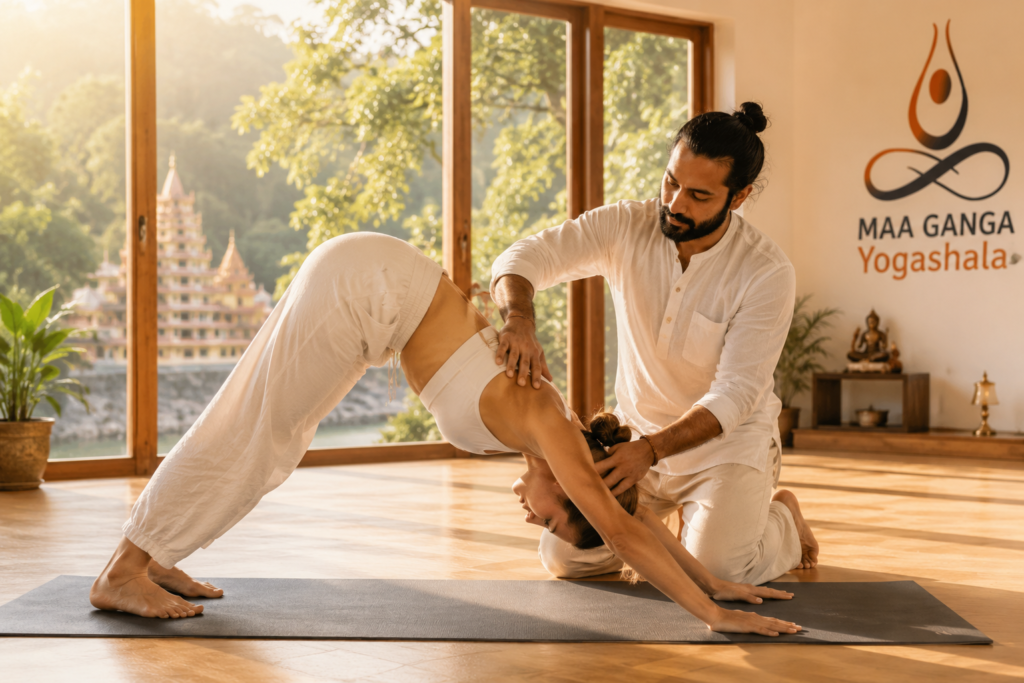
However, hands-on adjustments require immense skill, sensitivity, and anatomical knowledge. You must know exactly where to place your hands to offer support without forcing a student past their natural range of motion.
Learning proper yoga adjustments and assists in teacher training ensures you never injure a student while trying to help them.
The first rule of physical adjustments is establishing clear, continuous consent. You learn modern protocols for consent, utilizing cards or clear verbal check-ins before entering a student’s personal space.
There is a massive difference between an adjustment meant to correct an unsafe alignment and an assist meant to deepen a safe stretch.
If a student’s knee is buckling inward during Warrior II, placing a gentle hand on their outer thigh and asking them to press into your hand corrects the alignment safely.
Conversely, pushing forcefully on a student’s back during a seated forward fold is an outdated, dangerous practice that often leads to hamstring tears or lower back injuries.
You learn to use your own body mechanics to adjust safely. If you compromise your own posture to adjust a student, you risk injuring your own back.
We emphasize “energetic assists,” where a light touch simply brings the student’s awareness to a specific body part, allowing them to make the internal muscular shift themselves.
Integrating Philosophy into Physical Practice
Vinyasa yoga is fundamentally a moving meditation, deeply rooted in ancient philosophical concepts. While the physical postures (asanas) dominate the visual aspect of the practice, they are completely hollow without the underlying philosophy.
You will explore how the Yamas (ethical restraints) and Niyamas (personal observances) apply directly to how you move on the mat.
Ahimsa, the practice of non-violence, is directly applicable when you choose to modify a pose rather than forcing your body into a painful shape just to satisfy your ego.
Satya, truthfulness, requires you to honestly assess your energy levels on any given day and practice accordingly, rather than pretending you are at maximum capacity.
Understanding these concepts bridges the gap between a simple workout and a deeply spiritual experience. You will also study the terminology necessary to teach globally.
Familiarizing yourself with Sanskrit yoga teacher training essential terms allows you to connect your modern physical practice back to its historical roots.
Using Sanskrit pose names is not about sounding elite; it is about respecting the lineage and utilizing a universal language that yoga practitioners recognize anywhere in the world.
By weaving short, relevant philosophical themes into your physical sequencing, you elevate your teaching from standard fitness instruction to true holistic guidance.
Why Rishikesh? The Perfect Place to Learn
There is a profound reason seekers from across the globe travel specifically to Rishikesh to study yoga.
Nestled in the foothills of the Himalayas, this city vibrates with centuries of intense spiritual practice. The environment itself accelerates your learning and deepens your internal focus.
Practicing daily on the banks of the sacred Ganges River provides a backdrop that no city studio can ever replicate. The air is clean, the energy is deeply grounding, and the entire culture is built around supporting the yogic lifestyle.
Stepping away from your normal daily responsibilities, jobs, and social circles allows for complete, uninterrupted immersion.
If you are looking for a shorter introduction before committing to a full training, exploring a 3 Days Yoga Retreat in Rishikesh provides a perfect taste of the city’s unique spiritual atmosphere.
Rishikesh strips away the commercialized, aesthetic-driven elements of modern western yoga. Here, the focus returns entirely to the authentic, internal journey.
You are surrounded by highly experienced teachers, dedicated peers, and a lineage of wisdom that stretches back thousands of years. It is an environment designed entirely for profound personal transformation.
Elevate Your Journey with Maa Ganga Yogashala
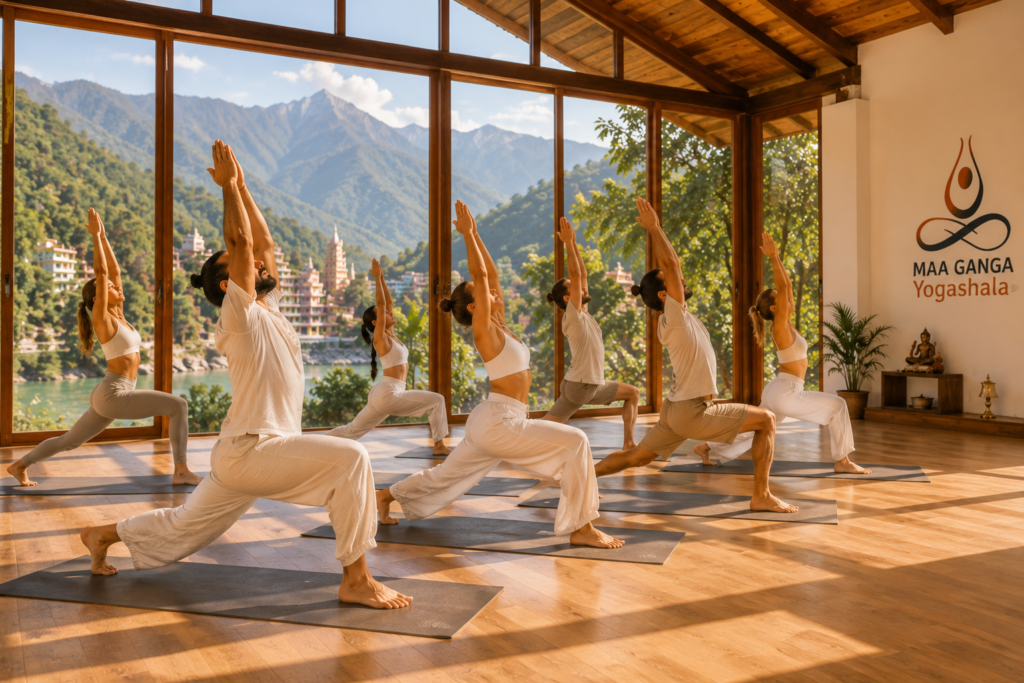
If you’re considering training in Rishikesh, Maa Ganga Yogashala offers an authentic, lineage-based education supported by modern anatomical science.
Our curriculum bridges the critical gap between intense physical asana and deep internal awareness.
We pride ourselves on keeping our class sizes intimate, ensuring you receive the personalized attention required to truly master foundational alignment.
Our experienced teachers guide you safely through the complexities of dynamic movement, ensuring you leave with absolute confidence in your practice.
FAQs About the Training
Who is the ideal candidate for a 100-hour foundational course?
This training is perfect for dedicated practitioners who want to refine their personal alignment, understand the mechanics of flow, and dive deeper than a standard 60-minute studio class allows. It is the perfect stepping stone for those unsure if they want to teach professionally.
Will this certification allow me to teach at a yoga studio?
No, 100 hours constitutes the first half of a complete teaching certification. To register with global alliances and teach professionally, you must complete the full 200-hour syllabus. However, the hours completed here directly count toward that ultimate goal.
What should I expect from the daily physical schedule?
Expect a highly rigorous day designed to challenge your stamina. A typical day includes early morning pranayama, an intense morning asana practice, midday anatomy and philosophy lectures, and a deeply restorative evening practice.
Do I need to be able to do advanced poses before arriving?
Absolutely not. The purpose of this training is to teach you how to build the foundation safely. An open mind, a willingness to unlearn bad habits, and dedication are far more important than physical flexibility or strength.
Conclusion
Mastering the vinyasa fundamentals 100 hour YTT fundamentally changes how you approach every single moment on your yoga mat. You stop forcing your body into shapes and start moving with profound intelligence, breath, and grace.
You build an unbreakable foundation of safe anatomical alignment and learn the deep mechanics of creative sequencing. This knowledge protects your joints, calms your nervous system, and gives you the tools to share this ancient practice safely with the world.
Ready to begin? Explore our 100-Hour Yoga Teacher Training in Rishikesh and take the first transformative step today.