Restorative Yoga 200-Hour TTC: Why Rest Is Part of Your Training
Imagine finishing a demanding morning of asana, anatomy and teaching practice, then being told that your next lesson is to do less. That is exactly where the restorative yoga 200 hour TTC curriculum becomes important: learning when not to push can be just as valuable as learning how to hold a challenging posture.
If you are considering a 200-hour yoga teacher training, you may expect most of your time to be spent practising, studying and teaching. But effective training also needs recovery, awareness and the ability to regulate effort.
Restorative yoga introduces you to slower, supported practices where the goal is not to achieve a deeper shape. Instead, you learn how props, positioning, breath and stillness can create conditions for physical and mental relaxation.
That perspective matters if you eventually teach others. A good teacher needs more than a collection of impressive asanas. You need to recognise when a student needs challenge, when they need modification and when they simply need permission to rest.
Why the Restorative Yoga 200 Hour TTC Curriculum Matters
A 200-hour teacher training can be physically and mentally demanding. You may practise several hours a day while also studying yoga philosophy, anatomy, pranayama, meditation, sequencing and teaching methodology.
Without recovery, it is easy to confuse exhaustion with progress.
Restorative yoga gives you a different framework. Rather than treating every practice as an opportunity to increase flexibility, strength or endurance, you learn to observe what happens when effort is deliberately reduced.
This is especially useful during an intensive residential training because your body is adapting to a new routine. You may be waking earlier than usual, practising unfamiliar techniques, sitting for theoretical classes and spending long periods concentrating.
Rest therefore becomes part of your learning process.
Rest Is Not the Same as Doing Nothing
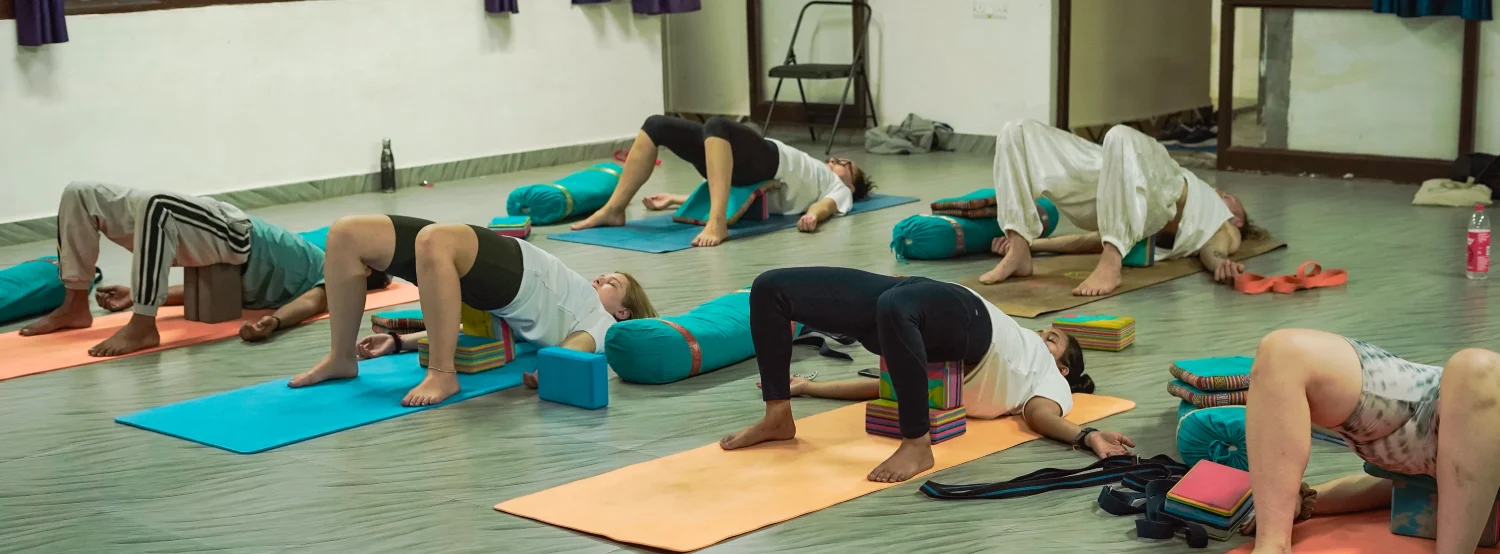
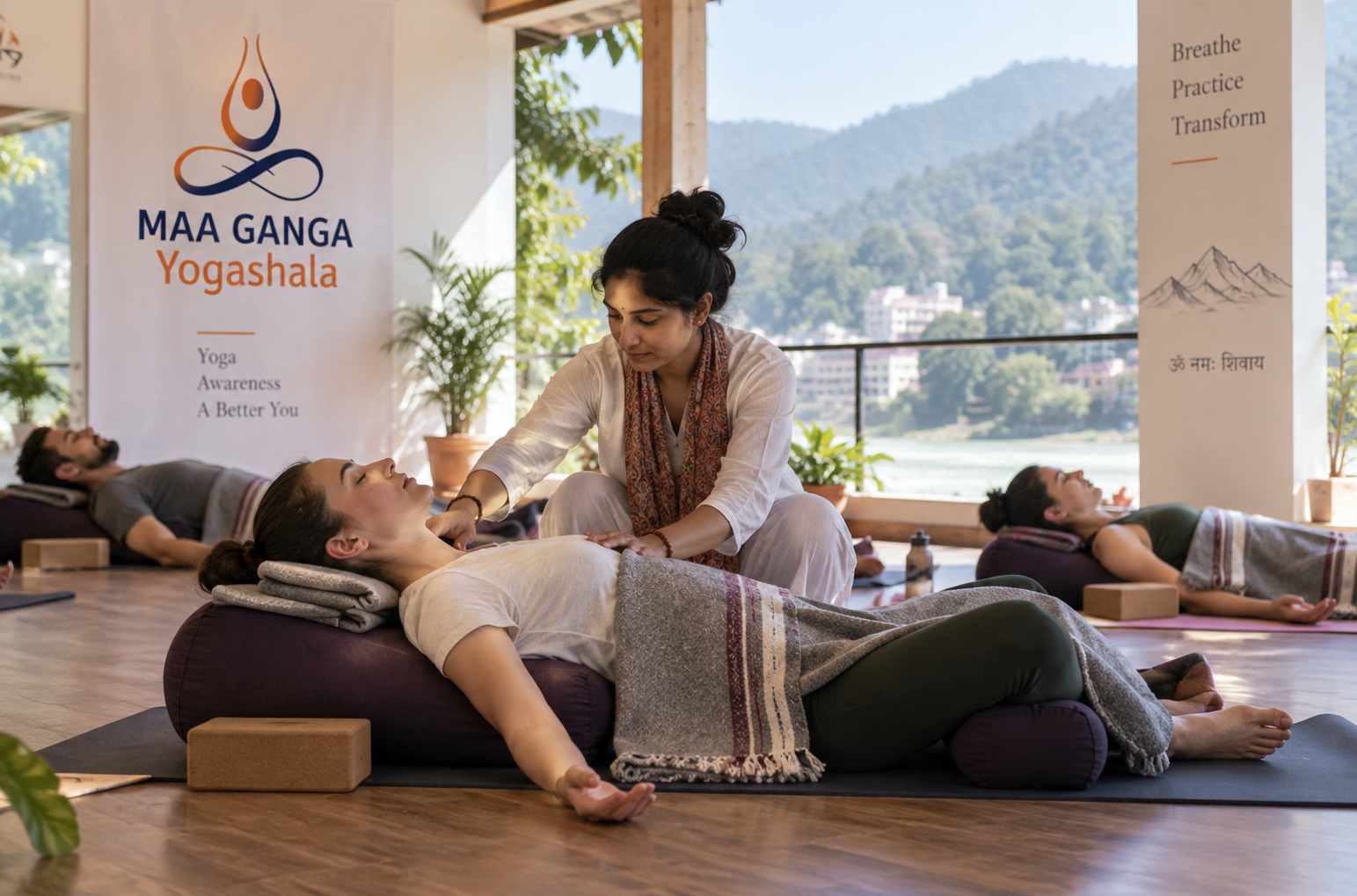
Restorative practice is structured. You may use bolsters, blankets, blocks, straps or a wall to support the body so that you can remain in a posture comfortably for longer.
The objective is not simply to lie down.
You are learning how to create stability, reduce unnecessary muscular effort and observe your breath and internal sensations. That requires attention.
The distinction is important for future teachers. If you understand only physically demanding yoga, you may unintentionally build classes around constant effort. Restorative work broadens your understanding of what a useful practice can look like.
The Ministry of Ayush’s yoga resources also describe practices such as Yoga Nidra and deep relaxation as approaches used for relaxation and calming the mind. (Y-Break)
The lesson is simple: recovery does not sit outside yoga education. It can be part of learning how to practise intelligently.
What You Actually Learn Through Restorative Yoga
When you encounter restorative work during teacher training, you are learning much more than a collection of relaxing poses.
You are learning how to manage effort, support, duration, breath and attention.
A restorative sequence may involve fewer postures than a vigorous class, but that does not make it technically empty. Small adjustments can significantly change your experience.
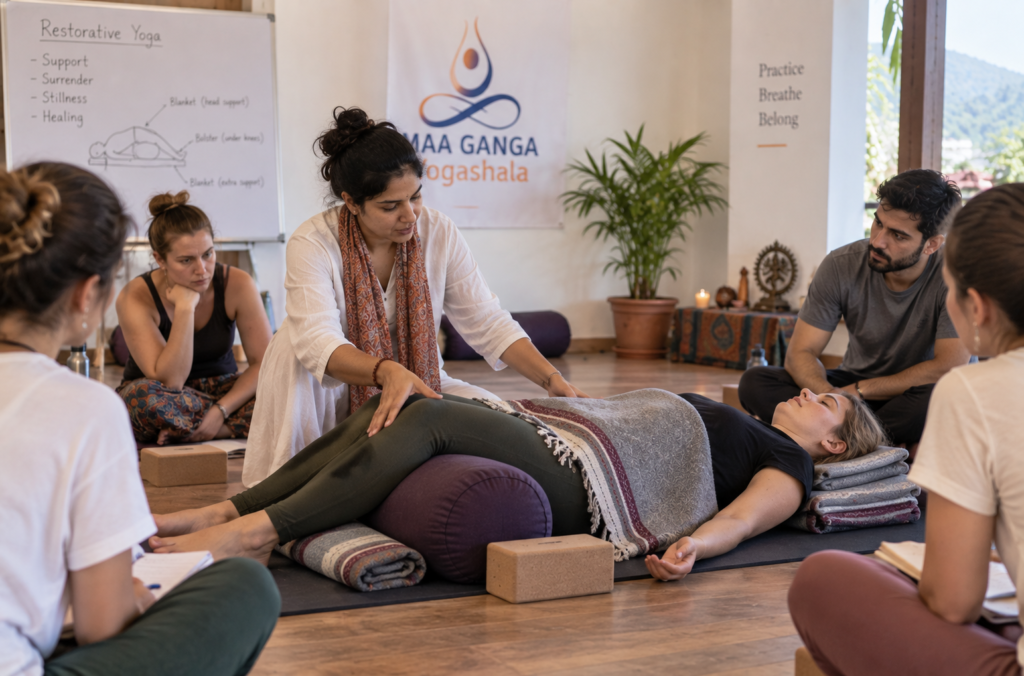
For example, you might learn how changing the height of a bolster alters the angle of your torso. You may discover that a blanket underneath the head reduces unnecessary neck tension. A block can change the relationship between your limbs and the floor.
These details become valuable teaching skills.
Learning to Use Props Intelligently
Props should not be viewed as signs that you cannot perform a posture.
They are tools for adapting practice.
During teacher training, you can learn to ask practical questions:
- Does the student feel stable?
- Can they breathe comfortably?
- Is unnecessary muscular effort present?
- Does the prop provide useful support?
- Can the posture be maintained without strain?
- Is the student’s attention becoming quieter or more distracted?
Those questions can improve your teaching beyond restorative classes.
They are equally relevant when modifying seated postures, meditation positions, forward folds and even demanding asanas.
Understanding Duration and Stillness
A restorative posture may be held longer than you are accustomed to.
That changes the learning experience.
You begin noticing sensations that can be missed during quick transitions. You may become more aware of subtle muscular gripping, breath patterns and habitual attempts to “fix” the posture.
This can make you a more observant practitioner.
It also teaches an important principle: more sensation does not automatically mean more benefit.
A student does not need to leave every class feeling physically exhausted. Sometimes the valuable outcome is greater ease, clearer awareness or simply learning how to remain still without constantly searching for the next task.
Restorative Practice, Yoga Nidra and Recovery During Training
Restorative yoga is only one part of the broader recovery toolkit you may encounter in teacher training.
Yoga Nidra, gentle pranayama, meditation and conscious relaxation can complement restorative asana practice.
Although these practices overlap in their emphasis on relaxation, they are not identical.
Restorative yoga generally uses supported physical postures and sustained stillness. Yoga Nidra is a guided practice involving awareness and systematic relaxation while remaining physically still.
Research on Yoga Nidra is growing. A 2026 systematic review and meta-analysis found potential benefits for stress, anxiety and depression, while also cautioning that methodological quality and variation between interventions limit how confidently those effects can be interpreted. (PubMed)
That distinction matters.
You should not treat restorative yoga or Yoga Nidra as a guaranteed treatment for a medical or psychological condition. Instead, you can understand them as practices that may support relaxation and recovery within an appropriate yoga programme.
Why Recovery Can Improve Your Learning
Think about a typical training day.
You may study anatomy in the morning, practise asana, attend philosophy lectures, participate in teaching assignments and review material with classmates.
Your body is working, but your attention is working too.
Recovery periods give you an opportunity to process that workload.
If you constantly add more stimulation, you can become physically tired while also making it harder to absorb information. A slower practice can create a deliberate change of pace.
This is particularly useful when your training includes repeated teaching practice. After teaching the same sequence several times, stepping back into a quiet practice can help you notice your own body rather than staying focused on performance.
How Restorative Yoga Can Change the Way You Teach
The biggest value of restorative yoga in a teacher-training curriculum may appear after you become responsible for someone else’s practice.
As a student, you can choose your own intensity. As a teacher, you have to consider the needs of a room full of different people.
One student may want a physical challenge.
Another may be recovering from a demanding day.
Someone else may be new to yoga and uncomfortable with intense movement.
A well-rounded teacher needs options.
Restorative principles can help you build those options into your classes.
From “Push Further” to “Choose Wisely”
Modern yoga spaces sometimes create the impression that progress means going deeper into a posture.
But teaching requires a broader definition of progress.
You might instead ask:
Can this student breathe comfortably?
Can they maintain awareness?
Is the posture appropriate for their current ability?
Would less intensity produce a better experience today?
Those questions can completely change how you sequence a class.
If you want to explore the physical foundations behind these decisions, studying yoga anatomy, muscles, joints and alignment can give you another useful perspective.
The teacher’s role is not to make every student look identical.
It is to create an environment where students can practise appropriately.
That is why restorative work has value even if you never plan to specialise in restorative yoga.
Building Better Class Sequencing
Restorative principles can also influence how you structure a complete class.
You may begin with accessible movements, gradually introduce stronger work, then intentionally reduce intensity before the final relaxation.
This creates a clearer arc.
Instead of treating Savasana as the five minutes you squeeze into the end, you start understanding how the entire sequence can prepare the student for stillness.
You can also use restorative postures between more demanding sequences when appropriate.
The result is not necessarily a “gentle class.” It is a class where effort has a purpose and recovery has a place.
Why Rishikesh Is a Meaningful Place to Study Rest and Recovery
Rishikesh offers a setting where yoga is part of the surrounding culture rather than simply an activity inside a fitness studio.
For an international student, that can make the training experience feel very different from a short weekend workshop at home.
The environment around Tapovan also gives you opportunities to step away from the training room between classes. The Ganga, nearby walking routes, temples, cafés and Himalayan surroundings create natural spaces for quiet reflection.
That does not mean the location magically makes your practice deeper.
Your learning still depends on the quality of your training, your consistency and how seriously you engage with the curriculum.
But the setting can support a rhythm in which practice, study and recovery are easier to notice.
If you are considering a shorter introduction before committing to intensive teacher training, you can also compare the experience with a 5-day yoga retreat in Rishikesh.
You may also find that Rishikesh changes your understanding of rest.
Rest does not necessarily mean escaping from your practice. It can mean sitting beside the Ganga after class, walking without your phone, practising a few minutes of conscious breathing or simply allowing your body to recover before the next session.
For a teacher in training, those moments can become part of the education.
What to Look for in a 200-Hour TTC That Takes Recovery Seriously
Not every 200-hour programme will teach restorative yoga in exactly the same way.
Curriculum structure, teaching methods, daily schedules and the depth given to particular subjects can differ between schools.
So when comparing programmes, do not look only at the number of asanas listed on a syllabus.
Ask how the course approaches recovery and sustainable practice.
Useful questions include:
- Is restorative or gentle yoga included in the curriculum?
- Is Yoga Nidra taught as part of relaxation or meditation work?
- How is recovery handled during intensive training days?
- Are modifications and prop use demonstrated?
- Do students receive opportunities to practise teaching different levels?
- Is anatomy connected to practical alignment and adaptation?
- Does the daily schedule leave enough time for rest and personal practice?
- How much teaching practice will you actually receive?
These questions can tell you more about the learning environment than promotional descriptions alone.
You should also consider what happens after certification.
A 200-hour course is a foundation, not the end of your education. If you eventually want to deepen your teaching skills, you may explore continuing education after a 200-hour YTT.
The strongest curriculum for you is one that develops both capability and judgement.
A Practical Restorative Mindset You Can Carry Into Teacher Training
You do not need to wait until a formal restorative class to start applying its principles.
During your training, experiment with observing effort.
When you enter a posture, notice whether you are using more muscular force than necessary.
When you sit for meditation, check whether your shoulders are unnecessarily lifted.
When you practise pranayama, notice whether your breathing remains comfortable rather than forcing a particular result.
And after an intense practice, give yourself time to recover instead of immediately judging the session by how tired you feel.
You can also keep a simple training journal.
Write down:
- Which practices left you energised?
- Which practices left you depleted?
- When did you notice unnecessary tension?
- Which props helped you practise more comfortably?
- What changes when you slow your breathing?
- Which teaching cues helped you release effort?
These observations can become useful teaching material later.
They also encourage you to treat your own body as something to understand rather than something to constantly push.
For more ideas about managing the realities of intensive teacher training, you can explore this guide to student life during a 200-hour YTT.
Learn Restorative Yoga in a Complete Rishikesh Training Environment
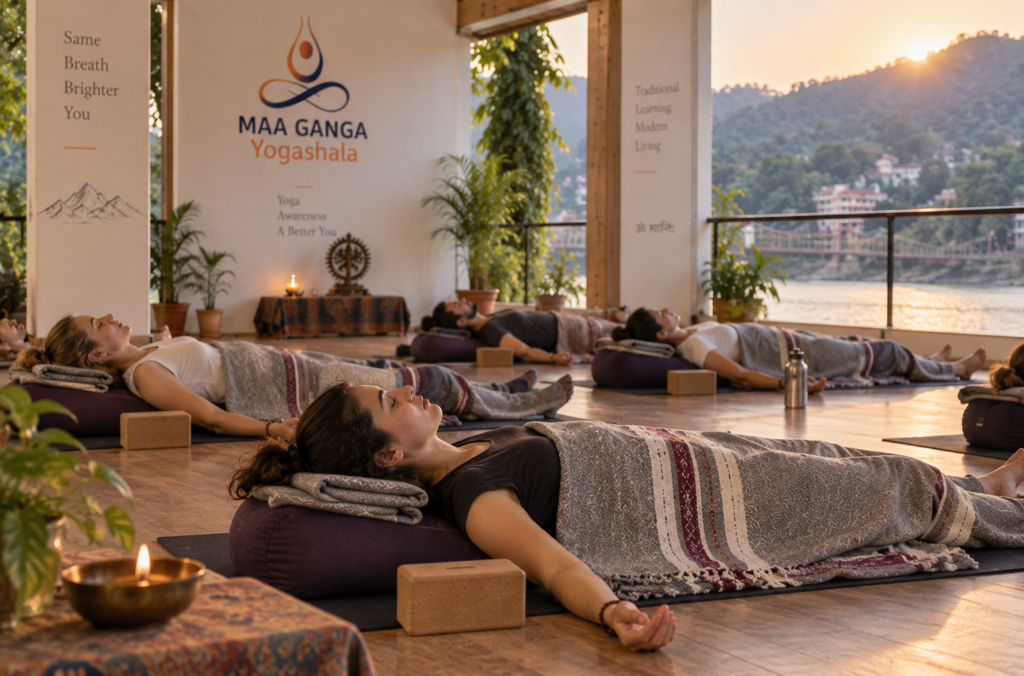
If you want your teacher training to include physical practice, philosophy, anatomy, meditation, teaching methodology and recovery rather than focusing on asana performance alone, we at Maa Ganga Yogashala offer a 200-hour Yoga Teacher Training in Rishikesh designed as a broader foundation for your development as a practitioner and future teacher.
The important question is not simply whether a course contains the word “restorative” in its syllabus.
Look at how the entire programme teaches you to balance effort with awareness.
That is the deeper lesson.
You are not training to become someone who can perform the most difficult posture in the room. You are training to understand practice well enough to guide different people safely and intelligently.
FAQs About Restorative Yoga in 200-Hour Teacher Training
Is restorative yoga included in every 200-hour TTC?
No. Every school structures its curriculum differently.
Some programmes give restorative yoga significant attention, while others may cover it briefly alongside relaxation, meditation or sequencing.
Before enrolling, review the actual curriculum and ask the school how restorative practices are taught rather than assuming that every 200-hour course follows the same structure.
Is restorative yoga easier than other types of yoga?
It can feel physically gentler because it generally reduces active muscular effort and uses support.
But “gentle” does not mean meaningless or effortless.
Remaining still, observing your breath and noticing habitual tension can require considerable attention. For a teacher, learning when to reduce intensity can be as valuable as learning how to increase it.
Can beginners learn restorative yoga during a 200-hour TTC?
Yes, provided the programme is designed to accommodate students with different levels of experience.
You do not need to master advanced asanas before understanding restorative principles. In fact, learning how to use props, modify positions and observe comfort can provide useful foundations for your teaching from the beginning.
Does restorative yoga replace active asana practice?
No.
A comprehensive teacher-training programme normally needs different forms of practice because you are learning different skills.
Active asana can develop strength, mobility, coordination and physical awareness, while restorative practices emphasise support, stillness and reduced effort.
They serve different purposes and can complement one another.
Is Yoga Nidra the same as restorative yoga?
No.
They can both involve deep relaxation, but they are distinct practices.
Restorative yoga primarily uses supported physical postures and stillness. Yoga Nidra is a guided awareness practice performed while physically still.
Learning both can help you develop a broader understanding of relaxation practices.
Conclusion: Rest Is Part of Becoming a Better Yoga Teacher
The restorative yoga 200 hour TTC curriculum is valuable because it challenges a common assumption about progress: that you must always do more to become better.
Teacher training should teach you when to engage, when to modify and when to stop.
Restorative practice gives you practical experience with support, stillness, props, breath awareness and reduced effort. Those skills can influence how you practise yourself and how thoughtfully you teach other people.
If Rishikesh is your preferred destination for this next step, we invite you to explore our 200-hour Yoga Teacher Training in Rishikesh and examine the curriculum, schedule and training environment before making your decision.