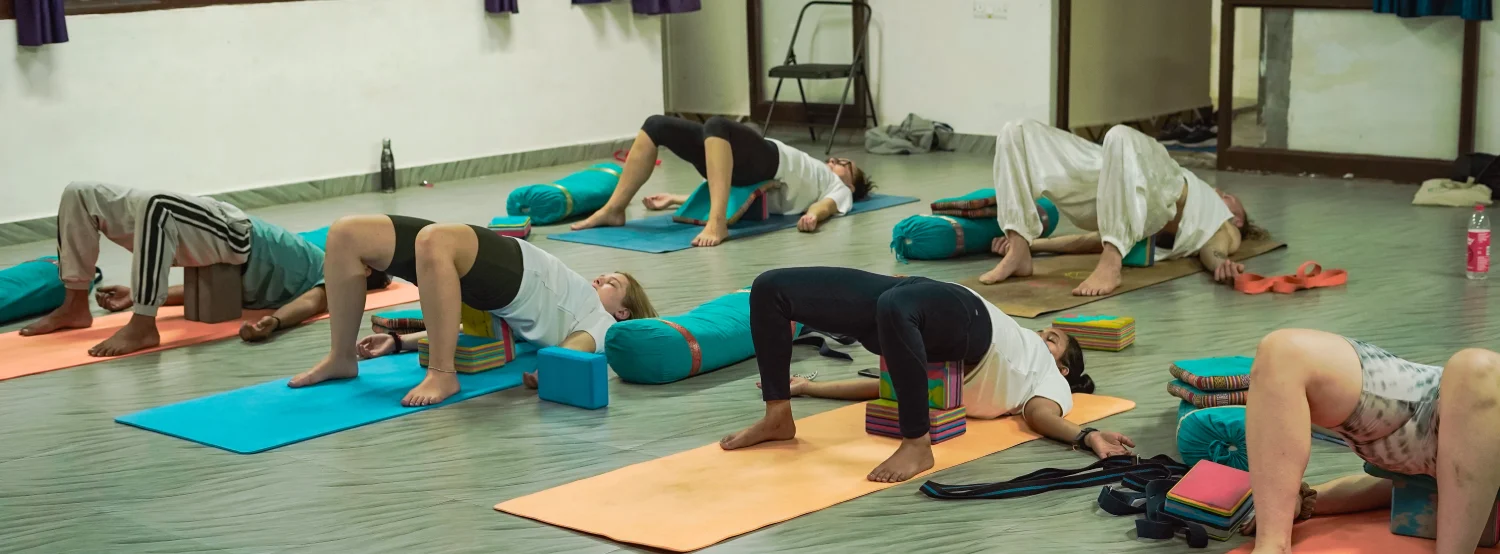

Qualities of a good yoga teacher 200 hour TTC: 7 Essential Qualities You Can Develop
Introduction
The qualities of a good yoga teacher 200 hour TTC develops go far beyond flexibility, impressive poses, or years spent on a yoga mat. Have you ever attended a class where the teacher made a difficult posture feel approachable simply by explaining it clearly? That ability comes from training, observation, practice, and an understanding of individual needs.
Becoming a yoga teacher means learning how to guide people safely, communicate instructions, respond to different abilities, and create an environment where students can practise without feeling judged. Your personal practice matters, but teaching requires a different set of skills.
A 200-hour yoga teacher training course introduces you to these foundations through asana practice, anatomy, pranayama, philosophy, meditation, and teaching practice. You begin to understand not only what to teach, but why, when, and how to teach it.
Whether you are an Indian practitioner deepening your sadhana or an international student considering yoga teacher training in Rishikesh, understanding these qualities can help you choose a suitable course and prepare for the responsibility of teaching others.
1. What Are the Essential Qualities of a Good Yoga Teacher?
A capable yoga teacher combines practical knowledge with patience, communication, self-awareness, and sound judgement. These qualities help you move beyond demonstrating postures towards guiding a class with purpose.
Strong foundations in yoga practice
You need a reliable understanding of the postures you teach, including their purpose, common challenges, variations, and limitations. You should know how to explain the difference between a pose that feels challenging and one that produces concerning pain.
For example, a beginner struggling with Warrior II may need a shorter stance, a different foot position, or more time to understand knee alignment. Repeating the pose more loudly will not solve the underlying problem.
Your own practice helps you develop body awareness, but it should not become the standard every student must meet.
Patience and respect for individual differences
Your future students may have different ages, fitness levels, mobility, cultural backgrounds, and reasons for attending class. Some may be confident practitioners; others may struggle with basic balance.
A good teacher avoids comparing students or treating flexibility as a measure of progress. You learn to offer options without making anyone feel inadequate.
Integrity and willingness to keep learning
Yoga teaching carries responsibility. You must recognise the limits of your knowledge, avoid unsupported therapeutic promises, and refer students to qualified healthcare professionals when appropriate.
A 200-hour course establishes a foundation. It does not make you an expert in every yoga style, medical condition, or therapeutic application.
These qualities grow through consistent practice, constructive feedback, and honest reflection. The aim is not to appear perfect, but to become a teacher students can trust.

2. How a 200-Hour TTC Develops Yoga Teaching Skills
A structured teacher training programme helps you turn personal experience into teachable knowledge. Instead of relying entirely on intuition, you learn principles that guide lesson planning, demonstrations, and communication.
Understanding anatomy and safe alignment
Basic functional anatomy helps you understand joint movement, muscular engagement, balance, and the ways bodies differ. You learn to observe students rather than assume every body should fit the same alignment template.
For example, two students performing Trikonasana may need different hand placements because their proportions, mobility, and balance differ. A useful adjustment gives each student a more appropriate option instead of forcing a predetermined shape.
Safety also means understanding when not to adjust someone physically. You should respect consent, explain adjustments when appropriate, and use verbal or visual alternatives whenever they are more suitable.
Learning pranayama, meditation, and philosophy
Yoga teaching involves more than asana. Training introduces breathing practices, concentration, meditation, and philosophical concepts that influence how you approach practice and daily life.
You also learn that breathing techniques require appropriate instruction. Forceful breathing or prolonged breath retention should not be treated as universally suitable for everyone.
Yoga philosophy can help you explore concepts such as ahimsa, or non-harming, and svadhyaya, or self-study. These ideas become practical when you avoid shaming students, acknowledge your mistakes, and encourage awareness rather than competition.
For broader information about yoga’s traditional and contemporary context, you can visit <a href=”https://www.yogaalliance.org/” rel=”nofollow”>Yoga Alliance’s official website</a>. A credential or course certificate should always be considered alongside the actual curriculum, teaching experience, and professional conduct.
Building confidence through practice teaching
You may understand a sequence perfectly while practising alone but find it difficult to explain when several students are watching. Practice teaching helps bridge that gap.
You learn to demonstrate clearly, use concise verbal cues, manage transitions, observe the room, and maintain a sensible pace.
A structured programme should give you opportunities to teach, receive specific feedback, and try again. Explore the practice teaching skills developed during a 200-hour YTT to understand why teaching experience matters.
Confidence becomes more reliable when it is supported by preparation rather than performance alone.
3. Seven Qualities You Can Develop During Teacher Training
You do not need to possess every teaching quality before enrolling. A well-designed training programme should help you recognise your strengths and work on the areas that need improvement.
1. Clear communication
Students need instructions they can understand while moving. Long explanations during a demanding posture can create confusion and distract them from their breathing.
You practise giving short, specific cues such as, “Keep your front knee aligned with your toes,” while recognising that not every student needs the same instruction.
Clear communication also includes knowing when to stop talking. Silence can give students space to notice their breath and sensations.
2. Observation and adaptability
A good teacher watches what is happening rather than simply following a memorised sequence.
If several students struggle with balance, you might offer wall support or spend more time establishing the posture. If a transition repeatedly causes confusion, you can demonstrate it again or simplify the sequence.
Adaptability is not a lack of preparation. It is the ability to respond thoughtfully when the original plan does not suit the room.
3. Empathy and emotional awareness
Students may arrive tired, anxious, frustrated, or uncomfortable in a group setting. You cannot know what someone is experiencing simply by looking at their posture.
Empathy means avoiding assumptions, using respectful language, and allowing students to rest or modify their practice without embarrassment.
It also means maintaining professional boundaries. A yoga teacher can offer a supportive class without presenting themselves as a substitute for a therapist or medical professional.
4. Knowledge of injury prevention
You learn to recognise common movement limitations, teach progressive preparation, and provide alternatives to challenging postures.
A sensible progression might introduce foundational standing poses before more demanding balances. Students should understand that sharp pain, dizziness, or unusual discomfort are reasons to stop and reassess rather than push harder.
You should never promise that yoga eliminates injuries. Good instruction reduces avoidable risks through appropriate choices, clear guidance, and respect for individual limitations.
For further preparation, see these yoga injury-prevention principles for teachers.
5. Discipline and consistency
Teaching requires preparation before students arrive. You may need to plan a sequence, check the practice space, organise props, review relevant modifications, and arrive early.
Your personal practice also helps you maintain a realistic understanding of effort, rest, and gradual development.
Discipline does not mean practising through illness or exhaustion. It means developing sustainable habits and making responsible decisions.
6. Humility and ethical responsibility
You will encounter questions you cannot answer. An ethical response is to acknowledge the gap, research the subject carefully, or direct the student to an appropriate professional.
You should avoid presenting personal beliefs as universal facts or claiming that a particular posture cures a medical condition.
Humility also includes respecting different traditions and recognising that a short certification is the beginning of professional development, not its endpoint.
7. A commitment to lifelong learning
Your first certification gives you a foundation, but teaching improves through experience, observation, continuing education, and feedback.
You may eventually explore restorative yoga, prenatal yoga, meditation, trauma-informed approaches, or advanced teacher training. Each area requires suitable education rather than assumptions based on general yoga knowledge.
India’s Ministry of AYUSH provides information about yoga and related traditional health systems at <a href=”https://ayush.gov.in/” rel=”nofollow”>the official AYUSH website</a>. Use reliable sources when researching traditional practices, while distinguishing established evidence from claims that need further scientific support.
Together, these seven qualities help you develop a teaching approach that is safe, thoughtful, and responsive to real students.
4. How to Choose a 200-Hour Yoga Teacher Training Course
The quality of your training environment can influence how confidently you begin teaching. A beautiful location or attractive photographs are not enough to establish whether a course prepares you for real classes.
Before enrolling, examine the curriculum, instructors, practice-teaching opportunities, accommodation arrangements, assessment methods, and total fees.
Look for a programme that explains how much time is devoted to anatomy, asana, pranayama, meditation, philosophy, and supervised teaching. Ask how students receive feedback and whether they must demonstrate teaching competence before graduation.
You should also clarify what the certification represents. Yoga Alliance registration is a specific professional credentialing framework; a school’s marketing description alone does not prove its current registration status. Check relevant details directly with the organisation.
Your training should also include discussion of consent, appropriate physical adjustments, inclusive language, and the limits of your professional role.
If you are comparing programmes, this guide on how to choose a 200-hour YTT school in Rishikesh can help you organise your questions.
Do not choose solely on the lowest price. A course that provides meaningful teaching practice and qualified guidance may offer better preparation than one that focuses mainly on completing the schedule.
5. Why Rishikesh Matters for Your Yoga Teacher Training
Rishikesh attracts yoga practitioners from India and abroad because it combines established yoga traditions, teacher-training schools, spiritual practices, and a setting close to the Himalayan foothills and the Ganga.
For many students, studying here offers an opportunity to establish a regular routine away from familiar distractions. Daily classes, meditation, pranayama, and interaction with fellow practitioners can make it easier to examine your habits and deepen your understanding of yoga.
However, location alone does not make a teacher-training course effective. Your learning still depends on the quality of instruction, the time devoted to practice, the feedback you receive, and the effort you contribute.
You should also consider practical matters such as seasonal weather, travel arrangements, food preferences, accommodation, and the intensity of the daily schedule. International students may need additional time to adjust to local conditions, while Indian students may have different travel or language considerations.
A residential course can provide continuity because you practise and study within a structured environment. Even so, you should leave with realistic expectations: a 200-hour TTC provides foundational preparation, not mastery of every aspect of yoga.
When you choose thoughtfully, Rishikesh can be a meaningful place to build both your personal practice and your initial teaching skills.

6. Begin Developing These Qualities with Maa Ganga Yogashala
If you are considering teacher training in Rishikesh, the next step is to compare the learning experience with your goals. Maa Ganga Yogashala is located on Badrinath Road in Tapovan, Rishikesh, near the Ganga River and surrounded by the Himalayan landscape.
We invite you to explore our 200-hour yoga teacher training course in Rishikesh to review the programme and assess whether it matches your learning needs.
Before enrolling, ask about the current curriculum, instructor experience, teaching-practice hours, assessment process, accommodation, and certification details. These questions help you make an informed decision rather than choosing based on marketing alone.
If you are not ready for a full teacher-training commitment, you can also compare shorter options, such as our five-day yoga retreat in Rishikesh, to explore a structured yoga experience before deciding on a longer programme.
The right next step depends on whether you want to deepen your own practice, explore yoga more seriously, or prepare for teaching others.
7. FAQs About Yoga Teacher Qualities and 200-Hour TTC
Can you become a good yoga teacher if you are not very flexible?
Yes. Flexibility is not the main measure of teaching ability. You need sound foundational knowledge, clear communication, an understanding of safe modifications, and respect for different bodies. Demonstrating advanced postures is not a substitute for these skills.
Is a 200-hour TTC enough to start teaching yoga?
A 200-hour TTC is a foundational teacher-training qualification commonly used as an entry point into yoga teaching. Whether you are prepared for a particular role depends on the course quality, your assessed skills, local requirements, and the needs of the students you intend to teach.
What should you learn during a 200-hour yoga teacher training course?
You should look for structured learning in asana, anatomy and physiology, pranayama, meditation, yoga philosophy, teaching methodology, sequencing, and supervised practice teaching. Ask the school how these subjects are taught and assessed.
Why choose Rishikesh for yoga teacher training?
Rishikesh offers access to yoga schools, traditional practices, and an international practitioner community. It can provide a focused learning environment, but you should still evaluate the individual school’s teaching quality, curriculum, safety practices, and credentials.
What is the most important quality of a yoga teacher?
There is no single quality that replaces all the others. Safety, empathy, communication, subject knowledge, and ethical judgement work together. A good teacher recognises limitations, adapts instruction, and continues learning.
Conclusion: Build Your Foundation as a Yoga Teacher
The qualities of a good yoga teacher 200 hour TTC helps develop are practical skills as much as personal values. Clear communication, safe instruction, patience, adaptability, humility, and consistent learning allow you to support students without expecting every person to practise in the same way.
Your own yoga practice gives you a starting point. Structured training helps you turn that experience into responsible instruction through foundational study, teaching practice, and feedback.
If you are ready to take that step, explore our 200-hour yoga teacher training in Rishikesh. Review the curriculum, ask your questions, and choose a programme that supports your goals.
Ready to begin? Explore Maa Ganga Yogashala’s 200-Hour Yoga Teacher Training in Rishikesh and take your next step towards becoming a more capable, thoughtful yoga teacher.