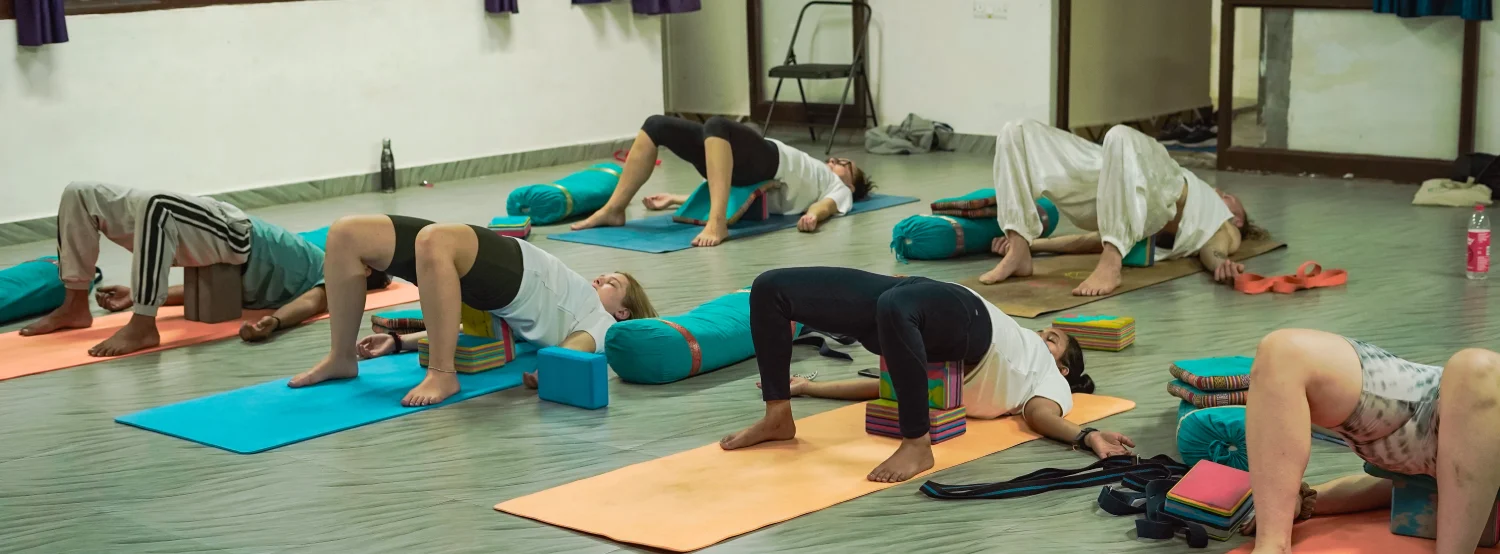

Introduction
Yoga injury prevention teacher training is essential if you want to guide students safely, confidently, and responsibly. What happens when a student follows your instructions perfectly but still experiences pain? The answer may have less to do with effort and more to do with anatomy, movement choices, previous injuries, or how the pose was taught.
As a new yoga teacher, you need more than a sequence of impressive asanas. You need to recognise when a movement may be unsuitable, understand how bodies respond differently to the same posture, and know when to offer a modification instead of encouraging someone to push further.
These skills matter whether you teach beginners in India, lead international students through a class in Rishikesh, or eventually establish your own studio.
This guide explains the practical principles behind safer yoga instruction, including anatomy, alignment, class planning, consent, modifications, and professional boundaries. You will also learn what to look for when choosing yoga teacher training in Rishikesh so you can develop sound teaching habits before taking responsibility for a group.
1. Why Yoga Injury Prevention Teacher Training Starts With Understanding Risk
Yoga involves movement, balance, stretching, strength, and sometimes sustained positions. Although many people practise without serious problems, yoga is not automatically risk-free. Discomfort, overuse injuries, and strains can occur, particularly when practice exceeds a person’s current capacity.
Your responsibility as a teacher is not to promise an injury-free class. It is to make sensible decisions that reduce avoidable risks.
Understand the difference between effort and pain
Students may experience muscular effort, mild stretching sensations, fatigue, or temporary balance challenges. These experiences are not identical to sharp pain, joint pinching, numbness, tingling, or sudden loss of strength.
Teach students to distinguish between ordinary effort and warning signs. If a movement produces sharp, increasing, or unusual pain, ask the student to stop rather than push through it.
Persistent symptoms, significant swelling, inability to bear weight, or new neurological symptoms warrant appropriate medical assessment. Severe or sudden symptoms may require urgent care.
Avoid treating flexibility as the goal
A student who can touch their toes is not necessarily more advanced than someone who cannot. Flexibility depends on several factors, including joint structure, muscle properties, training history, and individual anatomy.
Your job is to teach useful movement, not to make every student look identical.
For additional professional context, review the official Yoga Alliance website when researching yoga teaching standards and training pathways. Certification requirements and recognition should be checked against the relevant programme and organisation rather than assumed.
The key principle is straightforward: safety comes from informed teaching decisions, not from the appearance of a perfect pose.
2. Essential Anatomy and Safe Yoga Alignment for Beginners
Anatomy is one of the most useful subjects you can study during yoga teacher training. You do not need to diagnose medical conditions, but you should understand the basic structures involved in common movements.
Learn how joints and muscles work together
Your training should explain the roles of the spine, hips, shoulders, knees, ankles, and wrists. You should also learn how muscles produce movement, how joints tolerate different positions, and why the same posture may feel different to two students.
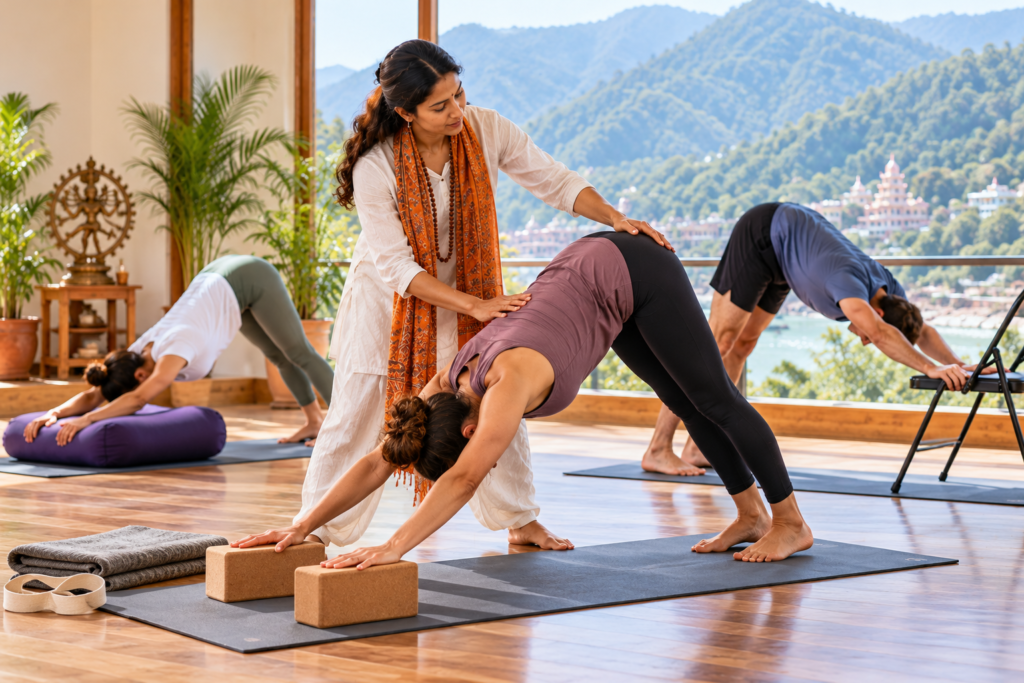
Consider Downward-Facing Dog. One student may comfortably straighten their legs, while another needs bent knees to maintain a more comfortable position through the spine and shoulders.
Neither variation automatically indicates a problem. The appropriate choice depends on the student’s mobility, strength, proportions, symptoms, and goals.
Teach alignment as a guide, not a universal rule
Alignment cues can help students organise movement, but rigid rules can be counterproductive when they ignore individual anatomy.
For example, forcing every student’s feet into the same stance width or insisting that every knee tracks through one exact angle may not suit every body.
Instead, observe the student’s comfort, control, balance, and ability to breathe without strain.
Useful questions include:
- Can the student enter and leave the pose with control?
- Is the position comfortable enough to sustain briefly?
- Does the student maintain steady breathing?
- Is there pain, excessive strain, or loss of balance?
- Would a smaller range of motion or a prop improve the experience?
Understand your professional limits
Anatomy knowledge helps you teach movement; it does not qualify you to diagnose a ligament injury, treat a slipped disc, or prescribe rehabilitation.
When a student reports a medical condition or ongoing symptoms, stay within your qualifications and recommend an appropriate healthcare professional when necessary.
3. Practical Modifications That Make Yoga Classes Safer
A strong teacher can offer alternatives without making students feel that they are failing. Modifications are not shortcuts. They are tools for matching a practice to a person’s current abilities.
Modify common postures thoughtfully
<text preserveWhitespace>{`• Plank Pose: Offer a knees-down variation or a wall-supported plank when a student struggles to maintain control or experiences wrist discomfort. Adjust hand placement only within a comfortable range.
• Downward-Facing Dog: Bend the knees, shorten the hold, or use a wall variation if the student struggles with spinal positioning, shoulder comfort, or balance.
• Forward Folds: Encourage a soft bend in the knees and a smaller range of motion. Blocks can bring the floor closer without requiring excessive reaching.
• Low Lunge: Use blocks for support and reduce the depth of the lunge when the student experiences discomfort or cannot maintain balance.
• Warrior Poses: Adjust stance width, reduce the depth of the bend, and use a wall or chair for balance when appropriate.
• Seated Twists: Encourage gentle rotation through a comfortable range rather than pulling the body deeper with the arms.
• Backbends: Begin with smaller movements and suitable support. Avoid pressuring students to achieve deep spinal extension.`}</text>
These are general teaching options, not prescriptions for every injury. If a variation causes pain or symptoms, stop and reassess rather than searching for a way to force the posture.
Use props as teaching tools
Blocks, straps, bolsters, folded blankets, chairs, and walls can make a practice more accessible. Their value lies in helping students find support, control, and an appropriate range of movement.
A block may reduce the need to reach towards the floor. A chair may provide stability during standing work. A bolster may support a comfortable restorative position.
Explain why you are offering a prop, then allow the student to choose where appropriate.
Progress gradually
A new student does not need an advanced arm balance in their first week. Start with foundational movements and develop strength, coordination, and balance over time.
Increase difficulty only when the student can manage the current version comfortably and with reasonable control.
For further evidence-based reading about yoga and health research, explore PubMed’s scientific literature database. When interpreting research, check the study design, population, limitations, and actual findings rather than assuming every published result applies to every practitioner.
4. Class Planning, Observation, and Consent: Skills Every New Teacher Needs
A safer yoga class begins before students arrive. Your sequence, instructions, room setup, and approach to individual needs all influence how comfortably people can participate.
Build a sensible class structure
Plan your class around its purpose, duration, and student experience. A beginner class may include gentle preparation, accessible standing postures, balanced movement patterns, appropriate rest, and a comfortable closing.
Avoid combining several demanding poses without considering fatigue. Students often lose control when they become tired, rush transitions, or attempt movements they have not prepared for.
Include time for transitions. A pose may be manageable on its own but difficult to enter or exit safely when the class moves too quickly.
Screen for relevant information without diagnosing
Before class, invite students to share information that may affect participation, such as current discomfort, movement restrictions, pregnancy, recent surgery, or advice from their healthcare provider.
Respect privacy. Ask only for information relevant to adapting the session, and do not pressure anyone to disclose personal medical details in front of a group.
If a student reports a new or unexplained problem, do not experiment with increasingly elaborate modifications. Offer a comfortable alternative or suggest professional assessment.
Obtain consent before physical adjustments
Hands-on adjustments are not automatically appropriate just because you are the teacher. Students may have personal, cultural, trauma-related, or physical reasons for preferring verbal guidance.
Ask permission clearly before touching a student. Make opting out easy, and respect the answer without asking the student to justify it.
You can often use demonstrations, simple verbal cues, mirrors where appropriate, or props instead.
Recognise when to stop a pose
Your instructions should make it easy for students to pause. Tell them they may rest, change position, or leave a pose whenever necessary.
Do not frame pain as a test of dedication. Avoid statements such as “no pain, no gain” or “push past your limits.”
A teacher who notices a problem early and changes the plan is demonstrating competence, not weakness.
5. Why Rishikesh Matters for Responsible Yoga Teacher Training
Rishikesh attracts yoga practitioners from India and around the world because of its established yoga community, Himalayan surroundings, spiritual traditions, and range of training programmes.
However, the destination alone does not guarantee a high-quality education. If you are comparing schools in Tapovan or elsewhere in Rishikesh, look beyond attractive photographs and broad promises about personal transformation.
Ask how much time the curriculum devotes to anatomy, physiology, alignment, contraindications, teaching methodology, and supervised practice teaching.
Find out whether instructors explain how to adapt postures for beginners, different body proportions, limited mobility, and students who need alternatives.
Also ask how feedback is provided. A useful training environment gives you opportunities to teach, receive specific corrections, revise your approach, and practise again.
What to look for in a teacher training programme
Prioritise a course that offers:
- Structured study of anatomy and movement principles.
- Practical instruction in posture modifications and prop use.
- Supervised teaching practice with constructive feedback.
- Clear guidance on consent and inclusive teaching.
- Honest explanations of certification, assessment, and course scope.
- A clear distinction between yoga instruction and medical treatment.
Check the current curriculum and credential details directly with each school. A certificate does not automatically qualify you to treat injuries, and a short course cannot replace extensive clinical education.
For international students, compare total costs, accommodation, schedule, class size, language of instruction, and the support available if you need to modify your practice.
The right programme should help you become a more observant and responsible teacher, not simply teach you to memorise a long sequence of poses.
6. Explore Yoga Teacher Training With Maa Ganga Yogashala
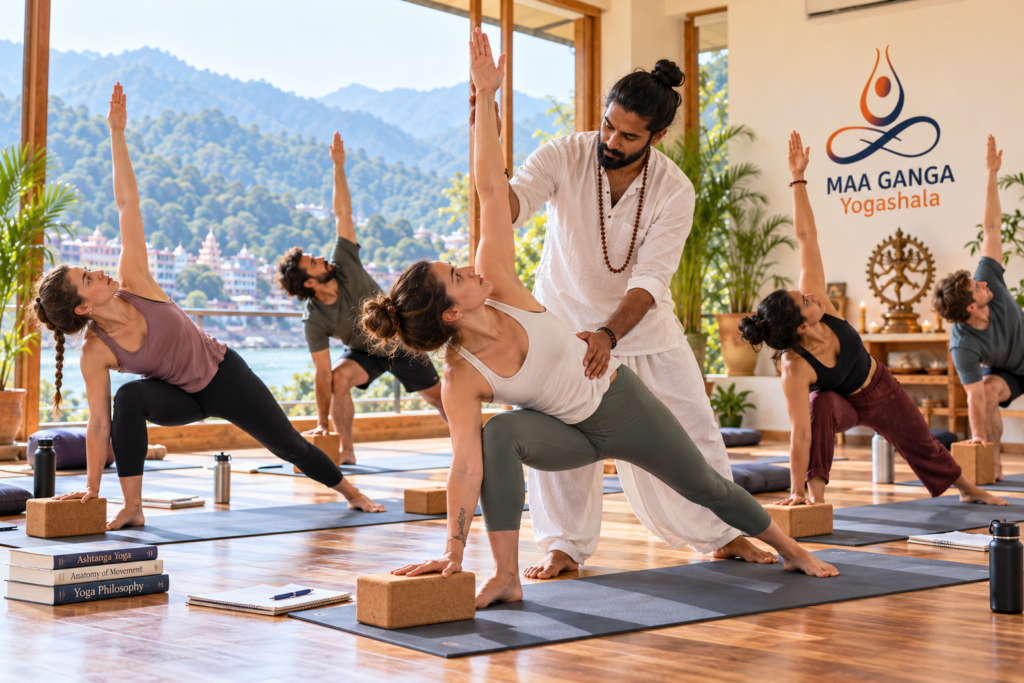
If you are considering studying in Tapovan, Rishikesh, Maa Ganga Yogashala offers yoga teacher training options for practitioners who want to develop their understanding of yoga and teaching.
Our location on Badrinath Road provides a setting in which you can explore yoga alongside the wider culture of Rishikesh. Before enrolling, review the curriculum and ask specific questions about how anatomy, alignment, modifications, and supervised teaching are covered.
Explore our 200-Hour Yoga Teacher Training in Rishikesh to learn more about the programme, its structure, and whether it fits your learning goals.
You can also read our guide to questions to ask before enrolling in a 100-hour yoga teacher training programme in India to help you compare training options carefully.
7. How to Keep Learning After Your Yoga Teacher Training
Completing a teacher training programme is the beginning of your teaching education, not the end. Your confidence should develop alongside your practical experience and willingness to keep learning.
Reflect on every class
After teaching, review what worked and what needs adjustment. Did students understand your cues? Did the transitions feel rushed? Were modifications available before anyone struggled?
Keep notes about recurring teaching challenges without recording unnecessary private information about individual students.
Over time, this reflection can help you identify gaps in your knowledge and improve the clarity of your instructions.
Continue your professional development
Seek workshops, anatomy education, mentoring, and continuing education that match your experience and teaching goals.
If you are interested in developing your class structure, our guide to a yoga class plan template for new teachers can help you organise sequences, teaching objectives, and modifications.
You can also explore continuing education options after completing a 200-hour yoga teacher training when you are ready to deepen your skills.
Know when to refer a student
You do not need to solve every problem yourself. Refer students to appropriately qualified healthcare professionals when symptoms require assessment or treatment beyond your scope.
Responsible teaching means recognising the limits of your knowledge and acting accordingly.
8. FAQs About Yoga Injury Prevention Teacher Training
1. Is injury prevention covered in yoga teacher training?
Many comprehensive teacher training programmes include anatomy, alignment, teaching methodology, and pose modifications. The depth varies, so check the actual curriculum rather than assuming every programme covers these subjects equally.
2. Can yoga teachers help students recover from injuries?
Yoga teachers can provide general movement instruction within their training and qualifications. They should not diagnose injuries or replace medical treatment. Students with existing injuries should follow appropriate professional advice and practise only within suitable limits.
3. Is a 200-hour yoga teacher training enough to teach safely?
A well-designed 200-hour programme can establish foundational knowledge and teaching skills. However, it does not make you an expert in every medical condition or guarantee that you can manage complex injuries. Continued learning, supervised practice, and professional boundaries remain essential.
4. How can beginners avoid injuries during yoga?
Begin with manageable movements, follow clear instructions, use props when helpful, and avoid forcing flexibility. Stop if you experience sharp or increasing pain, numbness, or unusual symptoms, and seek medical advice when appropriate.
5. Why choose Rishikesh for yoga teacher training?
Rishikesh offers a wide range of yoga schools, training formats, and opportunities to study within an established yoga community. Choose based on curriculum quality, instructor experience, practical teaching opportunities, transparent fees, and suitability for your goals—not location alone.
Conclusion: Make Safe Teaching Part of Your Foundation
Yoga injury prevention teacher training should prepare you to observe carefully, understand basic anatomy, adapt postures, plan balanced classes, and recognise when a student needs support beyond your qualifications.
Your success as a teacher will not be measured by how deeply your students stretch or how advanced their poses appear. It will be reflected in the clarity of your guidance, the respect you show for individual differences, and your ability to create an environment where students can practise without unnecessary pressure.
If you are ready to build these foundations in Rishikesh, explore our 200-Hour Yoga Teacher Training in Rishikesh. Review the course details, ask about anatomy and supervised practice teaching, and choose a programme that supports responsible instruction.
Start with the knowledge. Practise the skills. Keep your students’ wellbeing at the centre of every class.
Additional internal links to include before publishing
To satisfy the required internal-link distribution, add these two links naturally to Section 6:
The blog already contains the 200-hour training page and three relevant blog links. This brings the total to 3 unique main-page URLs and 3 blog URLs, excluding repeated appearances of the same URL.