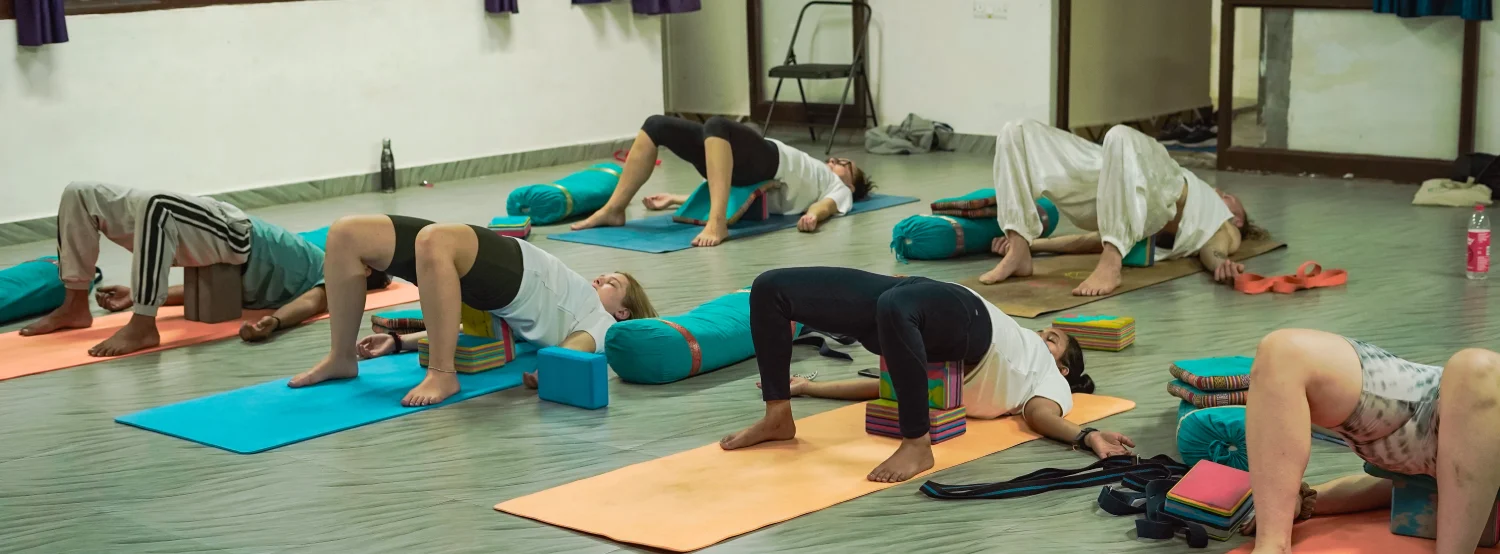

Hatha Yoga Fundamentals 100 Hour TTC: What You Actually Practice
If you think hatha yoga fundamentals 100 hour TTC means spending several weeks simply repeating basic yoga poses, you may be surprised by how much deeper the practice becomes. A serious 100-hour training can take you into asana, pranayama, alignment, meditation, cleansing practices, teaching methodology, and the discipline behind a consistent personal practice.
You also discover something important: Hatha yoga is not about making every posture look impressive. It is about learning how to work with your body, breath, attention, and energy with greater awareness.
For an international student or an Indian practitioner considering a shorter teacher-training format, understanding the actual curriculum matters. You want to know what you will practice each day, how physically demanding it can be, what theoretical subjects support the practice, and whether 100 hours are enough for your particular goal.
This guide breaks down what you can realistically expect from Hatha-focused training in Rishikesh and how the fundamentals fit together.

What Hatha Yoga Fundamentals Actually Mean in a 100-Hour TTC
Hatha yoga fundamentals are best understood as the building blocks of a disciplined yoga practice. Rather than treating asana as an isolated workout, Hatha training connects physical postures with breathing, concentration, purification, meditation, and traditional yogic principles.
In a 100-hour TTC, your practice generally becomes more structured than a regular studio class. You are not simply following a teacher from one pose to another. You are learning why a posture is performed, how to enter it safely, how to modify it, how breath affects the practice, and what you should observe while holding it.
Your asana sessions may include foundational standing, seated, balancing, twisting, forward-bending, backbending, and restorative postures. The emphasis is usually on stability and awareness rather than chasing advanced shapes.
You may also study pranayama, meditation, mudras, bandhas, and selected cleansing practices. Traditional Hatha sources place considerable emphasis on these practices alongside asana. India’s Ministry of Ayush educational material, for example, discusses Hatha practices including pranayama, bandhas, mudras, and purification techniques as distinct areas of study.
For a broader understanding of yoga-teacher education and credentialing, you can also review the standards published by Yoga Alliance.
The important point is that your 100-hour training should not feel like 100 hours of posture repetition. The value comes from understanding how the different parts of practice relate to one another.
Hatha Yoga Asana Practice: What You Actually Do
The physical practice is usually the part you notice first. But a good Hatha session is not simply a collection of poses.
You may begin with centering, breath awareness, or gentle movements before progressing into more demanding postures. The sequence can gradually prepare particular joints, muscle groups, and movement patterns.
Alignment Before Complexity
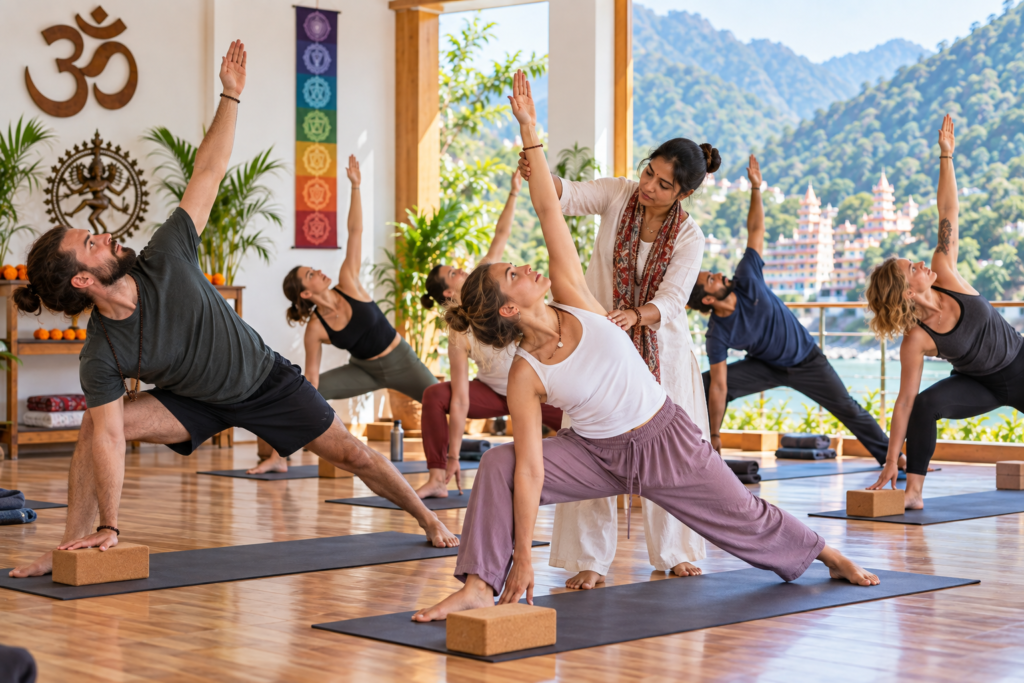
You will spend time learning basic alignment principles: how your feet are positioned, how your spine is organized, where your knees track, how your shoulders move, and how your breath behaves during the posture.
This is particularly useful if you eventually want to teach. You cannot confidently guide another student if you only know what a posture looks like from the outside.
You also learn that alignment is not necessarily about forcing every body into one identical shape. Different proportions, mobility levels, previous injuries, and experience can change how a posture looks.
For deeper study of safe alignment and the relationship between muscles, joints, and yoga postures, you can explore our guide on yoga anatomy, muscles, joints, and alignment.
Holding, Breathing, Observing
Hatha practice often gives you more time inside postures than a fast-paced flow class.
That changes the learning process.
Instead of immediately moving into the next pose, you have time to notice whether you are gripping your jaw, holding your breath, collapsing into your lower back, or mentally rushing toward the end of the posture.
This is where Hatha starts becoming an attention practice rather than merely physical exercise.
Your teacher may also introduce modifications using props or simpler variations. The goal is not to prove that you can tolerate discomfort. The goal is to understand the posture and practice it appropriately.
Pranayama, Bandhas and the Breath-Body Connection
One of the biggest differences between a Hatha-focused TTC and an ordinary yoga class is the amount of attention given to breathwork.
Pranayama is not simply “breathing deeply.” You may study different techniques, their purposes, their traditional context, and the importance of practicing them appropriately.
You can expect to encounter practices such as basic breath awareness, alternate-nostril breathing, controlled exhalation, and other traditional pranayama techniques depending on the school’s curriculum and your level.
The sequence matters. You generally learn the fundamentals before attempting more demanding breath practices.
Bandhas and Mudras
You may also study bandhas and mudras as part of traditional Hatha practice.
Bandhas are often introduced as energetic locks or controlled muscular engagements. Mudras are symbolic or functional gestures and positions used within traditional yogic practice.
These subjects can sound complicated when explained only through theory. In a TTC, you get an opportunity to understand them through guided practice and observation.
The Ministry of Ayush’s educational material describes mudras and bandhas as components of Hatha yogic practice and places them within a broader framework that also includes pranayama and purification techniques.
This is also why you should not judge a 100-hour TTC purely by the number of asanas it lists. A useful curriculum gives you multiple ways to understand the same practice: physically, through breath, through concentration, and through traditional theory.
Meditation, Cleansing Practices and the Mental Side of Hatha
A common misconception is that Hatha yoga is almost entirely physical.
A traditional practice can include meditation and selected cleansing practices alongside asana and pranayama. The exact techniques taught depend on the school, teacher qualifications, student preparation, and curriculum.
Meditation sessions may begin with straightforward concentration. You might work with breath awareness, observation of sensations, or maintaining attention on a chosen object.
The challenge is often surprisingly simple: staying present without constantly reacting to every thought or physical sensation.
Some Hatha programs also introduce shatkarma or yogic cleansing techniques. These should never be approached casually or treated as wellness “hacks.” Some traditional techniques require appropriate instruction, preparation, and awareness of contraindications.
That distinction matters when comparing yoga schools.
A responsible teacher should explain not only how a technique is traditionally performed, but also when it should be avoided or modified.
If you are interested in the restorative side of yoga alongside your training, you can also read about Yoga Nidra benefits and how to practice it.
Your mental practice may therefore develop alongside your physical practice. You begin noticing the difference between discomfort that can be observed and pain that signals you should stop or modify the posture.
From Personal Practice to Teaching: What Changes?
A 100-hour TTC can be useful for deepening your personal practice, but students often have another question: “Will I actually learn how to teach?”
The answer depends heavily on the specific program.
A teacher-training curriculum can include demonstration, observation, verbal instructions, sequencing, assisting, corrections, communication, and practice teaching. These are different skills from simply performing yoga yourself.
Imagine you can hold Trikonasana comfortably. That does not automatically mean you can teach it.
To teach it, you need to explain the setup clearly, demonstrate the movement, identify common mistakes, offer appropriate variations, and observe what your students are actually doing.
That is why practice teaching matters.
You may be asked to lead a short sequence in front of classmates. Initially, this can feel awkward. Your voice may become quieter, you may forget the order of instructions, or you may focus so much on your own demonstration that you stop observing the students.
Those mistakes are useful.
They reveal what you need to improve before teaching outside the training environment. If teaching is one of your goals, our guide to teaching your first yoga class and handling nervousness can help you understand what happens after the training room.
Why Rishikesh Matters for Hatha Yoga Training
Rishikesh offers something that is difficult to reproduce in a purely online or classroom-only environment: yoga is part of the surrounding culture.
Your experience is not limited to a studio timetable. You may encounter ashrams, traditional teachers, the Ganga, temples, meditation spaces, and practitioners from many different countries.
That environment does not automatically make every course better. You still need to evaluate the curriculum, faculty, accommodation, practice hours, student support, safety standards, and what the certificate actually represents.
But the setting can influence how you experience the practice.
A morning Hatha session followed by pranayama and philosophy feels different when you are living in Tapovan and regularly encountering yoga beyond the classroom.
Rishikesh is also useful for international students because it brings together practitioners with different backgrounds. You may practice alongside someone who has been doing yoga for years and someone else who has only recently discovered it.
That variety can challenge your assumptions.
You learn that there is no single “yoga body,” no universal flexibility level, and no requirement to perform the most advanced posture in the room.
For some students, the biggest benefit of studying Hatha in Rishikesh is precisely this change in perspective: you begin treating yoga as a discipline that requires patience rather than a performance that requires perfection.
Is a 100-Hour Hatha TTC Right for You?
A 100-hour program can make sense if you want concentrated study without immediately committing to a longer 200-hour training.
It may suit you if you want to:
- Build a stronger personal Hatha practice.
- Understand foundational asana and alignment.
- Explore pranayama and meditation in a structured environment.
- Learn basic teaching principles.
- Experience residential yoga training in Rishikesh.
- Continue toward more advanced teacher education later.
It may not be the right format if your only objective is to obtain the foundational training generally associated with a 200-hour teacher-training pathway. In that case, you should compare the curriculum and credentialing implications carefully rather than assuming that “100 hours” is simply half of a 200-hour program.
You should also ask a school exactly what is included in the course: daily schedule, practice hours, theory, anatomy, teaching methodology, assessment, accommodation, meals, certificate, and post-course support.
For practical guidance, our article on questions to ask before enrolling in a 100-hour YTT in India can help you evaluate a program before paying a deposit.
If your long-term goal is to pursue a more comprehensive foundation, you can compare the structure of a 200-hour Yoga Teacher Training in Rishikesh with the shorter format.
What a Typical Hatha Training Day Can Feel Like
The exact timetable differs between schools, but your day can be demanding.
You may start early with meditation, cleansing practices, pranayama, or an asana session. Later, you may attend anatomy, philosophy, methodology, or practical teaching classes.
There may also be assignments, self-practice, revision, and assessment.
The physical challenge is only one part of the workload.
You may discover that remembering Sanskrit terminology, understanding alignment cues, preparing a sequence, and maintaining concentration during philosophy sessions requires just as much effort as holding a challenging posture.
That is why recovery matters.
Adequate sleep, hydration, sensible nutrition, and respecting your physical limits can make a major difference during intensive residential training.
You should not measure your progress by whether you are exhausted every evening.
A better sign is whether you are becoming more precise in your practice, more aware of your breathing, more confident in explaining techniques, and better at recognizing when a practice needs modification.
Begin Your Hatha Practice in Rishikesh
If you want structured Hatha study in Rishikesh, we offer a 100-hour Yoga Teacher Training designed for practitioners who want concentrated training in yoga practice, theory, and teaching fundamentals: explore our 100-hour Yoga Teacher Training in Rishikesh.
The important thing is to choose a program based on what you genuinely want to learn, not simply the number of hours printed on the course page.
FAQs
Is Hatha yoga suitable for beginners?
Yes, Hatha yoga can be adapted for beginners, particularly when foundational postures, breathing techniques, and alignment are taught progressively. You do not need advanced flexibility to begin.
What do you practice in a 100-hour Hatha TTC?
Depending on the school’s curriculum, you may practice foundational asana, pranayama, meditation, mudras, bandhas, cleansing practices, anatomy, philosophy, sequencing, and teaching methodology.
Is a 100-hour TTC enough to become a yoga teacher?
That depends on the credential and your intended teaching pathway. A 100-hour course should not automatically be treated as equivalent to a foundational 200-hour teacher-training qualification. Always verify the school’s credentialing information and what the certificate represents.
How physically demanding is Hatha Yoga Teacher Training?
It can be demanding because you may practice yoga for several hours each day while also studying theory and teaching methodology. However, intensity varies by school, schedule, student level, and the specific practices included.
Why study Hatha yoga in Rishikesh?
Rishikesh provides an environment where yoga practice, Indian philosophical traditions, meditation, and the wider yoga community are part of daily life. For many students, that environment adds cultural and practical context to their training.
Conclusion: Practice the Fundamentals, Not Just the Postures
The real value of hatha yoga fundamentals 100 hour TTC is not the number of postures you can perform when the course ends. It is the understanding you develop about how posture, breath, concentration, discipline, and awareness work together.
You learn to pay closer attention.
You learn that alignment is more than appearance. You learn that pranayama requires preparation and respect. You learn that teaching requires observation, communication, and responsibility—not simply demonstrating a pose.
And you begin to understand why Hatha yoga can remain relevant even when your physical practice changes over time.
If you are ready to study these foundations in Rishikesh, we invite you to explore our 100-hour Yoga Teacher Training and see whether its curriculum matches your goals: view the 100-hour Yoga Teacher Training in Rishikesh.
Your next step should be based on what you want to learn—not simply how many hours you want to collect.